
The Norse Legacy of Clan Gunn

The history of Clan Gunn begins on the windswept northeastern coasts of Caithness, Sutherland, and the Orkney Isles, representing a unique bridge between Norse maritime dominance and the Scottish Highland clan system. While early mythology claims the clan descends from Olaf the Black, the Norwegian King of Man, documented history more reliably points to a Norse Viking adventurer named Gunni. Fittingly, his name translates to “war” or “battle” in Old Norse. Gunni was the grandson of the legendary Sweyn Asleifsson, celebrated in the Orkneyinga Saga as the “Ultimate Viking.” By the late twelfth century, Gunni married Ragnhild, who had inherited vast estates from her brother, the Jarl of Orkney, firmly establishing the clan’s foundational footprint in Scotland. Despite these rich Norse sagas, the first definitively recorded chief in Scottish historical texts is George Gunn, who served as the Crowner of Caithness in the fifteenth century.
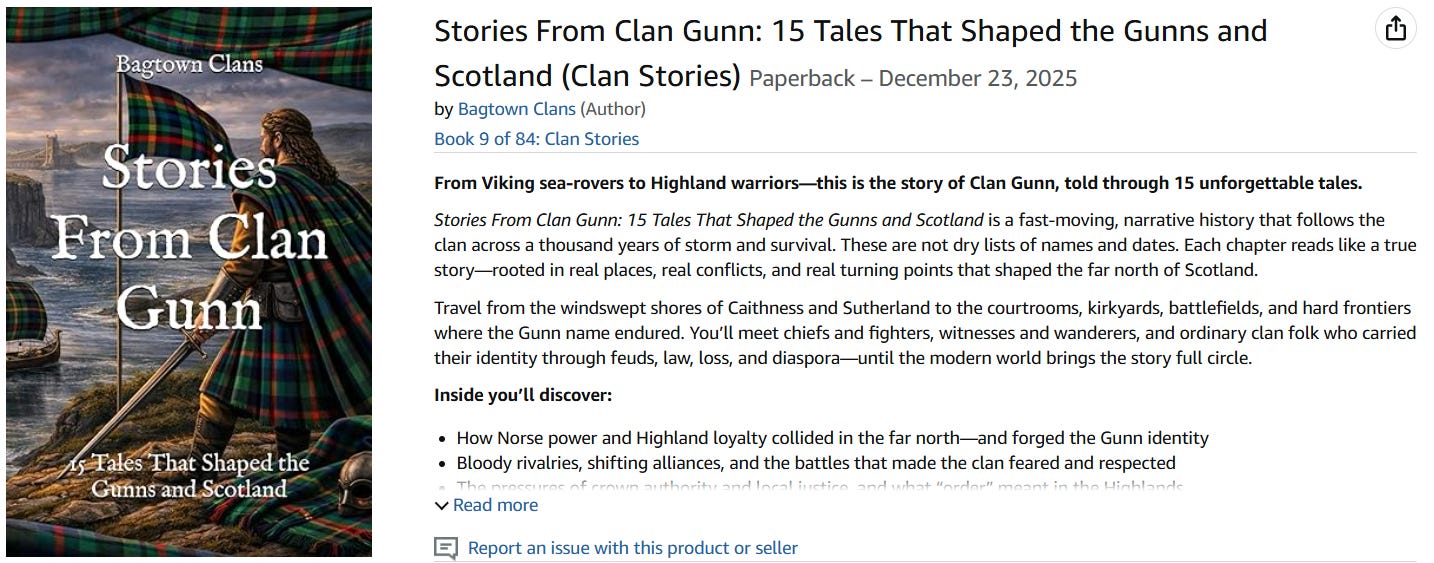
The visual identity of this formidable clan is captured powerfully in its symbols. Their motto, “Aut Pax Aut Bellum,” translates to “Either peace or war,” reflecting their pragmatic readiness for conflict in a hostile frontier. This martial ethos is mirrored in their crest badge, which features a dexter hand or arm grasping a sword in bend. For identification in the field, clansmen historically wore a sprig of juniper as their plant badge. Their traditional tartans—woven today in modern, ancient, muted, and weathered variations of green, blue, and black with a red stripe—served a practical purpose, with the ancient hues acting as effective camouflage against the somber Scottish heath and mountain landscapes. Unlike some families, there is no single coat of arms for the clan itself, as Scottish heraldry dictates that arms are granted only to individuals, though the current chief possesses his own distinct heraldic bearings.
Geographically, Clan Gunn initially held immense sway over Caithness. Their early seats of power included Clyth Castle, perched precariously on a sheer, sea-girt rock, and the heavily fortified Halberry Castle, protected by a massive landward ditch. They also held inland strongholds like Dirlot Castle to control local trade and military routes. However, as rival families like the Sinclairs, Sutherlands, and Keiths migrated northward with royal land grants, the numerically smaller Gunns were gradually pushed out of the fertile lowlands. This territorial shift forced the primary body of the clan to relocate into the mountainous regions of Sutherland, specifically settling in the Strath of Kildonan, where they established new bases such as Killearnan and later Badenloch.
This geographical splintering directly shaped the clan’s genealogy and structure. Following the death of George the Crowner, the clan divided into notable branches. His eldest surviving son, James, relocated to Sutherland and established the MacSheumais or MacHamish line, which became the recognized chiefly line. Other sons founded prominent cadet branches, such as the fiercely independent Robson Gunns of Braemore and the Gunns of Cattaig. Because surnames were not universally adopted early on, the descendants of these branches evolved into the clan’s numerous septs. Today, Clan Gunn recognizes over seventy-seven associated names, including Jameson, Johnson, Henderson, Robson, Williamson, and Swanson, reflecting the patronymics of the Crowner’s sons and their ancient Norse ancestors.
The history of the Gunns is steeped in relentless conflict, most notably their bitter, centuries-long blood feud with Clan Keith. The animosity escalated dramatically after the tragic abduction and subsequent suicide of Helen of Braemore, who threw herself from Ackergill Tower to escape her Keith captor. Hoping to settle their differences, the two clans agreed to a trial by combat known as the Battle of Champions in the late fifteenth century at the Chapel of St. Tears. Each side was to bring twelve men on horseback, but the Keiths arrived with two men per horse, treacherously slaughtering the outnumbered Gunns, including George the Crowner. Beyond local feuds, the Gunns also participated in broader national politics. While many Highland clans later rallied behind the exiled Stuarts during the Jacobite Risings, Clan Gunn remained loyal to the British government. In the 1745 rebellion, they raised an Independent Highland Company under the Earl of Loudon, deliberately avoiding the devastating rebel defeat at Culloden.
When not engaged in warfare, the daily economic life of the clan revolved around the harsh realities of the northern environment, relying heavily on cattle and sheep herding, coastal fishing, and cereal farming. Culturally, they transitioned over the centuries from their pagan Norse roots to Christianity, eventually facing the religious shifts of the Reformation. The arts held a highly respected place within their society. Pipers were integral to their martial and social life, with traditional tunes like “Failte na’n Guinnach” (The Gunns’ Salute) echoing through the glens, and prominent figures like the nineteenth-century pipe maker William Gunn preserving their musical heritage. In more recent times, their storytelling tradition has been embodied by celebrated Scottish novelists like Neil M. Gunn.
The decline of the clan’s traditional way of life accelerated rapidly in the eighteenth and nineteenth centuries. The British government systematically dismantled the Highland clan system following the Jacobite rebellions, eroding traditional allegiances. This cultural repression was compounded by the devastating Highland Clearances. To make way for profitable large-scale sheep farming, landlords, including the Sutherland estates, evicted the Gunns from their ancestral crofts in Kildonan. This forced dispersion sparked a mass global emigration, scattering members of the clan across the world to forge new lives in North America, Australia, and New Zealand.
In the modern era, this global diaspora has successfully reconnected to celebrate their shared heritage. The Clan Gunn Society, originally founded in 1821 and reconstituted in 1960, serves as a hub for members worldwide, maintaining the Clan Gunn Heritage Centre in the eighteenth-century old parish church of Latheron in Caithness. A monumental moment of healing occurred in 1978 when the Commander of Clan Gunn and the Chief of Clan Keith signed a formal treaty of friendship at the site of St. Tears, officially ending their 500-year feud. After 230 years without a recognized chief, the clan’s leadership was legally restored in 2015 with the appointment of Iain Alexander Gunn of Gunn. Following his passing in October 2024, the chiefship seamlessly transitioned to his son, John Gunn of Gunn, who continues to lead the thriving international community of this resilient, historic clan today.
--------------------------------------------------------------------------------
References
Athletin. (n.d.). Clan Gunn: A legacy of Norse & Highland heritage - Na Guinnich.
Bagtown Clans. (2023). Septs of Clan Gunn.
Britain Express. (n.d.). Clan Gunn Heritage Centre & Museum, Latheron, Caithness.
Celtic Studio. (n.d.). Gunn history, family crest & coats of arms.
Clan Gunn Society of North America. (2026). Geography & castles.
Clan Gunn Society of North America. (2026). Gunn septs.
Clan Gunn Society of North America. (2026). History.
Clanscape. (n.d.). The complete history of Clan Gunn: Origins, castles and stories.
Council of Scottish Clans & Associations. (2022). Clan museums and heritage centers.
Electric Scotland. (n.d.). Clan Gunn.
Gunn, R. M. (2009). An early history of Clan Gunn - The Viking clan. Skye-Net.
ScotClans. (n.d.). History of the Gunn clan.
St Kilda Store. (n.d.). Clan Gunn history.
The Keith Clan. (n.d.). The feud between Clan Keith and Clan Gunn.