Discover the full story of Clan Erskine—get your digital copy of The Complete History of Clan Erskine here: https://fairbairncrests.com/products/the-complete-history-of-clan-erskine-digital-edition
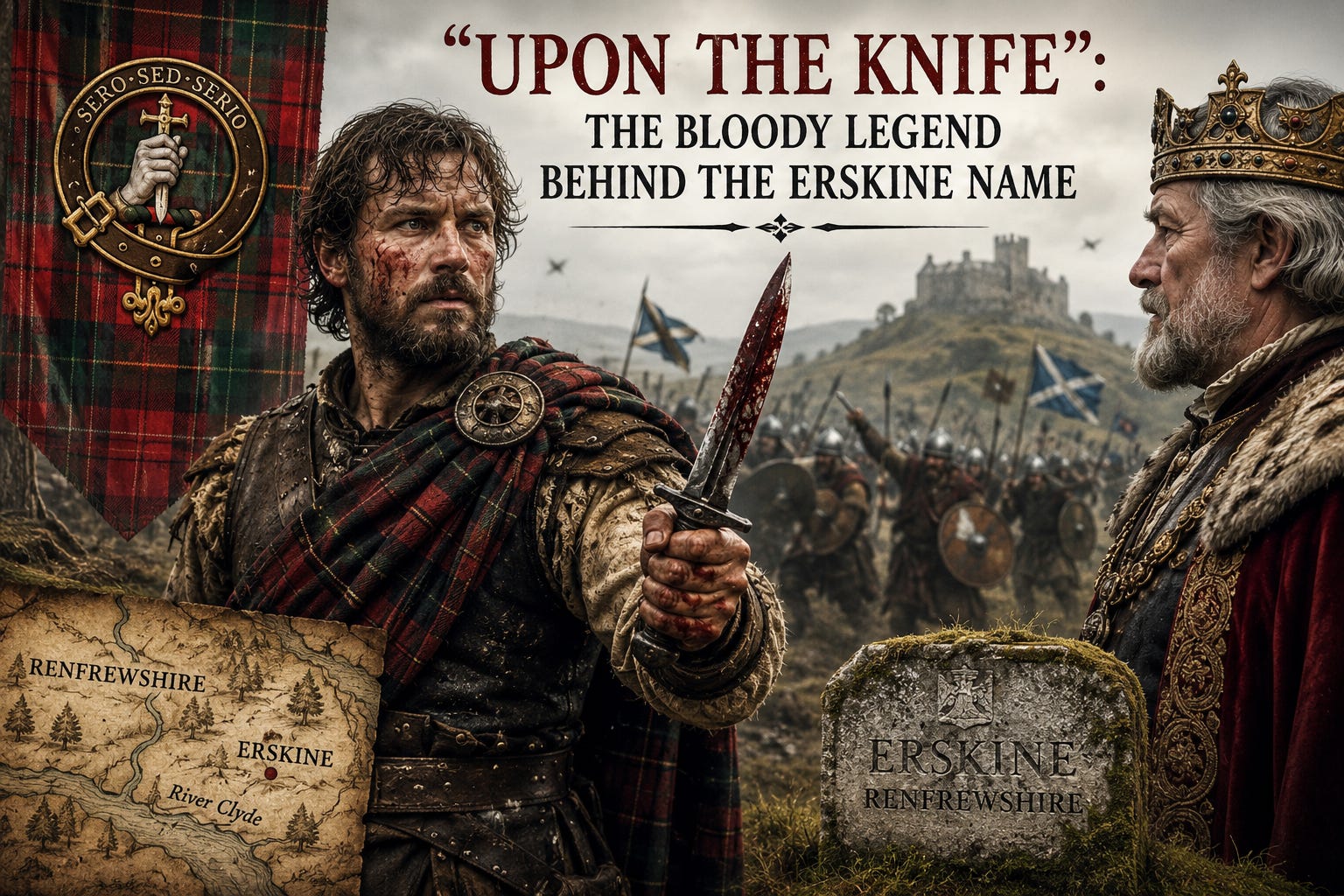
Few Scottish surnames possess an origin story quite as dramatic as the one traditionally told about Clan Erskine. According to an old and colourful legend, the name was born not from a quiet estate or medieval charter but on a battlefield soaked in blood. An unnamed Scottish warrior supposedly killed the commander of an invading Danish army, severed his head, and carried proof of the deed before his king. Holding up his bloodied weapon, the warrior is said to have declared the Gaelic words air an sgian—usually interpreted in the story as “upon the knife.” From those words, tradition claims, came the surname Erskine.
It is exactly the sort of story that generations of clan enthusiasts have loved. The legend contains nearly every ingredient of a perfect Scottish foundation tale: foreign invaders, desperate combat, personal bravery, a victorious warrior, a grateful king, and a surname supposedly created in a single unforgettable moment. In some versions, the encounter is associated with a battle called Murthill, where a Danish force threatened the Scots and the heroic ancestor changed the course of the fighting by killing its leader. The king, astonished by the warrior’s courage, supposedly rewarded him with lands and instructed him to preserve the words connected with his exploit as his family name. Over the centuries, air an sgian, the story says, gradually became Erskine.
The image is irresistible. One can easily imagine the exhausted warrior approaching the royal position after battle, his clothing stained from combat and the captured weapon still marked with blood. Around him stand soldiers waiting to hear how the enemy commander fell, while the king rewards an act that may have saved his army from defeat. The scene gives the Erskines an origin rooted directly in loyalty to the Scottish Crown, something particularly appropriate for a family that would later become deeply connected with Scotland’s monarchs. Yet the power of a story is not the same thing as proof that the story happened.
When the surviving historical evidence is examined, the Erskine name has a considerably less violent but much more securely documented origin. The family took its name from the lands of Erskine in Renfrewshire, on the southern side of the River Clyde. The place existed before the surname became firmly established as a hereditary family name, making Erskine a territorial surname of a type found throughout medieval Scotland. A man identified as “de Erskine” was essentially being described as a man “of Erskine,” connecting him with the estate from which he came or which he held. Over generations, that geographical description became the hereditary surname Erskine.
This pattern was completely normal in medieval Scotland. As systems of landholding became more formal during the twelfth and thirteenth centuries, important families increasingly adopted the names of their principal estates. Clerks writing charters in Latin commonly used the word de before a place-name, identifying a landholder by his territorial association rather than by the sort of fixed surname familiar today. Once a family remained attached to the same estate for several generations, that territorial description could become permanent even when descendants later moved elsewhere. The Erskines therefore did not need a battlefield proclamation to acquire their name; the land itself provided it.
The earliest secure documentary evidence strengthens this explanation. In 1226, Henry de Erskine appears as a witness to a charter preserved in the records of Paisley Abbey, providing an important early anchor for the family in medieval Renfrewshire. His role as a witness indicates that he possessed enough local standing to participate in legal transactions involving significant property and ecclesiastical interests. Later in the thirteenth century, the surname appears in varying forms, as was common in an age when spelling was anything but standardized. Forms such as Erskyn, Irskyn, Yrskin, and similar variations reflect the habits of medieval scribes rather than evidence of separate families with unrelated origins.
Another important appearance came in 1296, when John de Irskyn was recorded among the Scottish landholders who submitted to Edward I of England during the crisis that produced the famous Ragman Roll. His inclusion demonstrates that the family remained established among the landholding class of the region decades after Henry’s appearance. What the records do not provide is a neat, continuous genealogy linking every generation between these men. Medieval evidence is often frustratingly incomplete, and later writers were sometimes tempted to fill those gaps with attractive pedigrees, royal marriages, heroic ancestors, and ancient exploits that surviving contemporary documents cannot confirm.
The actual meaning of the place-name Erskine is itself less certain than many popular accounts suggest. One often repeated interpretation translates it approximately as “green rising ground,” an appealing description considering the gently rising landscape near the Clyde. Other linguistic possibilities have been suggested, including Gaelic and older Brittonic roots, reflecting the complicated language history of western Scotland. What matters for the history of the surname is that the place-name already existed before members of the medieval family began using it as their designation. Whatever the precise ancient meaning of the word, the evidence points from the land to the family rather than from a warrior’s Gaelic declaration to the land.
That raises an intriguing question: if the territorial explanation is so straightforward, why did the bloody knife story become so popular? Noble families frequently developed legendary origin stories as generations passed and memories of their earliest documented ancestors faded. A simple account of landholding and charter witnessing could seem disappointingly ordinary once descendants had become powerful aristocrats, royal officers, guardians of kings, and claimants to one of Scotland’s greatest earldoms. A heroic founder provided something parchment could not—a dramatic explanation of why the family supposedly deserved its later greatness. By giving the first Erskine a direct personal relationship with a Scottish king, the legend projected the family’s later tradition of royal service backward into an imagined ancient past.
The story became especially attractive because the later history of the Erskines really was closely intertwined with the monarchy. From comparatively modest Renfrewshire beginnings, the family rose dramatically through royal administration and eventually established its great power base around Alloa and Stirling. Generations of Erskines became associated with Stirling Castle, one of the most politically important fortresses in Scotland, and members of the family were repeatedly entrusted with extraordinary royal responsibilities. They participated in the protection of Mary Queen of Scots, became guardians of the young James VI, and reached a remarkable political peak when John Erskine, Earl of Mar, became Regent of Scotland. When viewed against that genuine history, the idea that the family had begun with an act of personal service to an ancient Scottish king must have seemed wonderfully appropriate.
The nineteenth century provided especially fertile ground for stories of this kind. Scotland’s medieval and Highland past was being romanticised on an enormous scale through antiquarian writing, historical novels, tartan culture, clan histories, tourism, and renewed fascination with old noble families. Readers wanted heroic founders, ancient battles, mysterious Gaelic phrases, royal rewards, and dramatic symbols that could link modern surnames with an imagined age of warriors. The air an sgian tradition fitted this cultural appetite perfectly, and repetition gave it an authority that documentary evidence could not. A story appearing again and again in clan literature can eventually feel ancient simply because generations have heard it.
Calling the tale a legend does not make it worthless. Folklore tells us something different from a charter: it reveals how later generations wanted to understand their ancestors and the qualities they believed their family represented. The Erskine knife story emphasises bravery, loyalty, military success, and service to the Crown, all themes that genuinely became important in the family’s later historical identity. In that sense, the legend may be historically revealing even if the supposed battlefield conversation cannot be verified. It belongs to the history of Erskine memory rather than to the securely documented history of the surname’s creation.
The real origin of the Erskine name may lack the severed head and bloodied dagger of the traditional story, but it possesses its own remarkable continuity. A territorial name attached to fertile land beside the Clyde became the surname of a family that eventually moved into the highest levels of Scottish political life. From Henry de Erskine’s appearance in a thirteenth-century monastic charter, the family would rise through royal service, establish itself at Alloa, guard Stirling Castle, claim the Earldom of Mar, survive political rebellion and forfeiture, and leave an enduring mark on Scottish history. The journey from a Renfrewshire estate to the centre of national government is arguably more extraordinary because it can be followed through surviving records rather than legend.
For anyone fascinated by Clan Erskine, the contrast between myth and evidence makes the story richer rather than poorer. The warrior crying air an sgian can remain part of the colourful folklore surrounding the name, while the surviving medieval documents reveal how the family actually emerged from the territorial world of Lowland Scotland. Understanding both allows us to appreciate how Scottish clan identity was created from a mixture of land, genealogy, political ambition, historical memory, and storytelling. The full journey—from the mysterious legends of the Erskine name to the family’s involvement with kings, castles, the Earldom of Mar, the Jacobite Rising, and modern clan identity—is explored in The Complete History of Clan Erskine. For readers with Erskine ancestry or an interest in Scotland’s noble families, the distinction between the story that was remembered and the history that can be documented is one of the most fascinating parts of the Erskine legacy.
References
Bain, J. (Ed.). (1884). Calendar of documents relating to Scotland preserved in Her Majesty’s Public Record Office, London (Vol. 2, A.D. 1272–1307). H.M. General Register House.
Great Britain, Royal Commission on Historical Manuscripts. (1904). Report on the manuscripts of the Earl of Mar and Kellie preserved at Alloa House, N.B. H.M. Stationery Office.
Innes, C. (Ed.). (1832). Registrum monasterii de Passelet: Cartas, privilegia, conventiones, aliaque munimenta complectens. Maitland Club.
National Records of Scotland. (1189–1957). Papers of the Erskine family, Earls of Mar and Kellie (GD124) [Archival collection].
Paul, J. B. (Ed.). (1908). The Scots peerage: Founded on Wood’s edition of Sir Robert Douglas’s Peerage of Scotland (Vol. 5). David Douglas.
Trevor-Roper, H. (1983). The Highland tradition of Scotland. In E. Hobsbawm & T. Ranger (Eds.), The invention of tradition (pp. 15–41). Cambridge University Press.