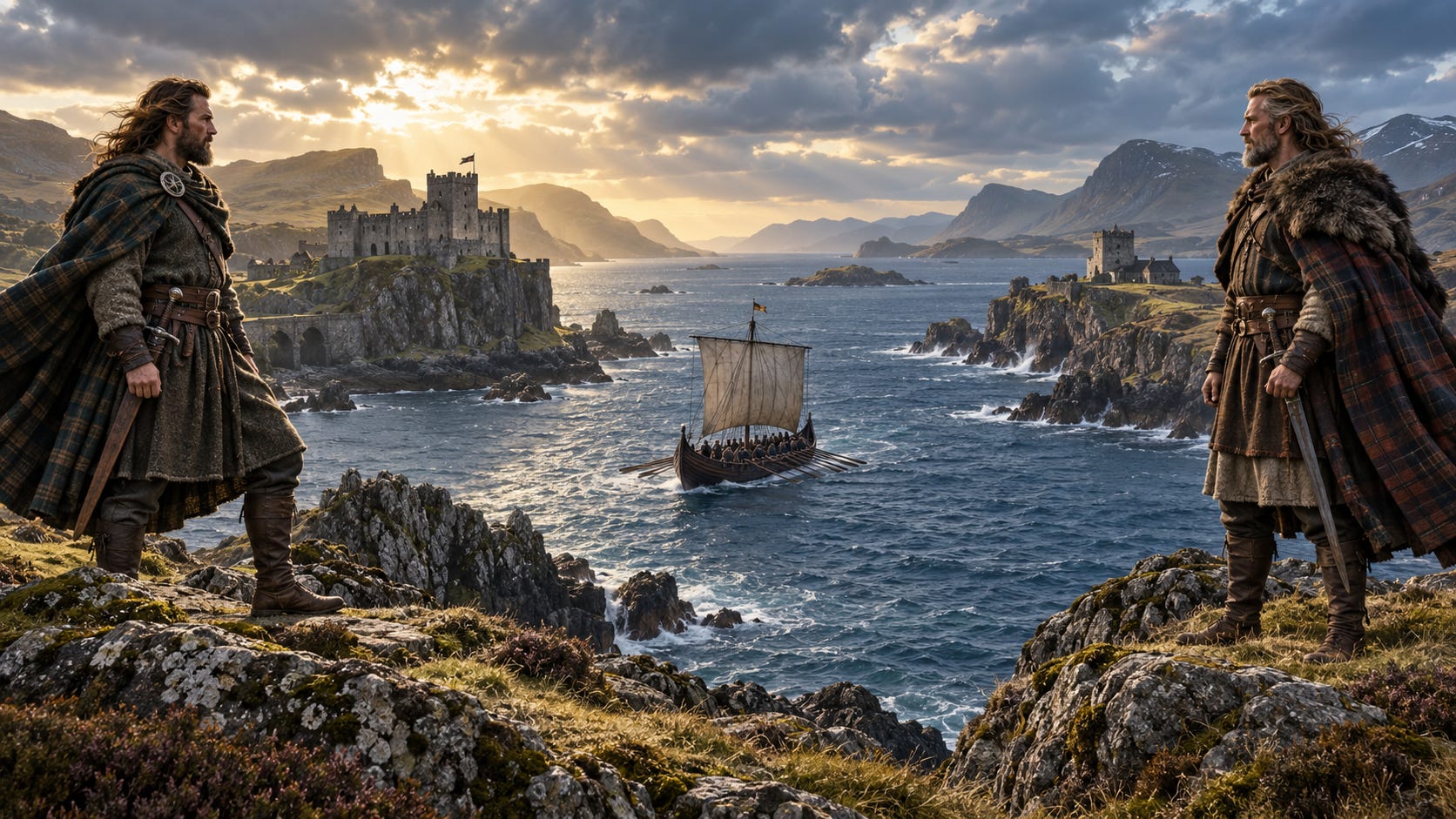
Uncover the epic origin and history of Clan MacLeod - https://fairbairncrests.com/products/the-complete-history-of-clan-macleod
The name MacLeod is often presented as though it belonged to one united Highland clan ruled from a single stronghold. The historical reality is far more interesting. During the medieval period, the wider MacLeod kindred developed into two principal branches with separate territories, leaders and political ambitions. These were Sìol Tormoid, the “Seed of Tormod,” and Sìol Torcaill, the “Seed of Torcall.”
Both branches traced their identity to the shadowy ancestral figure Leòd, traditionally placed in the thirteenth century. Later genealogies connected Leòd with Olaf the Black and the Norse-Gaelic rulers of the Isle of Man, but the precise details of his parentage remain uncertain. The earliest traditions maintain that Leòd had two important sons, Tormod and Torcall, from whom the principal branches descended. Whether every part of this family tree can be proven or not, the division it describes became a genuine feature of MacLeod history.
Sìol Tormoid became associated with Dunvegan, Harris and Glenelg. Its chiefs established their principal seat at Dunvegan Castle on the northwestern coast of Skye, overlooking a sheltered sea loch. Dunvegan was ideally placed for a maritime lordship whose territories were connected by water rather than by convenient roads. From this stronghold, the chiefs could communicate with Harris across the Minch and with Glenelg on the Scottish mainland.
The surviving record becomes firmer during the fourteenth century. A royal charter from about 1343 names Malcolm, son of Tormod MacLeod, and provides one of the earliest secure documentary anchors for the kindred. The branch associated with Tormod gradually emerged as a major power in Skye and the surrounding islands. Its chiefs operated within the political world of the Lords of the Isles before adapting to the growing authority of the Scottish Crown.
Harris formed one of the great territorial foundations of Sìol Tormoid. Its fertile coastal machair, grazing lands and access to productive sea routes made it a valuable possession, while Glenelg gave the branch an important foothold on the mainland. The three centres of Dunvegan, Harris and Glenelg created a lordship spread across different landscapes but joined by the western sea. These territories remained central to the wealth and identity of the chiefly family for centuries, even when political and financial pressures began to weaken the estate.
Sìol Torcaill followed a different path. Traditionally descended from Torcall, this branch became associated most strongly with the island of Lewis. A charter from around 1343 also names Torquil MacLeod, demonstrating that the Torcall line had entered the written record by the middle of the fourteenth century. From Lewis, its leaders developed a substantial island lordship with interests that were distinct from those of the chiefs at Dunvegan.
Lewis was not simply a northern extension of the Dunvegan estate. It had its own leaders, alliances, internal disputes and territorial challenges. The MacLeods of Lewis therefore acted as an independent political kindred rather than as a subordinate household waiting for instructions from Skye. A shared surname and origin tradition connected the two branches, but those ties did not produce a single chain of command. When danger came to one branch, assistance from the other could never be assumed.
The differences became particularly clear during the struggle for Lewis. Internal divisions weakened the MacLeods of Lewis while rival claimants, Crown-backed colonists and the increasingly powerful Mackenzies competed for control of the island. The conflict stretched across years of rebellion, legal pressure and armed resistance before Lewis ultimately passed into Mackenzie hands during the early seventeenth century. This was a devastating loss for Sìol Torcaill, but it did not destroy the Dunvegan branch or remove Sìol Tormoid from Skye.
The wider inheritance of Sìol Torcaill survived through important cadet branches, particularly the MacLeods of Raasay and the MacLeods of Assynt. Raasay lies between Skye and the Scottish mainland, and its MacLeod family developed a distinct history shaped by the island’s strategic position. Assynt, in the northwest Highlands, placed another branch within a very different mainland landscape of mountains, lochs and coastal settlements. These families remained part of the broader MacLeod story while making political choices based on their own local circumstances.
The MacLeods of Raasay offer one of the clearest examples of why Clan MacLeod cannot be treated as a completely unified political body. During the Jacobite rising of 1745, Norman MacLeod of Dunvegan supported the Hanoverian government and raised men for the Independent Companies. The MacLeods of Raasay, by contrast, joined the Jacobite cause and were represented in the campaign that ended at Culloden. Their decision brought severe consequences when government-aligned forces devastated Raasay in 1746.
This division was not evidence that one branch had ceased to be MacLeod. It showed how Highland loyalties were shaped by land, marriage, local alliances, personal judgment and political necessity. Members of the same extended kindred could reach opposing conclusions when faced with a national crisis. The image of every clansman automatically obeying one supreme chief belongs more to later romantic storytelling than to the complicated realities of Highland society.
Sìol Tormoid faced its own struggles as the power of traditional clanship declined. The chiefs at Dunvegan survived the violent feuds of the sixteenth century, royal intervention in the Isles, the Covenanting era and the political revolutions of the seventeenth century. By the eighteenth century, however, financial management had become as important as military leadership. Heavy debt eventually contributed to the sale of Harris and Glenelg, leaving the family with a much smaller portion of its former inheritance.
Dunvegan Castle nevertheless remained the symbolic and physical centre of the principal chiefly line. Its architecture preserves evidence of repeated rebuilding and adaptation rather than eight centuries of unchanged occupation. The castle also became the home of famous MacLeod heirlooms, including the Dunvegan Cup, Rory Mòr’s Horn and the Fairy Flag. These objects helped make Dunvegan a powerful focus of clan memory for MacLeods throughout the world.
The contrasting histories of the two branches reveal that a Scottish clan was more than a simple biological family. It was a network of chiefs, cadet houses, tenants, followers, allied families and local communities whose loyalties could change over time. Sìol Tormoid and Sìol Torcaill shared a name and a remembered origin, but they did not always share the same interests or fate. Their story is one of related island lordships developing beside one another across the seas of the Hebrides.
Understanding this division gives greater meaning to the survival of the MacLeod identity today. Dunvegan, Harris, Lewis, Raasay and Assynt were not interchangeable pieces of one estate; each helped shape a distinct part of the clan’s history. Together, their stories encompass medieval lordship, territorial warfare, political division, economic hardship and migration across the world. Readers who want to explore this remarkable journey in greater depth can discover the full story in The Complete History of Clan MacLeod, available in EPUB, KPF and PDF formats.
References
Gregory, D. (1881). The history of the Western Highlands and Isles of Scotland, from A.D. 1493 to A.D. 1625. William Tait.
Macinnes, A. I. (1996). Clanship, commerce and the House of Stuart, 1603–1788. Tuckwell Press.
MacLeod, R. C. (1927). The MacLeods of Dunvegan from the time of Leod to the end of the seventeenth century. Clan MacLeod Society.
MacLeod, R. C. (1938–1939). The book of Dunvegan (Vols. 1–2). Third Spalding Club.
Matheson, W. (1977). The ancestry of the MacLeods. Associated Clan MacLeod Societies.
Matheson, W. (1979). The MacLeods of Lewis. Associated Clan MacLeod Societies.
Munro, J., & Munro, R. W. (Eds.). (1986). Acts of the Lords of the Isles, 1336–1493. Scottish History Society.
Roberts, J. L. (1999). Feuds, forays and rebellions: History of the Highland clans, 1475–1625. Edinburgh University Press.
Roberts, J. L. (2002). The Jacobite wars: Scotland and the military campaigns of 1715 and 1745. Polygon.