

Discover the full story of Clan Cameron and explore your Scottish heritage—get your digital copy of The Complete History of Clan Cameron here:
https://fairbairncrests.com/products/the-complete-history-of-clan-cameron-digital-edition.
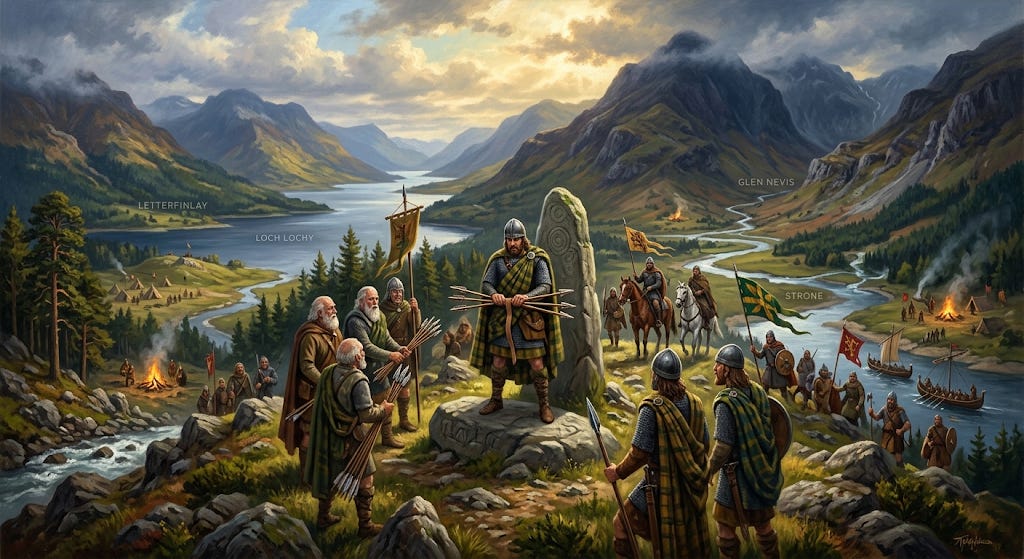
When people hear the name Clan Cameron today, it is easy to imagine a single great Highland family descending generation after generation from one distant ancestor. The reality of medieval Lochaber was considerably more complicated and, in many ways, far more interesting. Long before the Camerons emerged as one of the most powerful clans of the western Highlands, the country around Loch Lochy, Loch Eil, Glen Nevis, and the Great Glen was occupied by established local kindreds with their own leaders, territories, loyalties, and traditions. Three of these groups—the MacGillonies of Strone, the MacMartins of Letterfinlay, and the MacSorlies of Glen Nevis—became fundamental to the community that later history would know collectively as Clan Cameron.
Understanding these families changes the way we think about the Scottish clan system itself. A clan was not necessarily an enormous biological family in which everyone could trace descent from the chief through a tidy genealogical tree. Highland clanship could bring together blood relatives, tenants, allies, dependents, foster families, and older territorial groups who accepted the protection and leadership of a dominant chief. The emergence of Clan Cameron appears to have followed this pattern, developing gradually rather than being created at a single moment by one legendary founder.
The landscape explains much of the story. Medieval Lochaber was a country of deep lochs, narrow passes, mountains, forests, rivers, and isolated glens where control of relatively small areas could carry enormous strategic importance. Grazing land supported cattle, waterways served as transportation routes, and narrow corridors through the mountains determined how people, livestock, and armed parties could move. Families who had occupied these districts for generations possessed something that could not easily be granted by a distant king: intimate knowledge of the country and the ability to defend it.
Among the most important of these early communities were the MacMartins of Letterfinlay. Their traditional territory lay principally along the eastern shores of Loch Lochy, where they established a substantial local presence long before the Cameron chiefship became securely visible in surviving historical records. Later traditions sometimes attempted to fit the MacMartins neatly into Cameron genealogies, but the evidence encourages greater caution. They are better understood initially as an established Lochaber kindred with their own identity and leadership whose eventual incorporation into the Cameron political community strengthened the emerging clan enormously.
For anyone researching Cameron genealogy, that distinction is important. A person associated historically with the MacMartins should not automatically be imagined as belonging to a simple junior branch descended directly from an early Cameron chief. Medieval identities could overlap, change, and expand as political relationships developed over generations. A family might retain pride in being MacMartin while simultaneously recognising the Cameron chief as the principal military and political leader of the wider community.
The MacGillonies of Strone occupied another exceptionally important position. Strone stood near the interconnected waterways of the Great Glen, giving the kindred access to strategically valuable land and communications. The MacGillonies possessed their own resources, fighting strength, local relationships, and territorial interests rather than existing merely as followers awaiting Cameron leadership. Variations of their name, including forms such as MacIldowie, found in later traditions also make the task of reconstructing their early genealogy more difficult for modern researchers.
Their value to an emerging Cameron confederation would have been considerable. Highland power depended upon the ability to gather men quickly, control routes through difficult country, protect cattle, and respond to raids or invasions before an enemy could establish himself. The MacGillonies brought local knowledge and manpower to a wider alliance, while Cameron leadership offered the advantages of greater political and military coordination. What developed was therefore not simply the absorption of a weak family by a stronger one, but a relationship in which common security increasingly rewarded cooperation.
The third of the great formative kindreds was associated with one of the most spectacular landscapes in Scotland: the MacSorlies of Glen Nevis. The enclosed and defensible geography of the glen allowed communities living there to maintain a distinctive local identity for generations. Like the MacMartins and MacGillonies, the MacSorlies belonged to the human landscape of Lochaber before later genealogists attempted to arrange the region into neatly defined clan branches. Their relationship with the later Cameron families of Glen Nevis is consequently an area where tradition must be handled carefully rather than assuming that every later lineage can be connected directly to the earliest inhabitants.
Together these three kindreds reveal what Lochaber probably looked like before a unified Cameron identity dominated the region. There was no empty Highland wilderness into which a single Cameron patriarch arrived and founded an entire people. Instead, there were established communities occupying particular glens and shorelines, protecting their own interests while interacting through marriage, warfare, trade, fosterage, and alliance. Clan Cameron grew from this complicated world.
During the fourteenth century, the political pressures surrounding these smaller communities increased. The western Highlands were dominated by much larger powers, particularly the formidable Lords of the Isles, while rival families and confederations competed for land and influence around the Great Glen. Local kindreds that remained completely isolated risked being overwhelmed by enemies capable of mobilising considerably greater resources. A broader alliance under effective leadership therefore offered practical advantages that had little to do with modern ideas about surnames.
This is the environment in which Cameron leadership appears to have become increasingly important. The early chiefs could offer a focal point around which the inhabitants of different territories could coordinate military defence, negotiate with regional powers, settle disputes, and protect valuable land. Marriage alliances and fosterage would have reinforced these relationships, while the distribution and protection of land gave local leaders powerful reasons to remain loyal. Over time, allegiance to a Cameron chief could become as significant as membership in an older individual kindred.
The process should not be imagined as a sudden conquest in which the MacMartins, MacGillonies, and MacSorlies simply disappeared. Their identities and internal loyalties continued, and the Cameron chief depended upon their cooperation rather than exercising unlimited authority over them. A successful chief had to reward supporters, balance competing local interests, protect families from external aggression, and demonstrate that joining the larger confederation provided greater security than remaining independent. Early Clan Cameron was therefore closer to a political coalition bound by mutual obligations than to a modern organisation controlled from the top down.
By the end of the fourteenth century and the beginning of the fifteenth, the separate strands were becoming increasingly difficult to distinguish from the larger Cameron fabric. The three kindreds had helped create a combined social and military structure capable of defending territory in one of Scotland’s most contested regions. At approximately this point the historical picture also begins to become clearer, and the figure of Donald Dubh emerges as the first substantially authenticated chief in the conventional Cameron history. His importance was so enduring that subsequent Cameron chiefs became known by the Gaelic patronymic Mac Dhòmhnaill Duibh, linking the chiefship permanently with his name.
Donald Dubh therefore represents something more historically meaningful than another name on a long genealogy. His emergence symbolises the point at which a collection of older Lochaber communities was developing a recognisable and increasingly durable centre of leadership. Under Donald Dubh and his successors, the combined strength of the kindreds allowed the Camerons to contend with powerful neighbours, survive the changing influence of the Lords of the Isles, and resist efforts to remove them from territories they regarded as their own. The Cameron name gradually became an umbrella beneath which numerous families could share a common political identity.
That distinction has particular importance for modern descendants searching for their Scottish roots. Discovering an ancestral connection to Clan Cameron does not necessarily mean finding an uninterrupted chain of people named Cameron stretching back into the Middle Ages. An ancestor might have belonged to an older Lochaber family, a cadet house, an allied lineage, or a household that entered the Cameron community through residence and allegiance. In Highland society, belonging could be created through shared land, mutual defence, marriage, fosterage, service, and generations of common experience as much as through a surname.
There is even an intriguing echo of this ancient structure in the symbolism associated with Clan Cameron in later centuries. The familiar Cameron crest badge contains five arrows bound together, while the recognised Gaelic motto Aonaibh Ri Chèile carries the message of unity. These symbols were formally developed much later than the medieval period and should not be projected backwards as though the earliest MacMartins or MacGillonies carried them into battle. Yet the idea behind them—separate elements becoming stronger when joined together—fits remarkably well with the historical development of the clan.
The story of the MacGillonies, MacMartins, and MacSorlies ultimately reminds us that Highland history is rarely as simple as the family trees printed in Victorian clan books suggest. Clan Cameron was created not only through descent but through geography, necessity, alliance, leadership, and the repeated decision of separate communities to stand together. Those ancient kindreds did not merely vanish beneath a new surname; they helped provide the people, territories, and social foundations upon which Cameron power was built. To understand them is to see Clan Cameron not as the creation of one family, but as the remarkable product of a much older Lochaber world.
Their legacy would endure through centuries of territorial warfare, struggles with Clan Mackintosh and Clan Chattan, the rise of the chiefs of Lochiel, Jacobite rebellion, Culloden, migration, and the eventual creation of a worldwide Cameron community. Readers interested in exploring that larger journey—from the earliest traditions of Lochaber through the chiefs, conflicts, migrations, military service, and modern clan—can discover the complete story in The Complete History of Clan Cameron, available from Bagtown Clans. The history begins with those scattered communities beside the lochs and beneath the mountains, because before there could be a great Clan Cameron, there first had to be people willing to unite.
References
Drummond, J. (1842). Memoirs of Sir Ewen Cameron of Locheill, chief of the Clan Cameron: With an introductory account of the history and antiquities of that family and of the neighbouring clans (J. M’Knight, Ed.). Maitland Club.
Gregory, D. (1836). The history of the Western Highlands and Isles of Scotland, from A.D. 1493 to A.D. 1625. William Tait.
Mackenzie, A. (1884). History of the Camerons, with genealogies of the principal families of the name. A. & W. Mackenzie.
Macinnes, A. I. (1996). Clanship, commerce and the House of Stuart, 1603–1788. Tuckwell Press.
Stewart, J. of Ardvorlich. (1974). The Camerons: A history of Clan Cameron. Clan Cameron Association.
The register of the Great Seal of Scotland (Registrum Magni Sigilli Regum Scotorum). (Various years). H.M. General Register House.
The register of the Privy Council of Scotland. (Various years). H.M. General Register House.
I may have missed it, so forgive me if I ask a silly question, but how did the 3 communities become CAMRON rather than, for instance, Clan Lockaber or something else? Where did the Camron come from, please? And also I would like to ask, if I may, was there a Clan Lockaby? My Great-Grandmother-in-law was a Lockaby. That's all I can find about her . It never occurred to me she might be of Scottish ancestry. Thank you.