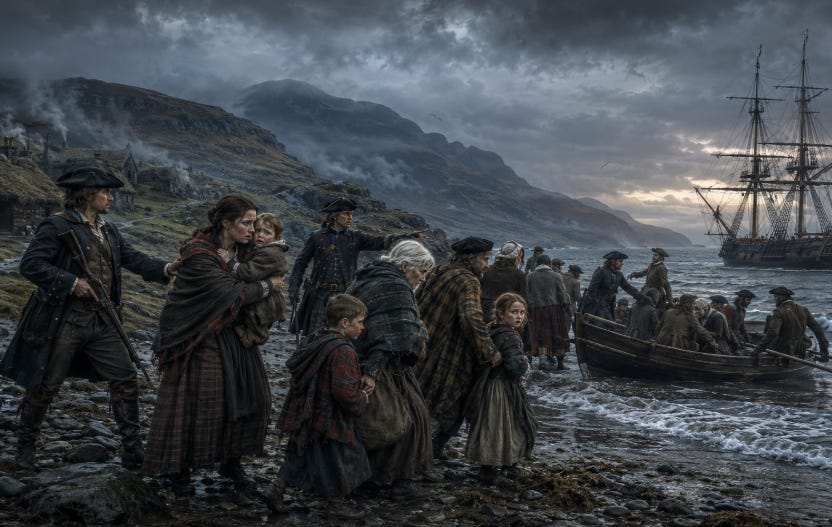
In the autumn of 1739, an Irish merchant vessel appeared among the islands of Scotland’s western seaboard with a purpose far darker than ordinary trade. The ship was the William, but Gaelic memory gave it another name: Soitheach nan Daoine, the Ship of the People. Men, women and children from Skye and Harris were seized, forced aboard and carried away from communities in which many had spent their entire lives. Their intended destination was America, where their captors planned to sell their labour for profit.
The crime was especially shocking because the scheme reached into the highest ranks of clan society. Sir Alexander Macdonald of Sleat and Norman MacLeod of MacLeod were landlords and hereditary chiefs expected to defend the people under their authority. Evidence implicated both men, while agents including Norman MacLeod of Unish and William Davidson, master of the William, carried out the practical work. This was not a raid by a foreign enemy, but an assault enabled by Highland leaders’ power over their own tenants.
By the early eighteenth century, the relationship between chiefs and clanspeople was changing. Chiefs increasingly spent like British aristocrats, while their island estates struggled with debt and a fragile cattle economy. Customary obligations connecting leadership, protection and kinship were giving way to demands for cash. Impoverished tenants could now be viewed not as members of a kindred but as assets whose removal might produce money.
The organisers disguised the enterprise with the language of law and punishment. Transportation of criminals and the sale of indentured labour were accepted parts of the eighteenth-century Atlantic world, creating a convenient cover for coercion. The islanders aboard the William had not freely agreed to emigrate, and claims that they were criminals could not explain the seizure of families and young children. Testimony instead described people being carried away against their will from MacLeod and MacDonald territory.
The exact number of victims varies among surviving accounts, but it was approximately one hundred and may have included children as young as five. People were gathered from Skye, particularly the MacLeod lands around Bracadale and Waternish, before the vessel moved through other island districts and Harris. The raids tore individuals from homes, relatives and the protection of their local communities with little warning. To those watching from shore, the departing ship must have seemed like the disappearance of an entire fragment of island society.
The plan was to carry the captives across the Atlantic and sell their service contracts. Indenture placed a person’s labour under a master for a fixed term, but these islanders had not voluntarily signed away their freedom. Their proposed status differed legally from the permanent, hereditary chattel slavery imposed on Africans and their descendants, and the two experiences should not be treated as identical. Yet forced capture, confinement, transportation and sale make this unmistakably an episode of human trafficking.
The voyage never reached America. Accounts differ over whether bad weather forced the William back toward Ireland or whether the ship called there principally for supplies and repairs, but it reached Donaghadee in County Down with its captives still under guard. Some were confined in a barn associated with Davidson while preparations were made for the Atlantic crossing. An attempted escape, followed by the recapture and beating of fugitives, drew the attention of people who could no longer ignore what was happening.
Local magistrates intervened, and the captives denied that they were convicted offenders undergoing lawful transportation. Warrants were issued for Davidson and MacLeod of Unish, but both men escaped immediate justice as accomplices and distant patrons traded accusations. The people aboard the William were ultimately liberated, although freedom in Ireland did not restore the lives from which they had been torn. Some returned to the Hebrides, but many remained around County Down, producing an involuntary migration even though the American sale failed. Behind every number was a disrupted household and a family forced to decide whether a dangerous journey home was possible.
When news reached Scotland, the chiefs moved quickly to protect themselves. Lady Margaret Macdonald wrote in January 1740 to Lord Justice Clerk Milton insisting that Sir Alexander was innocent and warning that prosecution would be expensive and troublesome. MacLeod likewise denied authorising a kidnapping and represented the passengers as people who could lawfully be transported. The defences reveal how influence worked: concern centred as much on protecting powerful reputations as on discovering what had happened to the islanders.
Neither Sir Alexander Macdonald nor Norman MacLeod suffered punishment proportionate to the accusations. Political friendships and the difficulty of prosecuting influential proprietors blunted the investigation, while the men who carried out the seizures disappeared. Duncan Forbes of Culloden, Lord President of the Court of Session, occupied a central place in the chiefs’ political network and was remembered as helping them avoid the scandal’s full consequences. Both chiefs later supported the Hanoverian government during the Jacobite rising of 1745, although the affair’s influence on that allegiance remains open to interpretation.
The Ship of the People matters because it exposes the collapse of an ideal often placed at the heart of clanship. A chief was supposed to protect his people, dispense justice and embody the honour of the kindred, yet here chiefly authority became a mechanism for capturing tenants and converting their bodies into income. The episode did not cause the nineteenth-century Highland Clearances, and it occurred under different economic and legal conditions. It nevertheless foreshadowed a world in which commercial estate policy could outweigh inherited responsibility to the communities living on the land.
Gaelic tradition refused to let the affair disappear behind legal evasions. The name Soitheach nan Daoine preserved the victims at the centre of the story, while Norman MacLeod’s reputation as “the Wicked Man” carried the moral verdict that the courts never delivered. Later generations remembered the vessel not for a successful voyage, but for betrayal interrupted. The survival of the story demonstrates how oral memory can preserve uncomfortable truths that official histories, family reputations and romantic images of clan life may prefer to soften.
For descendants of the MacDonalds of Sleat, confronting this episode makes the wider clan story more honest and human. Clann Ùisdein’s history contains courage and cultural achievement, but also moments when power was used against vulnerable people. The Complete History of MacDonald of Sleat places the Ship of the People within the transformation of Skye and North Uist, following the clan from medieval lordship through Jacobitism, landlordism, clearance and migration. The attempted sale reveals both what happened aboard the William and how profoundly the meaning of Highland chiefship was changing.
References
Alston, D. (2021). Slaves and Highlanders: Silenced histories of Scotland and the Caribbean. Edinburgh University Press.
Cameron, A. (1871). The history and traditions of the Isle of Skye. E. Forsyth.
Duff, H. R. (Ed.). (1815). Culloden papers: Comprising an extensive and interesting correspondence from the year 1625 to 1748. T. Cadell and W. Davies.
Hunter, J., & MacLean, C. (1986). Skye: The island. Mainstream Publishing.
Hunter, J. (2005). Scottish exodus: Travels among a worldwide clan. Mainstream Publishing.
MacInnes, A. I. (1996). Clanship, commerce and the House of Stuart, 1603–1788. Tuckwell Press.
Murdoch, A. (2010). Scotland and America, c. 1600–c. 1800. Palgrave Macmillan.