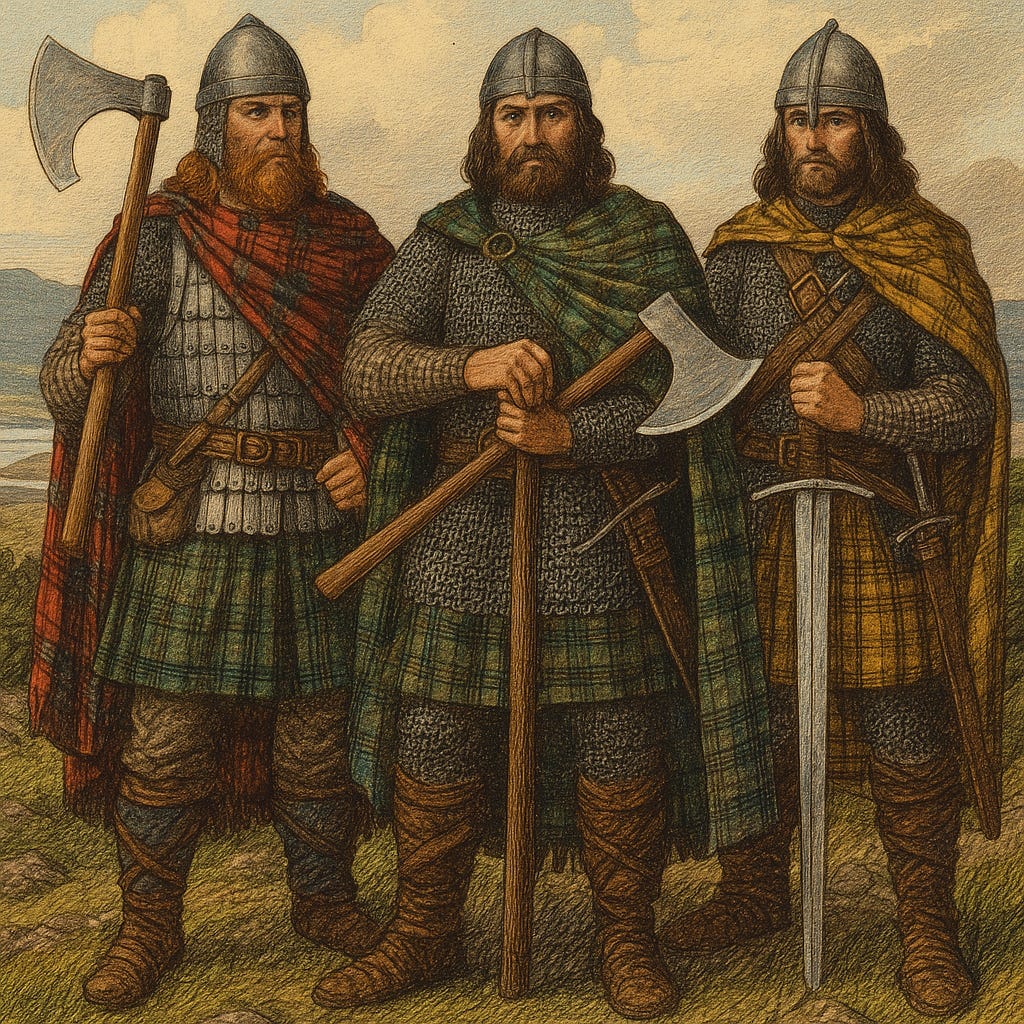
When people think of medieval Ireland, they often imagine swift-moving kern with javelins, or proud Gaelic lords ruling from their stone tower houses. Yet for nearly four centuries, there was another, more formidable presence on the Irish battlefield: the Gallowglass. These were not native Irish warriors but Scottish mercenaries—clan fighters from the Hebrides and western Highlands—who crossed the sea beginning in the 13th century. Once in Ireland, they became indispensable, their reputation as armored infantry so strong that the very word “Gallowglass” became synonymous with discipline, loyalty, and deadly efficiency. Their full story is told in my the book, The Gallowglass: Scottish Clan Warriors Fighting in Ireland, 1250–1650, now available for sale on Amazon.
Origins: From the Isles to Ireland
The Gallowglass (from the Gaelic gallóglaigh, “foreign warriors”) emerged from the fusion of Norse and Gaelic cultures in the Hebrides and western seaboard of Scotland. These Islesmen were the descendants of Vikings who had settled in the region from the ninth century, marrying into Gaelic families and adopting Gaelic customs while preserving Norse martial traditions. By the 1200s, their way of life was deeply martial: tough seafarers, castle-builders, and axe-wielding warriors.
The first recorded Gallowglass arrived in Ireland in 1259, when Aedh O’Connor, king of Connacht, married a daughter of Dubhghall MacRory of the Hebrides. Her dowry included 160 mailed warriors—Islesmen who would fight for her husband. This “dowry of soldiers” set a precedent. Soon, Irish chiefs across Ulster, Connacht, and Munster were importing Gallowglass companies, trading land and honor for their service.
The Clans That Supplied the Gallowglass
Several Scottish clans became synonymous with the Gallowglass tradition. They were not random mercenaries but organized family groups who came to Ireland with wives, children, and retainers, often settling permanently.
MacSweeneys (Mac Suibhne): Perhaps the most famous Gallowglass family. Originally from Argyll, they settled in Donegal, where branches like MacSweeney Fanad, Banagh, and na dTuath became hereditary captains to the powerful O’Donnells. Their castles at Doe, Rahan, and Rathmullan still stand as reminders of their prominence.
MacDonnells (Mac Domhnaill): Descended from the Lords of the Isles, the MacDonnells established themselves in the Glens of Antrim while maintaining power in Islay. Figures like Sorley Boy MacDonnell embodied the resilience of the Gallowglass, surviving imprisonment, massacre, and siege to secure his family as earls of Antrim.
MacCabes (Mac Cába): Though smaller in scale, the MacCabes became famous for their service to the O’Rourkes and O’Reillys in Leitrim and Cavan. Their name became shorthand for the Gallowglass tradition itself.
MacDougalls and MacRorys: Descendants of Somerled, the great sea-king of the Isles. Though overshadowed by the MacDonalds, they provided early Gallowglass service in Connacht and Ulster before being absorbed into Irish society.
MacSheehys (Mac Síthigh): Settled in Munster, serving the O’Briens of Thomond and the MacCarthys of Desmond. Their castles in Limerick and Clare became centers of Gallowglass power in the south.
MacNeills and MacLeans: From Barra, Gigha, and Mull, they supplied warriors to Ulster chiefs, sometimes arriving as seasonal “redshanks” but often establishing lasting ties.
Associated Families: Other clans like the Campbells and MacDowells occasionally provided warriors. Native Irish families, like the MacQuillans of Antrim, even began adopting the Gallowglass style themselves, blurring the line between “foreign” and “native” warriors.
Their Lives and Service
The life of a Gallowglass was professional, hereditary, and martial. Unlike kern, who were lightly armed and called up seasonally, the Gallowglass were permanent retainers. Each warrior was accompanied by a boy or attendant who carried provisions and spare weapons. They fought in disciplined companies led by captains, often their own kinsmen.
Their signature weapon was the two-handed battle axe, descended from Viking prototypes, capable of cutting through helmets and shields. Some also carried claymores—the great two-handed swords of the Highlands. They wore mail hauberks and iron helmets, far heavier armor than most Irish levies could afford. On the battlefield, they stood shoulder to shoulder, forming the mailed core of Irish armies while kern and horsemen fought around them.
Their pay was unusual: not coin alone, but land grants and honor-price. Chiefs granted them estates to ensure loyalty across generations. This made them more than mercenaries—they became nobility, landlords, and patrons of poets. The MacSweeneys, for example, employed bards who celebrated their deeds in verse, showing how fully they integrated into Irish high culture.
Famous Battles and Campaigns
The Gallowglass fought in almost every major Irish conflict from the 13th to the 17th century.
Edward Bruce’s invasion of Ireland (1315–1318) brought many Isles warriors into the country, setting the precedent for later service.
Clan feuds in Ulster often pitted O’Donnells against O’Neills, each backed by rival Gallowglass lineages.
In Munster, MacSheehy Gallowglass fought in the Desmond Rebellions (1560s–1580s) against Tudor forces.
In the Nine Years’ War (1594–1603), they served Hugh O’Neill and Hugh Roe O’Donnell, winning at Yellow Ford (1598), where Gallowglass formations helped inflict a devastating defeat on the English.
At the Battle of Kinsale (1601), they fought valiantly but were overwhelmed by cannon and musket fire. This battle marked the effective end of the old Gaelic order.
The Decline of the Gallowglass
The seventeenth century brought changes that ended the Gallowglass way of life. Firearms rendered axes and mail obsolete. The Flight of the Earls (1607) deprived them of patrons like the O’Neills and O’Donnells. The Plantations stripped their families of land. The Cromwellian conquest (1649–1653) dealt the final blow, smashing the last Gaelic strongholds with cannon and musket.
Some Gallowglass families assimilated into the Irish gentry. Others fled abroad, joining Irish regiments in Spain, France, and Austria, where they continued their tradition of professional soldiering. By the late seventeenth century, the Gallowglass as a distinct warrior class had disappeared.
Memory and Legacy
Though gone as fighting men, the Gallowglass lived on in folklore and literature. Bards remembered them as loyal retainers, always faithful to their lords. Folktales turned them into giants, superhuman warriors whose axes could cleave men in two. English writers, even when hostile, could not ignore their discipline and ferocity.
By the nineteenth century, romantic historians and antiquarians painted them as the Gaelic equivalent of knights—symbols of loyalty, resilience, and Gaelic pride. In modern times, they are remembered as bridges between Scotland and Ireland, proof that the two nations shared a deep, intertwined history.
Why Their Story Still Matters
The story of the Gallowglass is more than military history. It is about clan identity, kinship, and cultural exchange. They show how Scottish families—MacSweeneys, MacDonnells, MacCabes, MacSheehys, and others—reshaped themselves in Ireland, becoming both foreign and native. They show how professional soldiers could rise to nobility, how mercenary service could create dynasties, and how the bonds of Isles and Erin endured across centuries.
Today, the Gallowglass remain a powerful symbol. For those interested in Scottish clans, they represent one of the most fascinating chapters of clan history: a story of migration, adaptation, and endurance. For Irish heritage, they represent the mailed heart of resistance, the warriors who stood shoulder to shoulder with chiefs in Ireland’s darkest hours. Their axes may be silent, but their legacy still rings—and if you want to explore their story in full, the book The Gallowglass: Scottish Clan Warriors Fighting in Ireland, 1250–1650 is now available for sale on Amazon.