

On the night of April 12, 1588, the tallow candles of Torloisk House burned low against the damp stone walls of western Mull, casting long, trembling shadows across the remnants of a Highland wedding feast. Outside, the cold Hebridean swell broke ceaselessly against the basalt ledges of Loch Tuath, its rhythmic roar muffled by the thick masonry of the hall. Inside, the air was heavy with the scent of roasted mutton, peat smoke, and spilled wine. Across the trestle tables sat men who, only weeks before, would have drawn steel at the mere sight of one another’s tartan. The warriors of Clan Gillean and the fighting men of the MacIans of Ardnamurchan were raising their cups under the same roof, celebrating the marriage of John Mac Ian, the Lord of Ardnamurchan, to Janet Campbell, the twice-widowed mother of the formidable Sir Lachlan Mor Maclean of Duart.
To anyone unfamiliar with the blood-soaked politics of the sixteenth-century Isles, the union looked like a triumph of diplomacy over ancient enmity. Yet as the Rev. Alexander Maclean Sinclair chronicles in The Clan Gillean, peace in the Western Highlands was rarely forged without an ulterior calculation. Beneath the clatter of pewter flagons and the murmur of Gaelic toasts, a perilous game of survival was playing out. Before the sun would rise over the hills of Mull, the wedding hall of Torloisk would become a slaughterhouse, and the bridegroom himself would be dragged in chains from his marriage bed.
A Feud Written in Fire and Hostages
To understand why Sir Lachlan Mor of Duart stood host to a Macdonald chieftain at Torloisk, one must look south across the Firth of Lorn to the fertile, contested pastures of the Rhinns of Islay. For years, the Macleans of Duart and the Macdonalds of Islay and Sleat had been locked in a war of mutual extermination over those lands. It was a conflict stripped of all chivalric pretense. Three summers earlier, in 1585, a storm had driven Donald Gorm Mor Macdonald of Sleat to seek shelter on the northern shore of Jura. During the night, two treacherous Macdonald kinsmen stole a herd of Maclean cattle for the sole purpose of framing Donald Gorm Mor. Believing the theft to be deliberate, Sir Lachlan Mor descended upon the unsuspecting camp at Knock Breck and butchered sixty Macdonalds in the dark.
Retaliation came with terrifying escalation. When Angus Macdonald of Islay traveled to Duart in 1586 to broker peace, Lachlan Mor threw him into prison and forced him to surrender his young son James and his brother Ranald as hostages for the Rhinns. Weeks later, when Lachlan Mor crossed to Islay to claim the territory and accepted an invitation to feast at Mullintrea, Angus Macdonald surrounded the lodging house at midnight with four hundred armed men. Though Lachlan Mor used his young nephew James as a human shield at the doorway before surrendering on a solemn promise of mercy, the pledge proved worthless. Two of Lachlan’s fiercest companions, refusing to yield, were burned alive inside their quarters. In the days that followed, hearing a fabricated rumor from Allan Og Maclean that his brother Ranald had been slain at Duart, Angus Macdonald ordered his brother Coll to lead the Maclean captives out in pairs and behead them day after day until more than seventy men had been executed.
Only the intervention of King James VI and the Campbell guardians of the young Earl of Argyll saved Sir Lachlan Mor’s neck from the block, at the price of eight high-born Maclean and allied hostages. No sooner was Lachlan Mor free in 1587 than he swept back across Islay with fire and sword, putting every Macdonald capable of bearing arms to death, while the Macdonalds answered by ravaging Tiree, Iona, and the glens of Mull, slaughtering men, women, and even the livestock they could not drive to their galleys. From his distant court in Edinburgh, the King watched the carnage with cold indifference, knowing that the more the great island lords bled each other dry, the easier it would be for the Crown to confiscate their estates.
The Bait of Torloisk
By the spring of 1588, Sir Lachlan Mor stood in desperate need of allies. Facing a united league of every Macdonald branch from Skye to Kintyre, the Lord of Duart looked across the Sound of Mull to Ardnamurchan. Its chieftain, John Mac Ian, commanded a strategic peninsula and a battle-hardened following. For some time, Mac Ian had been courting Lachlan Mor’s mother, Janet Campbell, a daughter of Archibald, fourth Earl of Argyll. Janet was no stranger to the ruthless ambition of Highland politics. After the death of her first husband, Hector Og of Duart, she had married Hector Mac Allan of Torloisk, son of the notorious pirate-chieftain Ailein nan Sop. When Lachlan Mor discovered in 1577 that his stepfather was conspiring with the sixth Earl of Argyll to murder him and seize the leadership of the clan, the young chief had locked his stepfather in irons at Duart before having him beheaded on the island of Coll the following year.
Living now as a wealthy dowager at Torloisk House, Janet Campbell possessed both dower lands and accumulated substance that made her a prize in the eyes of John Mac Ian. Initially, Sir Lachlan Mor had flatly refused to sanction the match. A Macdonald of Ardnamurchan sitting in Torloisk was a dagger pointed at the heart of Mull. Yet as the war with Angus of Islay and Donald Gorm Mor ground on, Lachlan Mor’s strategic calculus shifted. Early in 1588, he sent word to Ardnamurchan that he desired Mac Ian’s friendship and would gladly bestow his mother’s hand upon him.
Lachlan Mor’s motive was purely political. By binding John Mac Ian to the House of Duart through marriage, he expected to sever the MacIans from the broader Macdonald coalition and secure his northern flank. John Mac Ian accepted the overture, gathered a retinue of more than twenty of his principal gentlemen and attendants, and sailed across the Sound of Mull to Torloisk.
The Boast in the Banquet Hall
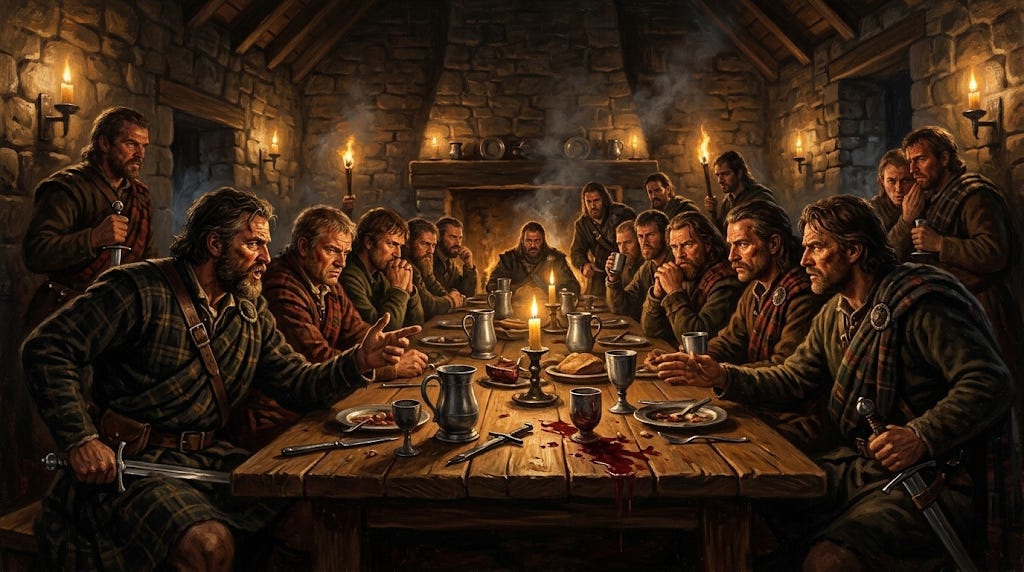
The wedding ceremony on April 12 passed with every outward mark of Highland hospitality. The tables groaned under the weight of meat and drink, the pipers and harpers filled the hall, and the two clans mingled as kinsmen. As the hour grew late, the bride and bridegroom were conducted with customary ceremony to their marriage chamber. Most of Mac Ian’s retinue, heavy with food and ale, walked out into the cool April night and settled down to sleep in the straw of an adjacent barn.
Inside Torloisk House, however, a select circle of the most prominent Macdonald gentlemen remained at the board, drinking deep into the night alongside Sir Lachlan Mor and his leading chieftains. As the Aqua Vitae circulated and the candles guttered, the guarded courtesy of the afternoon began to fray. Wine loosened tongues that caution had kept still. The conversation turned inevitably to the marriage itself, and then to the great war dividing the Isles.
One of the Macdonald gentlemen, emboldened by drink and pride, leaned across the table and let slip a fatal boast. His chief, he declared, had not wed the Lady of Torloisk out of any affection for her aging person, nor out of love for the House of Duart, but solely to get his hands upon her wealth. Worse still, the Macdonald added with reckless candor that no marriage ring would ever turn Ardnamurchan against his own blood: when the war banners were raised again, John Mac Ian would march shoulder to shoulder with Angus of Islay and Donald Gorm Mor against the Macleans.
For a heartbeat, the hall went dead silent. In that single drunken sentence, the entire diplomatic foundation of the marriage dissolved before Lachlan Mor’s eyes. He had given his mother, her dower wealth, and a foothold on Mull to a man who intended to use them to help destroy him.
A Maclean warrior sitting directly beside the boasting speaker did not wait for a second word. “Drunken men always tell the truth,” he cried out, and in the same motion drew his dirk and drove it to the hilt into the Macdonald’s heart.
The Midnight Slaughter and Its Aftermath
The blow was the signal for instantaneous carnage. Before the dying man hit the rushes on the floor, Sir Lachlan Mor and his chieftains drew their broadswords and fell upon the remaining Macdonalds at the table. Outnumbered and trapped between the heavy oak tables and the stone walls, the guests were cut down where they sat.
The bloodlust did not stop at the threshold of the hall. Knowing that if the men in the barn escaped to raiseArdnamurchan the coast of Mull would burn, the Macleans rushed out into the darkness with naked blades. Bursting through the barn doors, they slaughtered the sleeping Macdonalds in the straw before they could grope for their weapons. Over eighteen of Mac Ian’s kinsmen and followers perished in the space of a few minutes.
Only one target remained. His sword still wet with the blood of the wedding guests, Lachlan Mor led his men back up the stairs of Torloisk House and battered down the door of the bridal chamber. They dragged John Mac Ian from his bed, and the blades were already raised to finish him on the spot when Janet Campbell threw herself between her son’s warriors and her new husband. Her shrieks and tears stayed their hands. Softened by his mother’s pleas, or perhaps calculating that a living chieftain was a useful bargaining chip, Lachlan Mor spared Mac Ian’s life. The Lord of Ardnamurchan was hauled out of the bridal room in his nightclothes and flung into the dungeon, along with the only two members of his retinue who had survived the massacre: Allister Mac Ian and the chief’s young page, Angus Mac Ian.
When word of the red wedding at Torloisk reached Edinburgh, David Mac Gill of Nesbit, the King’s Advocate, petitioned the Privy Council in outrage, demanding that Mac Ian and his two surviving companions be freed. Summoned to answer for the slaughter, Sir Lachlan Mor ignored the royal heralds and was denounced a rebel on June 18, 1588. Far from repenting, when the great Spanish Armada galleon Florida limped into Tobermory Bay that autumn, Lachlan Mor traded provisions for the use of a hundred Spanish musketeers and sailed across the Sound to batter Mac Ian’s stronghold of Mingarry Castle and lay waste to Ardnamurchan and the Small Isles.
It was not until early 1589, when sheer exhaustion forced the warring clans to sheathe their swords, that John Mac Ian was finally released from his dungeon and permitted to return across the water to Ardnamurchan. The massacre at Torloisk House had achieved its cold, immediate purpose: as the Rev. Sinclair observes, when the Lord of Duart realized he could not persuade the MacIans to fight for him, he decided in a flash of ruthless fury to disqualify them from fighting against him.
Adapted From: Sinclair, A. M. (1899). The Clan Gillean. Haszard and Moore.
Such an incredible story told with verve and intrigue. Thank you!!!