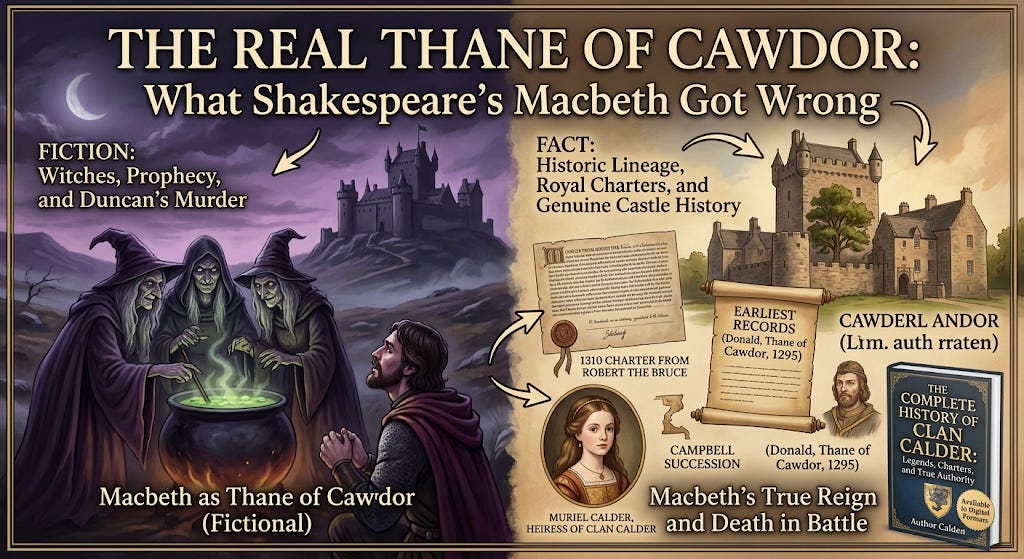
Few titles in Scottish history are as instantly recognizable as “Thane of Cawdor.” In Shakespeare’s Macbeth, the words arrive on a blasted heath, carried by three mysterious witches who greet Macbeth with a sequence of prophecies. He is already Thane of Glamis, they declare; he will become Thane of Cawdor and, at last, King of Scotland. When royal messengers almost immediately confirm that the Cawdor title is his, the impossible suddenly appears possible, and Macbeth begins the fatal journey from celebrated warrior to murderer and tyrant.
For Shakespeare, Cawdor is less a place than a dramatic trigger. The title proves that the witches possess knowledge beyond ordinary human understanding, giving Macbeth a reason to believe their final promise of kingship. The previous thane has betrayed King Duncan, lost his honour and forfeited his life, allowing the title to be transferred to a more deserving warrior. Yet Shakespeare’s perfect dramatic machinery has done something extraordinary to popular memory: it has persuaded generations of readers that Macbeth belonged to the historical line of Cawdor thanes.
The real Macbeth lived in a Scotland very different from the shadowed kingdom of the play. He became king in 1040 after Duncan was killed in battle, not murdered while sleeping as a guest beneath Macbeth’s roof. Macbeth then ruled for approximately seventeen years, a reign far longer and apparently more stable than Shakespeare’s feverish tragedy suggests. Although medieval evidence is incomplete, the surviving record does not securely establish the historical Macbeth as a member of the documented Calder family or as the holder of the later territorial thanage of Cawdor.
Shakespeare was not attempting to write a modern work of archival history. He drew heavily upon chronicle traditions that had already reshaped Scotland’s eleventh-century past, especially the accounts associated with Hector Boece and Raphael Holinshed. Characters, titles and events from different periods were blended into a powerful story about ambition, prophecy, loyalty and legitimate kingship.
The documentary history of the actual Cawdor thanes begins much later and under a name often written as Calder. Calder, Cawdor, Caldor and Caldore were among the spellings used by medieval scribes, who did not follow modern rules of standardized orthography. The name was rooted in the landscape of Nairnshire and is generally understood as a place-name connected with a hard, violent or forceful stream. Before it became internationally associated with witches and murder, it described a northern territory shaped by water, agriculture and royal administration.
The first secure personal anchor in the Calder story appears in 1295, more than two centuries after the historical Macbeth. In that year Donald, identified as Thane of Cawdor, served as a juror during a formal inquiry concerning the neighbouring lands of Kilravock and Easter Geddes. This surviving appearance is not the stuff of theatrical spectacle, but it is precisely the kind of evidence historians value: a named individual performing a recognizable legal duty in a particular place.
In 1310, Robert the Bruce issued a charter to William, Thane of Calder, granting the thanage under hereditary feu-farm tenure for an annual payment of twelve merks. That document reveals what the title actually meant in the securely recorded Calder period. A thane was not simply a romantic clan chieftain or the equivalent of a modern nobleman wearing an inherited badge. The office joined landholding, Crown service, revenue and local authority, making the thane an important link between the Scottish king and the territory he governed.
Cawdor Castle provides the most visible divide between Shakespearean imagination and Calder history. The central stone tower is associated with a royal licence to build and fortify granted to William Calder in 1454, roughly four centuries after Macbeth’s reign. The castle that visitors now connect with Duncan’s murder therefore could not have been Macbeth’s home, and Shakespeare never actually names Cawdor Castle as the site of the killing. Its genuine history belongs to the late medieval Calder thanes and to the generations who enlarged and preserved their fortified residence.
The castle has its own legend, and it is almost as memorable as anything in Shakespeare. Tradition tells of a thane who placed treasure upon a donkey and allowed the animal to wander until it rested beneath a tree, marking the divinely chosen location for his new stronghold. The tower was then said to have been built around the tree, whose remains became one of Cawdor’s most famous curiosities. The tale cannot replace the evidence of charters and architecture, but it shows that the real castle never needed Macbeth to possess mystery, atmosphere or romance.
The greatest drama in the documented Calder story came not from regicide but from inheritance. Near the end of the fifteenth century, the death of John Calder left his young daughter Muriel as heiress to the Cawdor lands. Her wardship and eventual marriage to Sir John Campbell drew the ancient estate into the expanding Campbell sphere, while later tradition described an armed pursuit by Calder relatives determined to recover the child. In 1511 the lands were formally granted to Muriel and her husband jointly, creating the foundation of the Campbell of Cawdor succession while confirming that Campbell authority came through the Calder heiress.
This transition reveals a Scotland that is less familiar than Shakespeare’s but no less compelling. Medieval power could turn upon the survival of a child, the wording of a charter, the rights of a widow, a royal decision or a carefully arranged marriage. The male line could lose its principal inheritance without the surname disappearing, and collateral Calder families later built new identities in commerce, landholding, military service and migration.
Shakespeare did not give us an accurate biography of Macbeth or a reliable genealogy of Cawdor, but he gave the title an immortality no charter could have achieved. His tragedy turned Cawdor into a symbol of temptation, betrayal and dangerous ambition, drawing readers and travellers toward a place whose authentic story is considerably later. The challenge is not to choose between literature and history, but to understand what each preserves. The play reveals how the early modern world imagined Scotland’s past, while the Calder records reveal how land, office and family power actually developed in medieval Nairnshire.
For readers who want to move beyond the witches and discover the people behind the title, The Complete History of Clan Calder follows the story from the River Nairn and the earliest surviving records to Cawdor Castle, Muriel Calder, the Campbell succession and the worldwide Calder diaspora. It carefully separates documented events from later tradition without stripping the past of its colour or drama. Available in EPUB, KPF and PDF formats, the book offers Calder descendants, genealogists and lovers of Scottish history a fuller account of the family whose real inheritance has stood for centuries in the long shadow of Macbeth.
References
Aitchison, N. (1999). Macbeth: Man and myth. Sutton Publishing.
Barrow, G. W. S. (2003). The kingdom of the Scots: Government, church and society from the eleventh to the fourteenth century (2nd ed.). Edinburgh University Press.
Bullough, G. (Ed.). (1973). Narrative and dramatic sources of Shakespeare: Major tragedies: Hamlet, Othello, King Lear, Macbeth (Vol. 7). Columbia University Press.
Duncan, A. A. M. (2002). The kingship of the Scots, 842–1292: Succession and independence. Edinburgh University Press.
Grant, A. (1993). Thanes and thanages, from the eleventh to the fourteenth centuries. In A. Grant & K. J. Stringer (Eds.), Medieval Scotland: Crown, lordship and community (pp. 39–81). Edinburgh University Press.
Innes, C. (Ed.). (1859). The book of the Thanes of Cawdor: A series of papers selected from the Charter Room at Cawdor, 1236–1742. Spalding Club.
Rose, H. (1848). A genealogical deduction of the family of Rose of Kilravock (C. Innes, Ed.). Spalding Club.
Shakespeare, W. (2015). Macbeth (S. Clark & P. Mason, Eds.). Bloomsbury Arden Shakespeare. (Original work published 1623)
Shaw, L. (1775). The history of the province of Moray. William Auld.
Taylor, A. (2016). The shape of the state in medieval Scotland, 1124–1290. Oxford University Press.
Woolf, A. (2007). From Pictland to Alba, 789–1070. Edinburgh University Press.