Get a your copy of the Complete History of Clan MacNeil - https://fairbairncrests.com/products/the-complete-history-of-clan-macneil-digital-edition
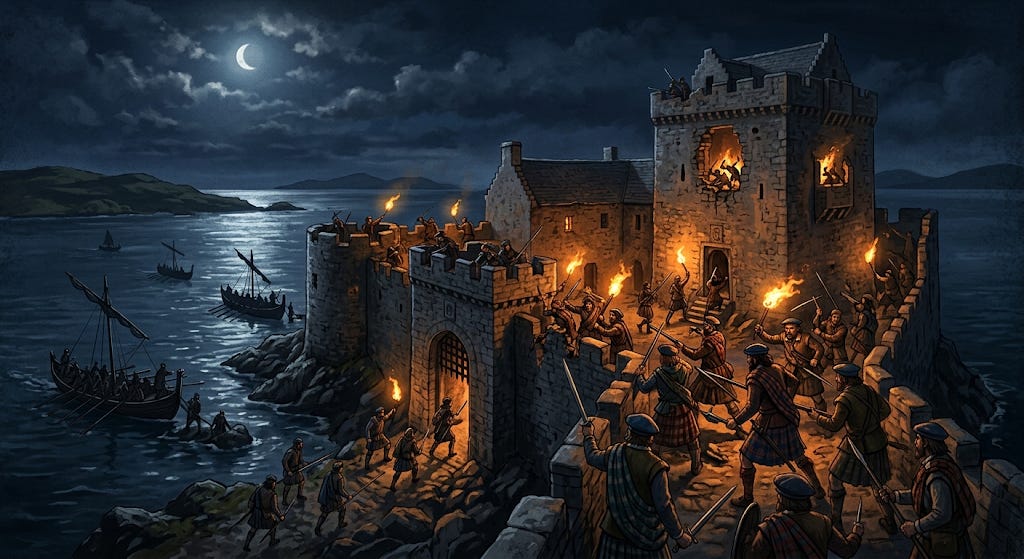
For centuries, Kisimul Castle stood as the great stone symbol of Clan MacNeil power on the island of Barra. Rising from a rocky islet in Castlebay, surrounded by seawater and reachable only by boat, the fortress was designed to protect the MacNeil chiefs from enemies approaching across the Hebrides. Yet in 1612, the greatest danger to the castle did not arrive aboard an enemy fleet. It came from within Clan MacNeil itself.
At the centre of the crisis was Ruairi MacNeill of Barra, remembered in later clan tradition as Rory the Turbulent. The nickname suited a chief whose career unfolded during one of the most unsettled periods in the history of the Western Isles. Ruairi belonged to an older Gaelic political world in which island chiefs maintained armed followers, controlled their own strongholds, sailed powerful galleys, and built alliances with neighbouring clans. That independence increasingly collided with a Scottish monarchy determined to bring the Hebrides firmly under royal authority.
During the late sixteenth century, Ruairi was closely allied with the powerful MacLeans of Duart. Records from 1595 described MacNeill of Barra as an important supporter of MacLean and suggested that Barra could provide a substantial body of fighting men when required. The MacNeils were not simply isolated inhabitants of a distant Atlantic island. They were participants in a maritime political system stretching from the Scottish Highlands across the Irish Sea.
The MacNeil galleys became involved in the conflicts of western Ireland during the 1590s, sometimes supporting allied forces and sometimes participating in raids. This brought prestige and resources to Barra, but it also attracted the attention of royal officials. King James VI increasingly regarded independent military activity by Hebridean chiefs as incompatible with the authority of the Scottish Crown. Ruairi’s reputation as a formidable sea lord therefore became both a source of power and a growing political liability.
By the beginning of the seventeenth century, Edinburgh was determined to change the way the Western Isles were governed. In 1605, the Crown demanded that several Hebridean chiefs surrender their principal castles, bringing Kisimul directly into the struggle between traditional Gaelic lordship and centralized royal government. The Scottish state was also supporting attempts by Lowland investors, remembered as the Fife Adventurers, to establish themselves in Lewis. To men like Ruairi, such projects offered a disturbing glimpse of what could happen if the old island leadership lost control of its lands.
Ruairi became associated with resistance to the Crown’s policies, and by 1606 government records accused the MacNeill chief of participating in opposition to the Lewis plantation. A royal commission established the following year considered severe measures against several troublesome western chiefs. Edinburgh possessed the legal authority to threaten Ruairi, but Barra’s geography made actually enforcing those threats considerably more difficult. Kisimul’s position in the waters of Castlebay offered protection that orders written hundreds of miles away could not easily overcome.
The Crown therefore began relying increasingly on political pressure, alliances and legal action rather than attempting a straightforward conquest of Barra. Ruairi’s relationship with the MacLeans came under pressure, while disputes involving shipping created further trouble for the chief. Around 1610, forces associated with Ruairi were accused of intercepting a Lowland merchant vessel and taking its cargo. What may have appeared from Barra as an assertion of traditional maritime authority looked to royal officials like piracy and defiance of the king’s peace.
Ruairi now faced enemies outside his island, but an even more dangerous struggle was developing inside his own household. As the aging chief’s succession became increasingly important, his sons began competing over who would control Barra after him. Gilleonan Og MacNeill appears in the surviving record as a son closely aligned with Ruairi and positioned as an important supporter of his father’s authority. Other sons of Ruairi feared that their own claims and position within the family were being threatened.
Between roughly 1610 and 1612, the disagreement developed from a succession argument into an armed confrontation. Ruairi’s natural sons gathered followers capable of directly challenging their father and Gilleonan Og. The same system that allowed a Highland chief to summon armed supporters could also become extraordinarily dangerous when members of the chiefly household divided against one another. Barra was no longer simply resisting pressure from Edinburgh; the MacNeil lordship itself was beginning to fracture.
Kisimul Castle inevitably became the centre of the confrontation. Whoever controlled the fortress controlled far more than an impressive medieval building, because Kisimul was the administrative and military heart of the Barra estate. Its walls protected the chief’s household, weapons, supplies and authority, while its position in Castlebay gave its occupants command of the principal stronghold of the island. Taking Kisimul therefore offered the rebellious faction the most direct route to taking effective control of Barra.
In October 1612, the struggle reached its violent climax. According to the formal complaint later submitted to the Scottish authorities, Ruairi’s natural sons and their armed supporters suddenly seized Kisimul Castle. They overcame the defenders and occupied the stronghold, although the surviving records do not provide enough detail to reconstruct precisely how they entered the fortress. What the documents do make clear is that the attack succeeded.
The result was an extraordinary reversal for Rory the Turbulent. A chief who had spent much of his career resisting royal interference and participating in the turbulent maritime politics of the Hebrides was captured by members of his own family. Ruairi and Gilleonan Og were taken prisoner, while the faction responsible for the seizure assumed control of Kisimul. The fortress that had helped protect Ruairi from outside enemies had effectively become his prison.
The episode reveals one of the weaknesses hidden beneath the impressive image of Highland chiefly power. A chief’s authority depended not only upon stone walls and armed retainers but also upon family loyalty, recognized succession and the willingness of influential members of the kindred to support him. Once those loyalties broke apart, even an isolated fortress such as Kisimul could not guarantee security. The MacNeils had successfully resisted enormous pressure from outside Barra, only to discover that a struggle inside the chief’s own family could accomplish what royal commissions had failed to do.
There was another remarkable twist. Instead of simply raising another armed force and attempting to retake his castle, Ruairi and Gilleonan Og appealed to the Scottish government for assistance. The same chief who had spent years resisting Edinburgh now turned to Edinburgh to help restore his position. It was an extraordinary indication of how dramatically the political world of the Hebrides was changing.
On 11 March 1613, the dispute entered the official record of the Privy Council of Scotland. The complaint described the occupation of Kisimul and the imprisonment of the established leadership, transforming what might once have remained an internal clan feud into a matter for the king’s government. For historians, this surviving record is particularly valuable because it provides documentary evidence of a dramatic episode that might otherwise have survived only as clan tradition. It allows the violence surrounding the MacNeil succession to emerge from the paperwork of the early Scottish state.
The Crown had good reason to pay attention. For years, royal officials had regarded Ruairi himself as a troublesome island chief, yet they now received a request from him to intervene against members of his own family. The situation gave the government an opportunity to insert itself directly into the internal affairs of Barra. A struggle between father and sons therefore became part of the much larger transformation through which Edinburgh gradually reduced the independence of the old Hebridean lordships.
Exactly what happened immediately after the complaint remains frustratingly unclear. The surviving documents do not reveal every stage of the negotiations, the precise settlement reached between the competing MacNeils, or all the details of Ruairi’s final years. That uncertainty is important because it prevents the story from being turned into a neat historical drama in which every participant’s motives and fate are known. What survives instead is something more valuable: documentary evidence of a genuine family crisis taking place at a pivotal moment in Highland history.
The consequences extended beyond one violent night at Kisimul. In the following years, Barra moved into a different political and legal environment, and in 1621 the superiority of Barra and Kisimul was granted to Roderick MacKenzie of Coigach. The MacNeils continued to occupy their island and remained closely associated with Kisimul, but their relationship with outside authority had fundamentally changed. The independent maritime world in which Rory the Turbulent had built his reputation was slowly disappearing.
Today Kisimul Castle still dominates Castlebay, and its romantic appearance can make it easy to imagine an uninterrupted story of chiefs ruling securely from their island fortress. The events of 1612 reveal a far more complicated reality. Behind those walls were ambitious heirs, political rivalries, prisoners, armed followers and a family struggling over who had the right to lead. For a brief and extraordinary moment, one of Scotland’s most famous island castles became the battleground of the very clan it was supposed to protect.
The story of Rory the Turbulent and the seizure of Kisimul is only one episode in the much larger history of the MacNeils of Barra. Their story stretches from the medieval Lordship of the Isles through naval warfare, royal intervention, religious change, emigration, the loss of Barra, the MacNeil diaspora and the eventual restoration of Kisimul Castle. These events and many more are explored in The Complete History of Clan MacNeil, which follows the clan from its earliest documented origins to its worldwide modern legacy.
References
Campbell, J. L. (Ed.). (1936). The book of Barra. G. Routledge & Sons.
Dunbar, J. G. (1978). Kisimul Castle, Isle of Barra. Glasgow Archaeological Journal, 5, 25–43.
Holden, T., Boardman, S., McNeill, T., Brann, M., Walker, B., & Morrison, J. (2016). Kisimul, Isle of Barra. Part 1: The castle and the MacNeills. Proceedings of the Society of Antiquaries of Scotland, 146, 181–213.
MacFarlane, W. (1906). Geographical collections relating to Scotland. Scottish History Society.
Macneil, R. L. (1964). Castle in the sea. Collins.
MacPhail, J. R. N. (Ed.). (1914). Highland papers (Vol. 1). Scottish History Society.
The register of the Privy Council of Scotland. (1877–1970).