Uncover the epic history of Clan Montgomery - https://fairbairncrests.com/products/the-complete-history-of-clan-montgomery
In April 1586, Hugh Montgomerie, fourth Earl of Eglinton, was killed near Stewarton in Ayrshire. He had inherited his title only the previous year, yet he also inherited a rivalry that had troubled his family for generations. His attackers belonged to the Cunningham following, whose struggle with the Montgomeries had already brought destruction to the district. Decades earlier, Eglinton Castle itself had burned in the feud. Behind these events lay a contest over who could command, judge, and profit from life in northern Ayrshire.
The names Montgomery and Cunningham now suggest tartans, family gatherings, and ancestral pride. In medieval and early modern Ayrshire, their leading houses controlled estates, maintained followers, and competed for positions that carried real authority. The Montgomeries became Earls of Eglinton, while the Cunninghams held the earldom of Glencairn. Their lands and interests brought them into repeated contact, making a neighbour’s advancement difficult to ignore. Each family had much to gain from royal favour and much to fear when that favour strengthened its rival.
One office stood at the centre of the dispute: the bailiary of Cunninghame, the northern district of Ayrshire. A bailie exercised judicial and administrative authority, giving the officeholder influence beyond the boundaries of his private estate. Control of courts and the enforcement of rights could bring income, prestige, and opportunities to strengthen a following. For a competing noble family, being subject to a rival’s jurisdiction was an uncomfortable prospect. What sounds today like a disagreement over a council appointment could then affect the balance of power across a whole district.
It is tempting to give the feud a single birthday, as though one appointment immediately created generations of hatred. The surviving history points instead to a developing struggle over grants, competing claims, and the confirmation of offices. Montgomerie possession of the bailiary became a continuing source of Cunningham opposition. Both houses sought recognition from the Crown because a royal charter could make a disputed advantage harder to challenge. Yet a legal victory could leave the losing side determined to reopen the contest through pressure, alliances, or force.
National politics made this local rivalry more dangerous. In 1488, Hugh, Lord Montgomerie, supported the faction associated with the future James IV, while Alexander Cunningham, first Earl of Glencairn, fought for James III. Glencairn died at Sauchieburn, where the king’s cause was defeated. Montgomerie emerged on the winning side and benefited from the new reign. The consequences reached back into Ayrshire, where access to the monarch could help turn a battlefield success into lasting local authority.
The Montgomeries also used violence to advance their position. In 1488, Hugh received a royal remission covering the destruction and plundering of the Cunningham stronghold generally known as Kerelaw. A remission offered protection from punishment; it did not undo the damage or erase the resentment of those who suffered it. The episode helps explain why royal government could both restrain and aggravate a feud. A family that watched its opponent receive royal protection had reason to doubt whether the next appeal to justice would bring a fair result.
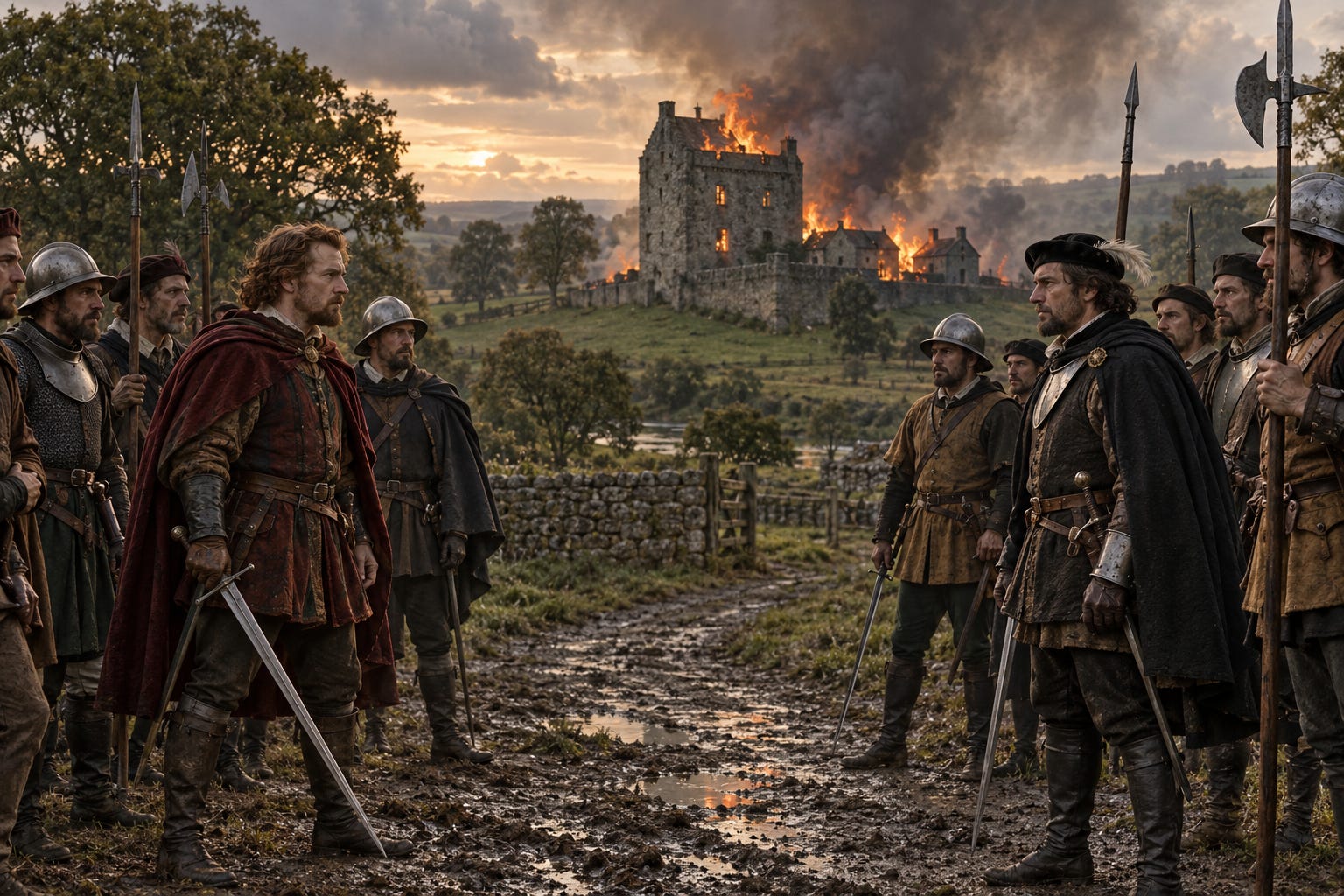
In 1528, the violence reached Eglinton itself when Cunningham attackers burned the family’s castle. The assault struck at a residence that also served as a centre of household management, estate business, and noble authority. Its destruction challenged the earl’s ability to protect the place most closely associated with his power. Accounts also record the loss of charters and other legal papers, followed by a royal grant renewing his titles to land. In a society where written documents supported possession, burning an archive could have consequences long after the flames had gone out.
The castle fire did not settle the underlying dispute. Rebuilding a residence could restore its usefulness, but it could not remove competing claims to offices or the memory of an attack. Nor should the decades between the burning and the fourth earl’s murder be imagined as uninterrupted warfare between everyone bearing the two surnames. These were networks of nobles, relatives, tenants, and allies whose interests did not always match. Negotiation and litigation existed alongside intimidation, with fresh injuries capable of undoing attempts at agreement.
The young earl’s murder in April 1586 became the feud’s most memorable event. Accounts connect the attack with the Stewarton area and the Annick Water, but they differ over his journey, the size of the attacking party, and the precise sequence of the killing. David Cunningham of Robertland was among those implicated. One narrative describes Robertland gaining the earl’s confidence before turning against him, presenting the murder as a betrayal of personal trust. Such differences matter because a secure historical event can acquire a much less secure collection of dramatic details.
The best-known tradition places a meal at Lainshaw before the ambush. In this version, a white napkin displayed from the house signals that the earl is leaving, allowing the waiting attackers to act. It is an effective story because an ordinary household object becomes an instrument of betrayal. However, versions disagree about the woman’s identity and role, and the signal should be presented as tradition rather than established fact. The murder requires no invented dialogue or certainty about a window to reveal the danger surrounding the young earl.
Revenge carried the consequences beyond the place of the killing. Montgomery supporters pursued those associated with the attack, and the struggle exposed other households and estates to reprisals. For tenants and lesser landholders, a noble family’s demand for justice could mean insecurity, damaged property, and interrupted livelihoods. The Crown tried to contain such conflicts through legal proceedings and financial guarantees of peaceful behaviour. Making powerful men and their supporters answerable for renewed violence was one way to raise the cost of keeping a feud alive. The losses were widely shared.
The wider Montgomery story gives these events their meaning. The Complete History of Clan Montgomery follows the family from its early Scottish roots through the rise of Eglinton, religious conflict, military service, migration, and the growth of a worldwide clan community. The Cunningham feud forms one part of that longer history, showing how land, royal service, and family ambition could bring both opportunity and danger. For readers exploring Montgomery ancestry or Scotland’s past, the book connects the famous episodes with the institutions and choices behind them. These neighbours became enemies because their power overlapped, and successive generations found the costs of surrendering it difficult to accept.
References
Anderson, W. (1860–1863). The Scottish nation; or, The surnames, families, literature, honours, and biographical history of the people of Scotland (Vols. 1–3). A. Fullarton & Co.
Bagtown Clans. (2026). The complete history of Clan Montgomery. Rigby Publishing.
Chambers, R. (1859). Domestic annals of Scotland from the Reformation to the Revolution (2nd ed., Vol. 1). W. & R. Chambers.
Paul, J. B. (Ed.). (1907). The Scots peerage: Founded on Wood’s edition of Sir Robert Douglas’s Peerage of Scotland (Vol. 4). David Douglas.