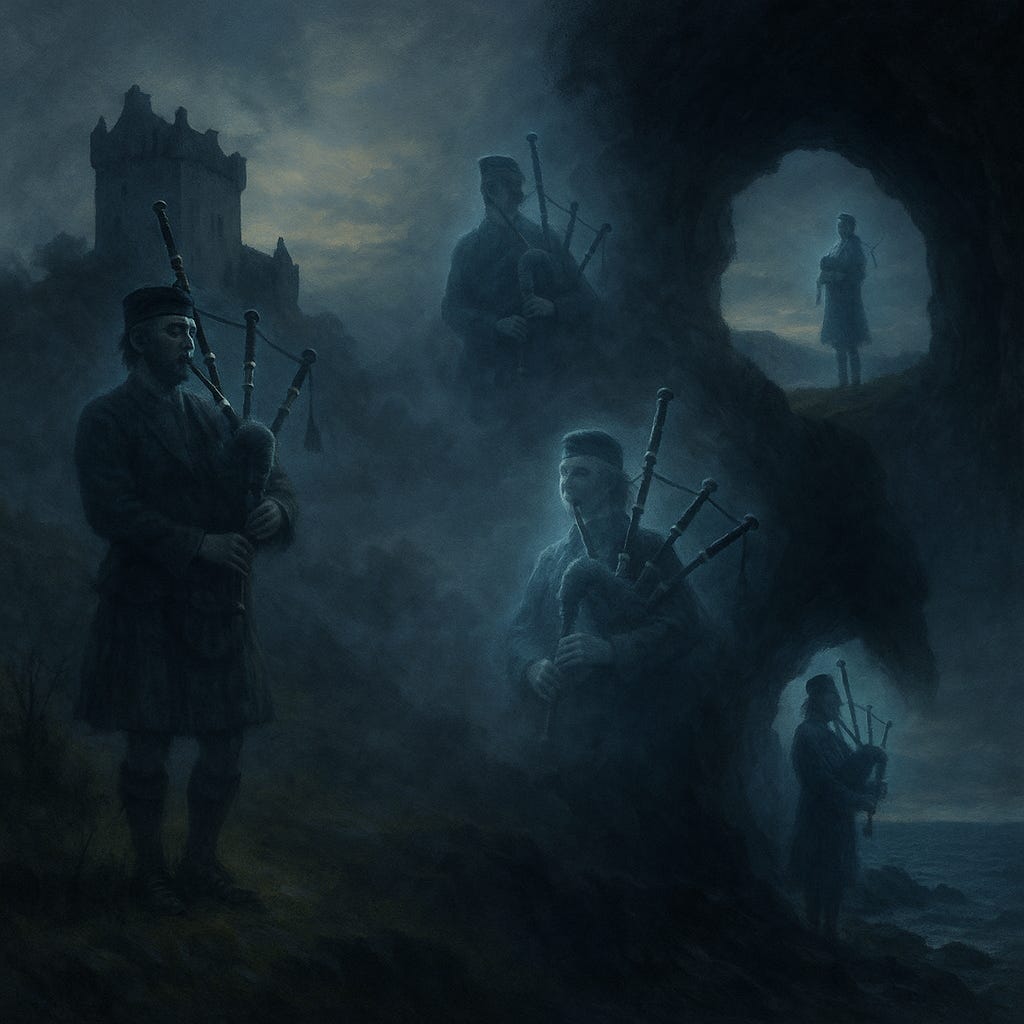
Few sounds carry the soul of Scotland quite like the pipes. In mist and memory, the drone of a chanter seems to come from nowhere — and everywhere. Across the centuries, stories tell of pipers who vanished beneath castles, drowned beneath cliffs, or entered caves never to return. Yet their music is still heard, carried by wind and water.
The “ghost piper” is more than a campfire tale. He is the voice of clan tradition, of courage and warning, of a culture that has always known how thin the veil can be between this world and the next.

The Lost Piper of Edinburgh Castle
Beneath Edinburgh Castle runs a network of ancient tunnels once said to connect to Holyrood Palace. When they were rediscovered, a young piper was sent to explore, his music marking his progress for those above. Halfway along the Royal Mile, the tune suddenly stopped — and the boy was never seen again. On still nights, residents claim to hear his pipes faintly playing below the cobblestones.
There’s no single clan tied to the legend, but its setting — Scotland’s seat of kings — reminds us that even in the capital, mystery sleeps just beneath the streets.
The Phantom Piper of Duntrune Castle
In Argyll, Duntrune Castle overlooks Loch Crinan — once caught between Clan Campbell and Clan MacDonald. During a siege, a MacDonald piper was captured by the Campbells. When he heard his chief approaching to reclaim the castle, he played a warning tune with a hidden signal. The Campbells realized his trick, cut off his hands, and left him to die. Yet the ghostly notes of his lament are still heard through the halls.
This legend is a haunting memorial to Highland loyalty: a piper who kept faith with his clan even as his own blood was spilled.
The Ghost Piper of Culzean Castle
The Kennedys of Culzean Castle once laughed at talk of haunted sea caves. To prove them wrong, their piper and his dog ventured below the cliffs, playing a lively march as they went. The tune faltered, stopped, and the dog returned — shivering and hairless. On the eve of Kennedy weddings, people still hear pipes near “Piper’s Brae.”
This Ayrshire tale binds family, celebration, and superstition: even joy, in Scotland, must sometimes make room for the otherworldly.
The Phantom Piper of Clanyard Bay
Down in Galloway, at the Cove of Grennan, a piper and his dog explored tunnels said to run beneath the sea to Clanyard Bay. Fishermen heard his music echoing under the waves — until it ceased. The dog emerged terrified, but the man was lost forever. Locals say his tune still drifts from the cliffs on misty nights.
This lowland tale may not name a specific clan, but the piper stands for every bold soul who sought to pierce the boundaries between worlds — and paid the price.
The Piper of Uamh an Òir — The Cave of Gold (Isle of Skye)
In northern Skye, the basalt cavern known as Uamh an Òir — the Cave of Gold — is home to one of Scotland’s eeriest piping stories. A piper, said to be from the MacArthur piping line, entered the cave in search of fairy treasure. He played as he went deeper, his melody growing faint until it vanished altogether. His dog staggered out hairless, his master gone. Some nights, islanders still hear music rising from the rocks.
Here the piper’s bravery becomes a parable: the musician who dares to enter the fairy realm, bearing only his tune as protection.
The Piper of Kinnaird Head (The Wine Tower, Fraserburgh)
At the sea-beaten Wine Tower of Kinnaird Head, the Frasers’ stronghold, tragedy mingled love and song. A Fraser daughter fell in love with her father’s piper. When he tried to reach her through the sea cave below, a storm rose — his pipes could be heard through the crashing waves as he drowned. The girl flung herself from the tower in grief. To this day, fishermen report phantom bagpipes in the spray.
The clan connection is clear: the Frasers of Philorth, who built the tower, carry a legend where love’s melody outlasted death itself.
The Blind Piper of Culross Abbey
In the abbey ruins of Culross, Fife, townsfolk tell of a blind piper who entered a secret tunnel said to lead to buried treasure. His dog followed. As he advanced, people above ground could hear his tune — until the pipes stopped abruptly. The dog reappeared, trembling and hairless, but the piper never came back.
Culross lies near lands once under the Frasers of Fife and the Earls of Dunfermline. The story’s mixture of courage and loss mirrors the island versions from Skye — the same motif, transposed to Lowland stone.
The Smothered Piper of St Andrews
On the East Neuk, the university town of St Andrews guards another legend. The “Smothered Piper of the West Cliffs,” recorded by William T. Linskill in St Andrews Ghost Stories, tells of a piper who entered the sea caves below the Principal’s House. The cliffs collapsed and buried him alive. Even today, his music is said to pulse faintly beneath the surf.
Though not linked to any one clan, the Smothered Piper reminds us that even scholars’ stones may rest upon ancient echoes.
The Piper’s Cave of Campbeltown (Beinn Ghuilean, Kintyre)
Above Campbeltown lies Beinn Ghuilean, where another ghostly piper supposedly played his last tune. One stormy night he sought refuge in a cave, filling the glen with mournful notes. When the echoes faded, only one of his shoes was found by the entrance. Some versions name him a retainer of the MacAlisters or MacNeills, both Kintyre clans with long piping traditions.
Hikers still pause near Piper’s Cave when the wind hums strangely through the rock, half-believing they hear his tune.
Why So Many Ghost Pipers?
So why do Scotland’s hills and harbours teem with spectral pipers?
Part of the answer lies in the instrument itself. The pipes were once the voice of the clan — the herald of war, the signal of gathering, the soundtrack of both victory and mourning. When a piper vanished or died, his music seemed too full of life to end; it had to echo on somewhere.
Most of these legends unfold in liminal places: caves, tunnels, and cliffs where land meets sea, or life brushes against death. Others are tied to clan loyalty and sacrifice, echoing centuries of conflict and devotion. The ghost piper, then, is not merely a spirit — he is Scotland’s collective memory made sound.
Echoes That Never Fade
From Duntrune to Culzean, from Skye to St Andrews, these phantom musicians play on in wind and story alike. Their tunes are laments, warnings, love songs, and memories — the voice of a land that has never truly fallen silent.