Discover the full story of Clan MacLean and explore your Scottish heritage—get your digital copy of The Complete History of Clan MacLean here: https://fairbairncrests.com/products/the-complete-history-of-clan-maclean
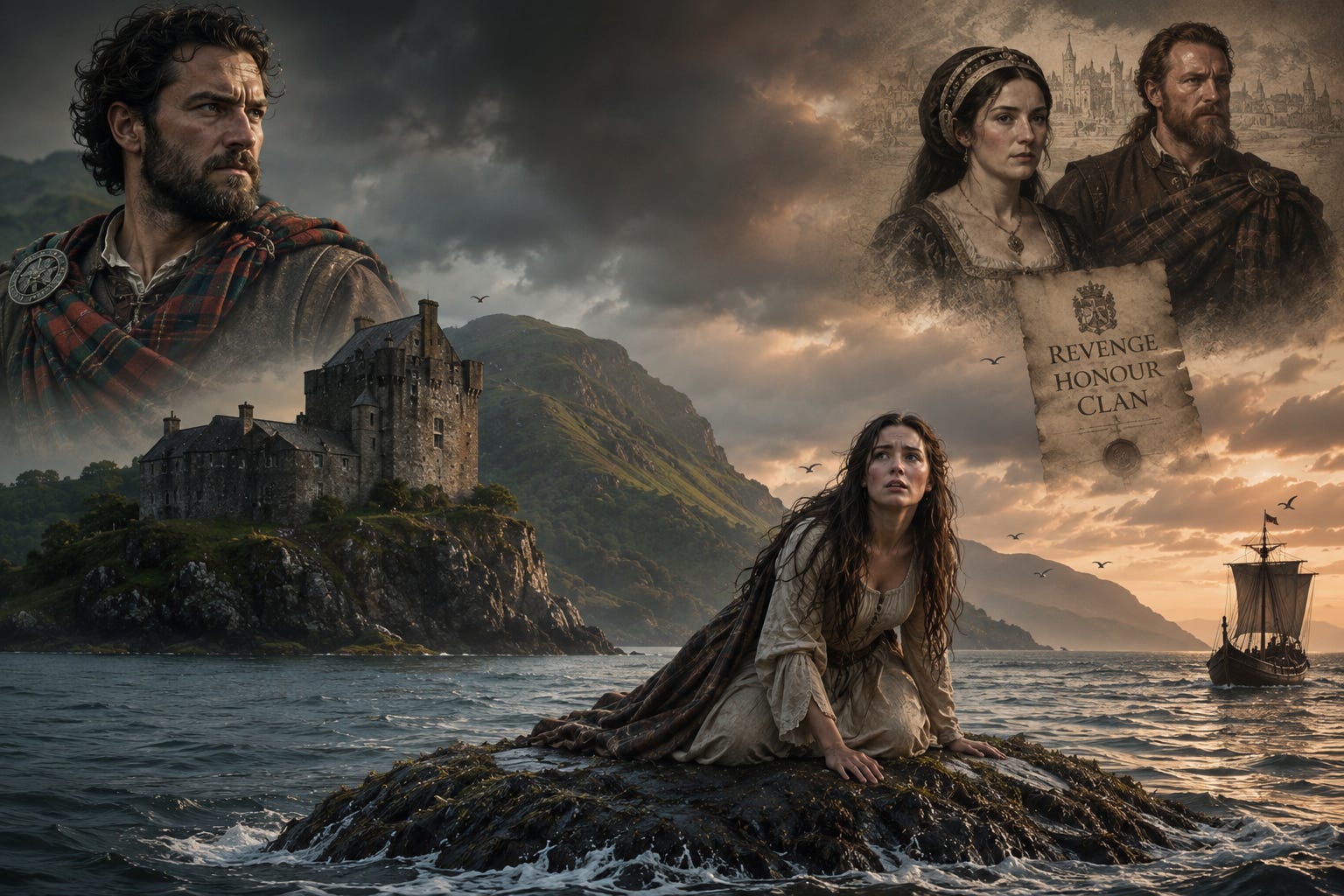
Few stories from the Scottish Highlands combine romance, betrayal, attempted murder, clan rivalry, and revenge as dramatically as the legend of the Lady’s Rock. The tale belongs to the history of Clan MacLean and centres on Lachlan Cattanach MacLean of Duart and his wife, Catherine Campbell, a marriage that was supposed to strengthen two of the most powerful families in the western Highlands. Instead, according to tradition, their union became the setting for one of Scotland’s most chilling clan legends. Catherine was allegedly taken from Duart Castle, abandoned on a lonely tidal rock in the Sound of Mull, and left there to die as the sea rose around her.
The story begins during an exceptionally unstable period in Scottish history. The death of King James IV at the Battle of Flodden in 1513 had thrown Scotland into another royal minority, weakening central authority and creating opportunities for powerful regional families to settle disputes on their own terms. In the western Highlands and islands, Clan MacLean possessed significant strength around Mull and the surrounding seaboard, while the Campbells of Argyll were steadily expanding their political influence. Lachlan Cattanach MacLean lived in a world where marriage could be every bit as important as warfare in determining whether a clan gained allies or dangerous enemies.
Lachlan’s marriage to Catherine Campbell was therefore far more than a private relationship between two people. Catherine belonged to the immensely influential Campbell family, and such a union had the potential to reduce hostility between the Campbells and the MacLeans while binding their interests together. Highland marriages among leading families regularly served as diplomatic agreements, creating networks of obligation that could protect lands, secure political support, and discourage attack. Unfortunately, the marriage of Lachlan and Catherine became remembered not for the peace it created, but for the extraordinary story of how violently it supposedly collapsed.
According to the traditional account, Lachlan eventually decided that he wanted Catherine dead. Rather than murdering her openly at Duart, he supposedly arranged for her to be taken onto the waters of the Sound of Mull and left on a tidal skerry that would disappear beneath the water when the tide returned. The intention was simple and terrifying: Catherine would be stranded with no means of escape, the rising sea would kill her, and her death could be presented as an accident. The isolated rock became permanently associated with the story and came to be known as the Lady’s Rock.
It is easy to understand why the legend has survived for centuries. The setting could hardly be more dramatic, with the dark waters surrounding Mull, the towers of Duart nearby, and a solitary figure trapped on a rock while the tide steadily rises. In later retellings, Catherine waits helplessly for the water to claim her as those responsible for abandoning her sail away believing the deed accomplished. The story possesses all the elements of a Highland tragedy, but its most memorable twist is that Catherine does not die.
Tradition says that passing boatmen discovered Catherine and rescued her before the rising water covered the rock. Instead of returning openly to Duart, she was supposedly taken to safety and eventually reunited with her Campbell relatives. Lachlan, meanwhile, believed that his wife was dead. What followed became the most theatrical part of the entire legend and helped transform what might otherwise have remained a local tale into one of the best-known stories associated with Clan MacLean.
According to later versions, Lachlan travelled to Edinburgh and presented himself before Catherine’s family as a grieving widower. He supposedly wore mourning clothes and behaved as though his wife had died in an unfortunate accident, expecting the Campbells to accept his account. The performance ended spectacularly when Catherine herself appeared before him, alive and safely among her relatives. The image of the MacLean chief suddenly confronting the woman he believed he had successfully murdered is the scene that gives the legend much of its enduring power.
Yet this is precisely where history and folklore must be carefully separated. The Lady’s Rock story was preserved through clan tradition and later historical accounts, particularly works written centuries after Lachlan and Catherine lived. There is no surviving contemporary document that securely proves Catherine was deliberately abandoned on the rock or that Lachlan attempted to murder her in this manner. The absence of such evidence does not prove that nothing happened, but it prevents historians from presenting every dramatic element of the traditional story as established fact.
That distinction is important because Highland history was preserved through more than government documents and legal records. Gaelic communities maintained memories through genealogists, storytellers, family traditions, poetry, and oral accounts, allowing stories to survive long after the people involved had died. Over generations, real political struggles could become concentrated into unforgettable personal episodes in which betrayal, courage, revenge, and family honour carried the meaning of a much more complicated conflict. The Lady’s Rock may therefore preserve a genuine memory of serious hostility within the marriage even if the exact attempted drowning cannot now be proved.
What can be documented makes the legend considerably more intriguing rather than less so. Lachlan Cattanach really did become entangled in bitter conflict with the Campbell interest during a period when the Campbells were becoming increasingly influential throughout the western Highlands. His relationship with Catherine belonged to a much larger political struggle involving land, alliances, royal authority, and the survival of MacLean power. Most significantly, Lachlan himself eventually met a violent death connected directly with Catherine’s family.
In 1523, Lachlan Cattanach was killed in Edinburgh by Sir John Campbell of Cawdor, Catherine Campbell’s brother. Unlike the attempted drowning on the Lady’s Rock, Lachlan’s violent death belongs much more securely to the historical record. The killing occurred while the MacLean chief was in the capital under circumstances in which he apparently expected a degree of security, making the episode especially significant in later interpretations of the feud. A chief who had supposedly attempted to kill a Campbell woman was ultimately killed by that woman’s own brother, creating an almost irresistible narrative of revenge.
It is tempting to connect the two events with a perfectly straight line: Lachlan tried to murder Catherine, Catherine survived, her brother learned what had happened, and he eventually avenged her. That is essentially the dramatic structure preserved by the legend, but history is rarely so tidy. Lachlan Cattanach and the Campbells operated within a dangerous political environment in which personal quarrels overlapped with territorial competition and national politics. Sir John Campbell of Cawdor therefore had reasons to regard Lachlan as an enemy that extended beyond whatever may have occurred within his sister’s marriage.
The story also reveals something important about the changing balance of power in the Highlands. The MacLeans had risen to prominence through their service to the Lords of the Isles and had established Duart as one of the great maritime strongholds of the Inner Hebrides. By the early sixteenth century, however, the old political order associated with the Lordship of the Isles had been dismantled, and the Scottish Crown was attempting to impose greater control over the west. The Campbells were particularly successful at operating within this new system, combining royal favour, legal authority, marriage, land acquisition, and military strength to expand their influence.
Lachlan Cattanach therefore inherited a difficult position. Maintaining MacLean independence required the chief of Duart to negotiate with the Crown while simultaneously protecting his clan’s interests from ambitious neighbouring families. Marriage to Catherine Campbell may originally have offered a practical solution, creating a bridge between two competing powers. If relations between husband and wife truly deteriorated as severely as tradition claims, the collapse of their marriage would have carried consequences far beyond the walls of Duart Castle.
The Lady’s Rock itself became a physical anchor for the story. Clan legends become especially powerful when they are attached to recognisable landscapes because visitors can stand beside the sea, look toward the islands, and imagine the event unfolding. Castles, battlefields, burial grounds, caves, islands, and rocks turn oral history into something almost tangible. In the case of the Lady’s Rock, the surrounding waters provide a haunting stage upon which generations have reconstructed Catherine Campbell’s supposed ordeal.
For modern readers, the most interesting question may therefore not be whether every detail happened exactly as later storytellers described it. The more revealing question is why the story survived and why generations of MacLeans, Campbells, historians, and visitors continued repeating it. It captured the dangerous mixture of marriage and politics that characterised Highland aristocratic life, while reducing a complicated regional rivalry to an intensely human drama. Catherine becomes the survivor, Lachlan the doomed chief, and the Lady’s Rock the enduring symbol of betrayal.
The legend also offers a valuable warning about how Scottish clan history should be approached. Some famous stories are supported by contemporary charters, legal proceedings, government correspondence, or other documentary evidence, while others first appear clearly in much later traditions. Treating every colourful story as literal fact diminishes rather than strengthens the historical record. The most rewarding approach is to preserve the legends while identifying honestly where documentary certainty ends and inherited memory begins.
That balance is particularly important in the history of Clan MacLean, whose past contains warfare, maritime power, political alliances, dramatic personalities, and centuries of oral tradition. The Lady’s Rock deserves to remain part of that history because the story itself became part of MacLean cultural memory, whether every detail can be proven or not. At the same time, the documented assassination of Lachlan Cattanach demonstrates that the underlying hostility was not merely the invention of later storytellers. Behind the legend stood a genuinely dangerous world in which marriages between powerful clans could fail spectacularly and political rivalry could end in bloodshed.
Nearly five centuries later, the Lady’s Rock continues to fascinate because the mystery has never completely disappeared. Perhaps Catherine Campbell really was abandoned to the tide and survived through an extraordinary rescue, or perhaps later generations transformed a bitter marital and political quarrel into a more dramatic tale. What is certain is that Lachlan Cattanach’s marriage became entangled with the broader struggle between MacLean and Campbell power, and that Lachlan ultimately died violently at the hands of Catherine’s brother. The legend survives somewhere between those documented facts, carried through generations by the landscape and memory of the Hebrides.
For readers who want to go beyond this single remarkable story, The Complete History of Clan MacLean follows the clan from its earliest origin traditions through the rise of Duart and Lochbuie, the Lords of the Isles, Harlaw, the Islay conflicts, the Civil Wars, Jacobitism, the loss and eventual recovery of Duart, and the creation of the worldwide MacLean diaspora. The Lady’s Rock is only one episode in a history filled with political ambition, warfare, family rivalry, migration, legend, and survival. Understanding the full history of Clan MacLean reveals the complicated world behind stories such as Catherine Campbell and the lonely rock that still bears her memory.
References
Gregory, D. (1836). The history of the Western Highlands and Isles of Scotland, from A.D. 1493 to A.D. 1625. William Tait.
MacLean, J. P. (1889). A history of the Clan MacLean from its first settlement at Duard Castle, in the Isle of Mull, to the present period: Including a genealogical account of some of the principal families together with their heraldry, legends, superstitions, etc. Robert Clarke & Co.
Maclean-Bristol, N. (1995). Warriors and priests: The history of the Clan Maclean, 1300–1570. Tuckwell Press.
Monro, D. (1961). Monro’s Western Isles of Scotland and genealogies of the clans, 1549 (R. W. Munro, Ed.). Oliver and Boyd.
Seneachie. (1838). An historical and genealogical account of the Clan Maclean, from its first settlement at Castle Duart, in the Isle of Mull, to the present period. Smith, Elder and Co.
Sinclair, A. M. (1899). The Clan Gillean. Haszard and Moore.