Uncover the epic history and origin of Clan Kerr - https://fairbairncrests.com/products/the-complete-history-of-clan-kerr-digital-edition
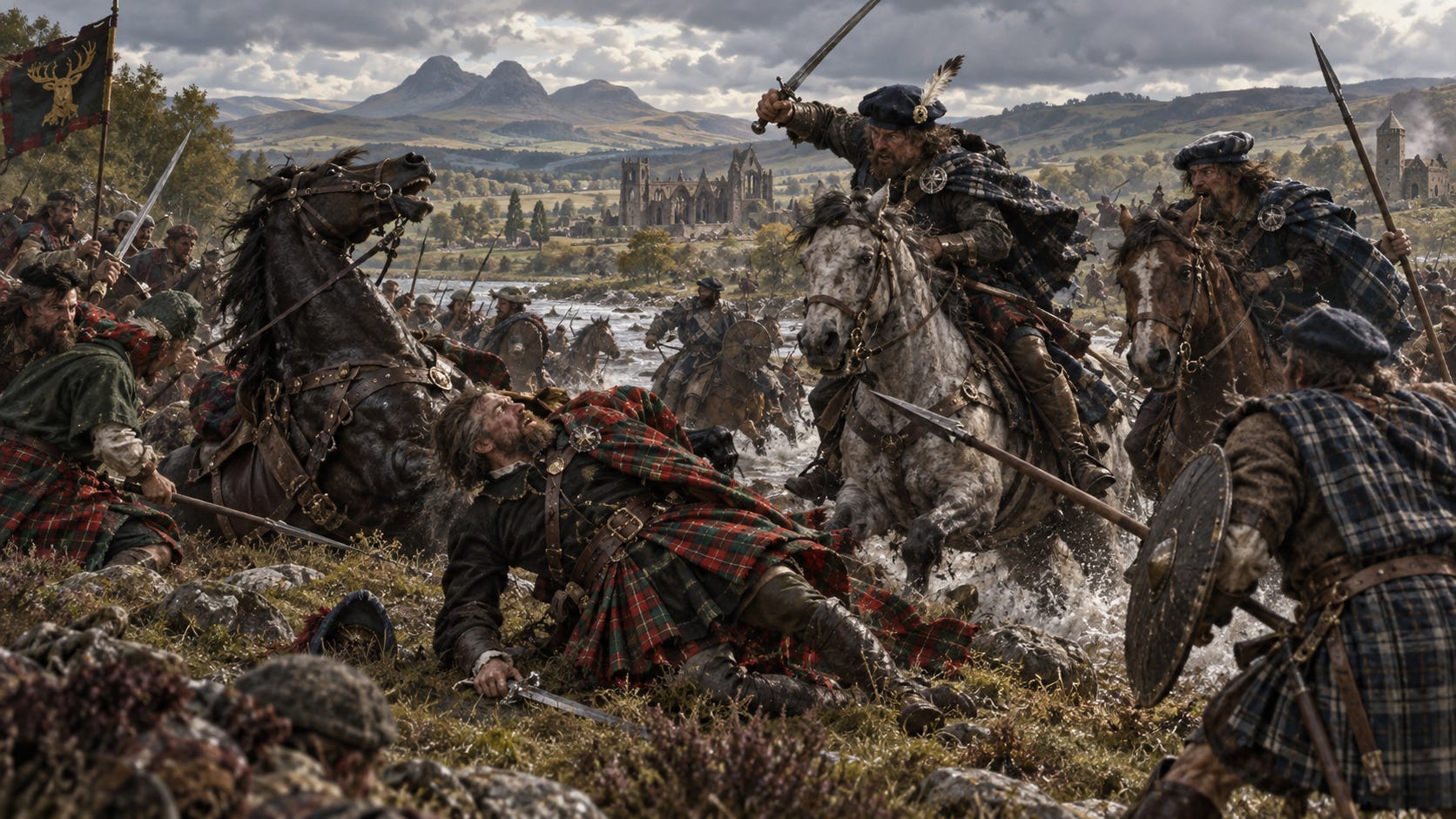
In the summer of 1526, the road near Melrose became the scene of a violent clash that would echo through Border history for decades. King James V was still a young monarch, and real power rested heavily with men who controlled access to him. Walter Scott of Buccleuch attempted to break the influence of the Earl of Angus and the Douglas faction by confronting the royal party near Darnick, close to Melrose. Among those defending the king’s company was Sir Andrew Kerr of Cessford. By the end of the fighting, Buccleuch’s attempt had failed, but Sir Andrew Kerr was dead.
The encounter was more than a local skirmish between two Border families. It was tied to the wider struggle over who would control James V and, through him, the government of Scotland. Later tradition remembered the death of Cessford as the beginning of a bitter Kerr–Scott feud, and the killing gave the Kerr family a powerful grievance. In Border society, the death of a leading laird could affect inheritance, alliances and the expectations of relatives and followers. Yet what followed was not one uninterrupted private war lasting twenty-six years.
Sir Andrew’s son Walter succeeded to Cessford and inherited far more than land. He inherited the standing of the house, its responsibilities and the memory of his father’s death. It is tempting to imagine the Kerrs immediately dedicating themselves to revenge, but the record shows something more complicated. Kerrs and Scotts continued to take part in government, negotiation, marriage arrangements and estate business. Feud existed beside ordinary political and family life rather than replacing it.
The relationships among the Border houses make that complexity clearer. Walter Kerr of Cessford married Isobel, a daughter of Andrew Kerr of Ferniehirst, while John Kerr of Ferniehirst married Catherine, a daughter of the Cessford laird killed in 1526. These marriages tightened connections between the principal Kerr houses even while rivalries continued. Ferniehirst would later become closely connected by marriage to the Scotts of Buccleuch as well. Blood ties could therefore cross divisions that later histories sometimes present as permanent.
The Scottish Crown had a strong interest in stopping private quarrels from becoming permanent warfare. Powerful lairds could raise men, administer justice and help enforce order, but those same resources made them difficult to control when grievances turned violent. Government used summonses, warding, remissions, bonds and negotiated settlements to restrain them. A feud therefore moved through legal as well as violent stages. Revenge was memorable, but paperwork and negotiation were just as important to how these disputes developed.
The political world also changed after Melrose. James V escaped Douglas control in 1528, alliances shifted and Border offices changed hands. Kerrs and Scotts remained deeply involved in the government of the Marches, sometimes cooperating and sometimes opposing one another. That is why the idea of a single continuous feud can be misleading. The grievance endured, but the circumstances around it kept changing.
The Rough Wooing of the 1540s added another danger. English armies and garrisons placed Border families under pressure, forcing them to think about survival as much as inherited hostility. Ferniehirst was occupied and later recovered, estates were damaged, and local lords sometimes submitted when the alternative was destruction. Old feuds did not disappear, but they competed with war, royal policy and the need to preserve households. Border politics rarely allowed one grievance to dominate every decision.
By 1552, however, the old hostility again erupted with deadly consequences. Sir Walter Scott of Buccleuch was killed in Edinburgh during a nocturnal encounter involving Kerrs led by Walter of Cessford. The killing took place not in a remote Border valley but in the capital, close to central government. What could be remembered as revenge for Sir Andrew Kerr’s death in 1526 now created a fresh legal crisis. The Crown could not easily ignore a homicide involving some of the most powerful men in southern Scotland.
The Kerrs soon faced the possibility that punishment might threaten both their lives and estates. They petitioned the government, describing the killing as an unhappy occurrence and seeking terms that would preserve their persons and inheritances. Banishment to France followed for some of those involved, along with later pardons and remissions. Yet a royal remission settled the Crown’s right to punish particular offences; it did not automatically end the grievance of Buccleuch’s relatives. Public law and private reconciliation were connected, but they were not the same thing.
The years after Buccleuch’s death show why “feud” should not be treated as constant warfare. Kerrs were ordered into ward, placed under supervision and drawn into agreements intended to prevent renewed bloodshed. At the same time, they continued to hold offices and participate in the same political world as families with whom they had recently been in violent conflict. Settlements could reduce immediate danger without erasing memory. Formal peace did not require families to forget who had been killed and why.
Marriage eventually became one of the strongest tools for reshaping those relationships. Thomas Kerr of Ferniehirst married Janet Scott in 1569; she was the sister of the contemporary Buccleuch and a granddaughter of the laird killed in 1552. The marriage did not erase every old grievance, but it gave reconciliation a family structure that legal documents alone could not provide. Agreements in the late 1560s sought to settle remaining claims connected with earlier bloodshed, while public gestures of apology gave those settlements visible meaning. Kerrs and Scotts could now be tied by marriage even while the memory of violence remained part of their shared history.
The Kerr–Scott feud is therefore best understood as a chain of conflicts, responses and settlements rather than a single war stretching from 1526 to 1552 and beyond. The death of Sir Andrew Kerr near Melrose created a grievance powerful enough to shape later memory, and the killing of Sir Walter Scott in Edinburgh supplied a dramatic second act. Between those events lay changing governments, marriages, military crises, alliances and repeated attempts to restore workable relations. The story becomes more human when told this way because it shows how families could carry anger across generations while still being forced to live, marry, govern and negotiate with one another.
That tension is one reason the history of Clan Kerr remains so compelling. The Border world was not divided neatly into permanent friends and enemies, and neither the Kerrs nor the Scotts acted as unchanging political blocs. Their decisions were shaped by land, family, office, royal service and the dangers of the moment. The bloodshed became famous because violence was memorable, but settlement was just as important to what happened next. Readers who want the wider story of Cessford, Ferniehirst and the Scottish Borders can explore these events in much greater depth in The Complete History of Clan Kerr.
References
Fraser, W. (1894). Report on the muniments of His Grace the Duke of Roxburghe at Floors Castle in the county of Roxburgh. In Historical Manuscripts Commission, Fourteenth report, appendix, part III (pp. 1–55). Her Majesty’s Stationery Office.
Paul, J. B. (Ed.). (1908). The Scots peerage (Vol. 5). David Douglas.
Rigby Publishing. (2026). The complete history of Clan Kerr. Rigby Publishing.