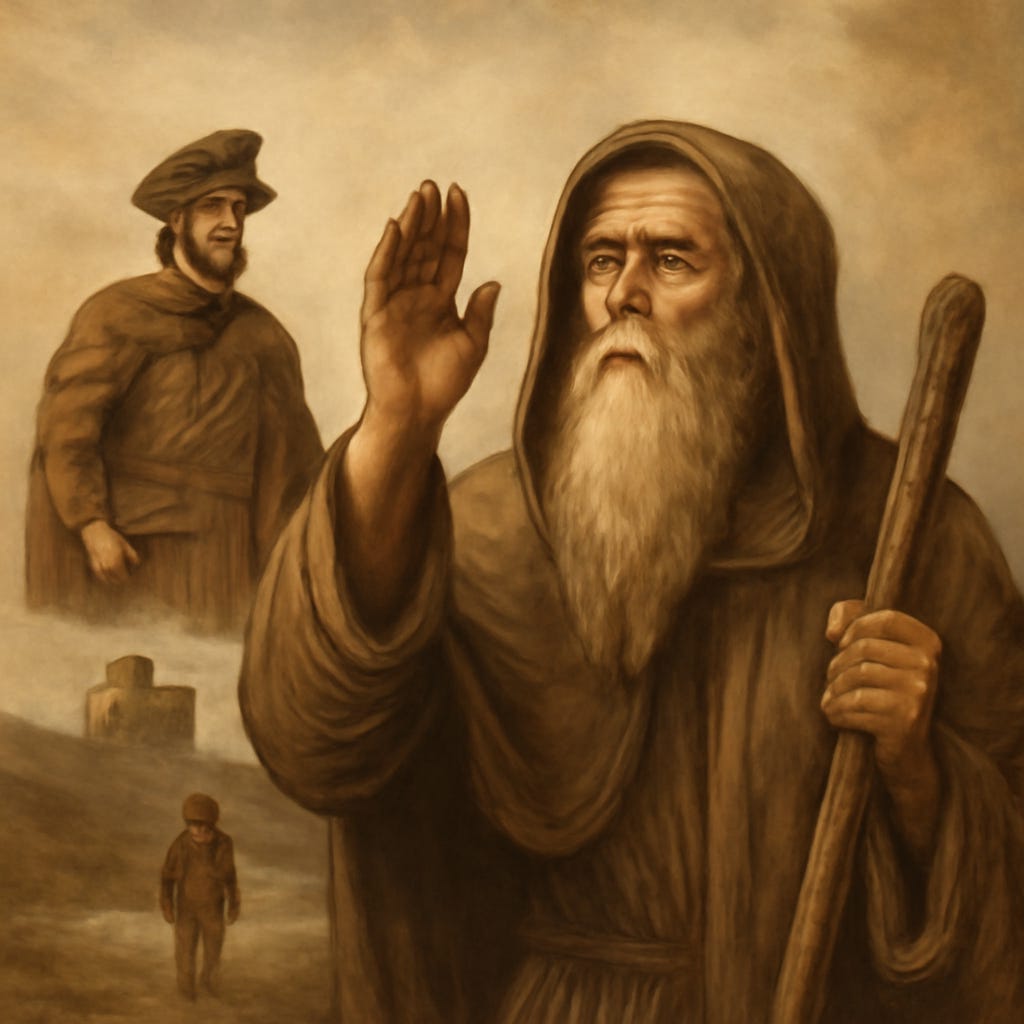
The Highland Prophets
Exploring the Secrets of Scottish Seers and Their Clans

From rugged glens to ancient seats of power, the Scottish Highlands and Islands have long held stories of those endowed with the gift of prophecy or “second sight” — individuals who claimed to peer beyond the veil of time and glimpse what others could not. For many of the great clans of Scotland, these seers were not simply oddities or footnotes in folklore; they were sometimes entwined with the fate of the clan itself. Their visions shaped how clans saw themselves, how feuds and family fortunes were narrated, and how the spiritual world and material world intersected.
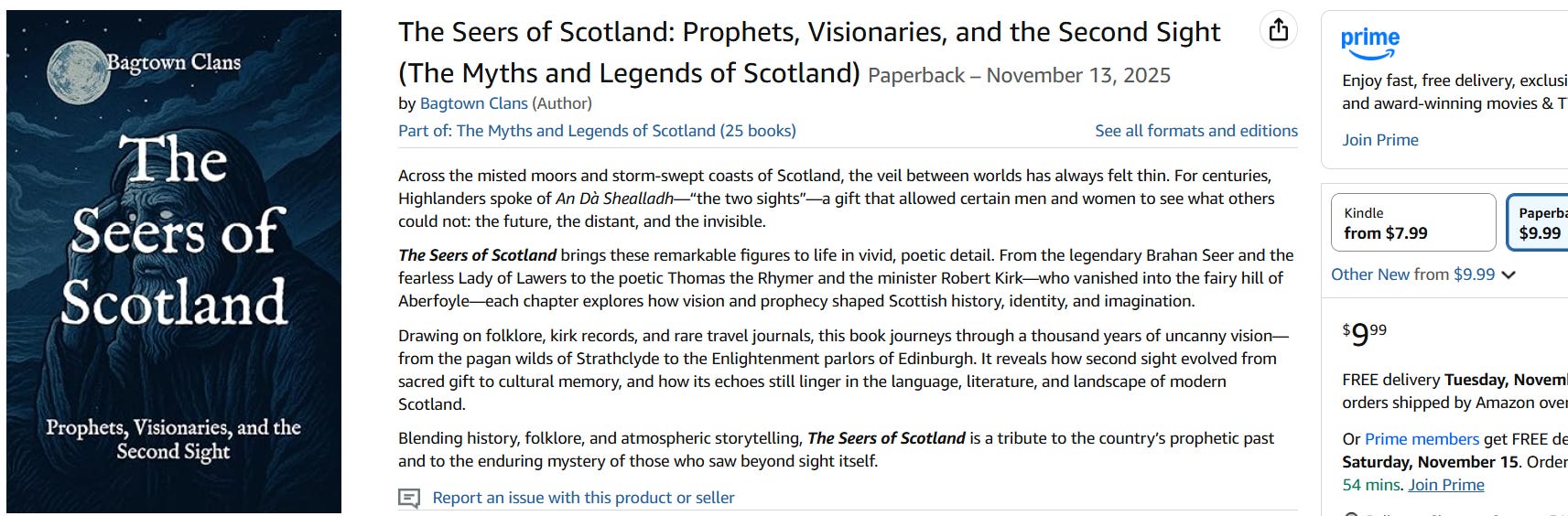
Explore the lives of Scotland’s 14 most famous seers, from prophets to visionaries, and uncover their captivating tales in The Seers of Scotland: Prophets, Visionaries, and the Second Sight, available now on Amazon.
What is “second sight” and why clans paid attention
In Highland folklore the “second sight” (sometimes called the “two sights”) is described as the ability to see both this world and a parallel dimension of spirits, omens or future events. As one Highland‑era treatise puts it, the second sight involves “seeing something that is to happen, both at a distance of time and place.” Importantly, the gift was rarely treated as a comfortable blessing; rather, seers often regarded it as a burden and even a misfortune.
Clans, whose identity was deeply bound to lineage, land, honour and seasonal rhythms, found in these seers something more than curiosity: a kind of spiritual barometer of their fate. If a seer uttered that a moor would run red, or that a stronghold would stand empty, clan chiefs and their followers paid heed—whether out of fear, hope, or the need to interpret change in a tumultuous landscape.
The clan and the seer: partnership, warning and myth
Take, for example, the storied case of the legendary seer associated with the Clan Mackenzie: the so‑called Brahan Seer (Gaelic: Coinneach Odhar). According to oral tradition, he purportedly served as a labourer on the Brahan estate (seat of the Seaforth line of the Mackenzies) and was credited with many prophecies about the family, their lands, and the wider Highlands. Among his most dramatic: the moor of Drumossie (the site of the Battle of Culloden) would be stained with Highland blood, the Mackenzies would lose their lands, and an estate would stand cold and empty.
Whether or not each prediction truly came to pass, the story reinforced the idea that a seer’s vision could become interwoven with clan destiny. In one version of the tale, it is said that the Seer’s prophecy prompted anxiety in the Seaforth line, and the Seer was ultimately executed at Chanonry Point. Thus the relationship between clan and seer could be at once reverential, fearful, strategic and tragic.
Beyond Mackenzie: the wider clan‑seer matrix
The Mackenzie‑Brahan case is striking, but not unique. The tradition of seers and second sight recurs across many clan regions. For instance, the Lady of Lawers, thought to be Mary Campbell of Lawers near Loch Tay, is remembered for a string of prophecies affecting land‑, church‑ and clan‑ fortunes in the Breadalbane‑region. Her predictions included the roof ridging stones of the church being washed away, an ash tree planted beside the church growing to split the building, a “ship driven by smoke” (interpreted as steam‑ship) sinking in Loch Tay, and a predicted depopulation of the land.
In that case the connection is less overtly military or clan‑political than in the Mackenzie example — yet still the seer’s visions touched the ground of land‑holding, church, clan and community. The seer’s role here was less an advisor to a chief and more a kind of spiritual sentinel for a region and its kin.
Why clans turned to seers in changing times
Several factors help explain why the seers became important—even indispensable—within the clan world:
Uncertainty and change: The 17th and 18th centuries in Scotland were fraught — wars, Jacobite risings, the Clearances, agrarian transformation, religious upheaval. A seer’s vision provided a narrative for that turbulence.
Legitimacy and lineage: Clans affirmed their identity through landed possession, hereditary chiefship and continuity. A seer could articulate a destiny (positive or negative) that gave weight to those claims.
Spiritual cosmology: In a Gaelic cultural context, the worlds of spirits, visions and other‑worldly forces were not fringe but integrated in belief. The seer functioned at the threshold of those layers.
Warning and control: In some accounts, seers warned against recklessness, hubris or external threats. In this way, they served a quasi‑counselling role for chief and clan alike.
Stories in action
1. The Mackenzie decline and the Brahan Seer’s warning
The Mackenzies, once dominant in Ross‑shire, suffered forfeiture, loss of estates and diminishing power. The Brahan Seer predicted the decline: “No future chief of the Mackenzies shall bear rule at Brahan or Kintail.” Folklore holds that Fairburn Tower (belonging to the Mackenzies of Fairburn) would see one of its chambers occupied by a cow birthing a calf (indeed local tradition reports exactly that). Whether one regards these accounts as literal prophecy or retrospective storytelling, they show how the seer‑clan story became part of the clan’s historical narrative.
2. The Lady of Lawers and her ash tree
At Lawers, the seer planted an ash tree beside the church and prophesied: “When it reaches the height of the gable the church will split asunder; when it reaches the ridge the House of Balloch will be without an heir; evil will come to him who harms the ash tree.” In the 19th century, when the tree reached those heights, indeed the church’s west loft collapsed in a storm; later the laird’s line died out; then a farmer cut the tree and died soon thereafter from a bull‑goring, his assistant madness, his horse dead. In this case the seer’s vision carried weight in local community memory and became woven into the lore of the land and clan region.
3. Clans, prophecies and the Clearances
Some accounts link seers’ warnings to the coming wave of change—the Highland Clearances — when landholders shifted, tenants were evicted, sheep replaced people. In one version of the Brahan Seer’s prophecy: “the clans will become so effeminate as to flee from their native country before an army of sheep.” That stark metaphor—an army of sheep—speaks to the transformation of Highland society and the anxiety of clans about their future in a changing economic and territorial world.
Interpreting the clan‑seer relationship
What emerges from the stories is that clans and seers seldom operated in a simple patron‑client relationship (chief pays seer for predictions). Rather, the relationship was symbiotic, complex and ambivalent. The seer gained standing and protection through the clan, and the clan gained spiritual legitimacy (or warning) through the seer. Yet the seer remained marginal in some ways—often perceived as having a burdened gift, and sometimes suffering for speaking truth to power.
Moreover, the seer’s prophecies often had a dual character: they might reaffirm the clan’s place or foretell its downfall. That dual potential made them powerful tools in clan identity‑making. The stories of fulfilled prophecy helped solidify internal cohesion (“our seer foresaw it”), while the warnings served as moral or existential checks (“heed the warning, lest our fortunes fade”).
The legacy today
In contemporary times, many Scottish clans actively engage with their histories, legend and identity. The stories of seers continue to play a role in clan gatherings, publications and heritage tourism. While academic historians may treat many of the seer accounts sceptically (noting the lack of contemporary documentation and the retrospective shape of the tales), the cultural value remains real. These seer‑clan relationships tell us a good deal about how Highland and Island society understood power, prophecy, change and the unseen world.
For the modern reader, they carry several lessons:
They remind us that in eras of uncertainty, communities often looked to voices that proclaimed vision beyond the ordinary.
They show how identity is reinforced through story: clan and seer narratives reinforce each other.
They provide a lens through which to read the cultural transition of Scotland—from clan feuds and land‑holding to modern economy, memory and heritage.
Conclusion
The old alliances between clans and seers may seem like folklore, but they were more than quaint tales. They embodied a way for clans to interpret their world, to situate themselves within a larger cosmology of time, land and fate. Whether the visions were literally accurate or not, the embeddings of prophecy in clan narratives shaped how communities told their stories, how they read change, how they remembered themselves. In that sense, the seer was as much a historian and myth‑maker as a foreteller—a mirror held up to the clan about its past, present and uncertain future.
If you’ve enjoyed exploring the fascinating world of Scottish seers, be sure to pick up a copy of The Seers of Scotland: Prophets, Visionaries, and the Second Sight, now available on Amazon.