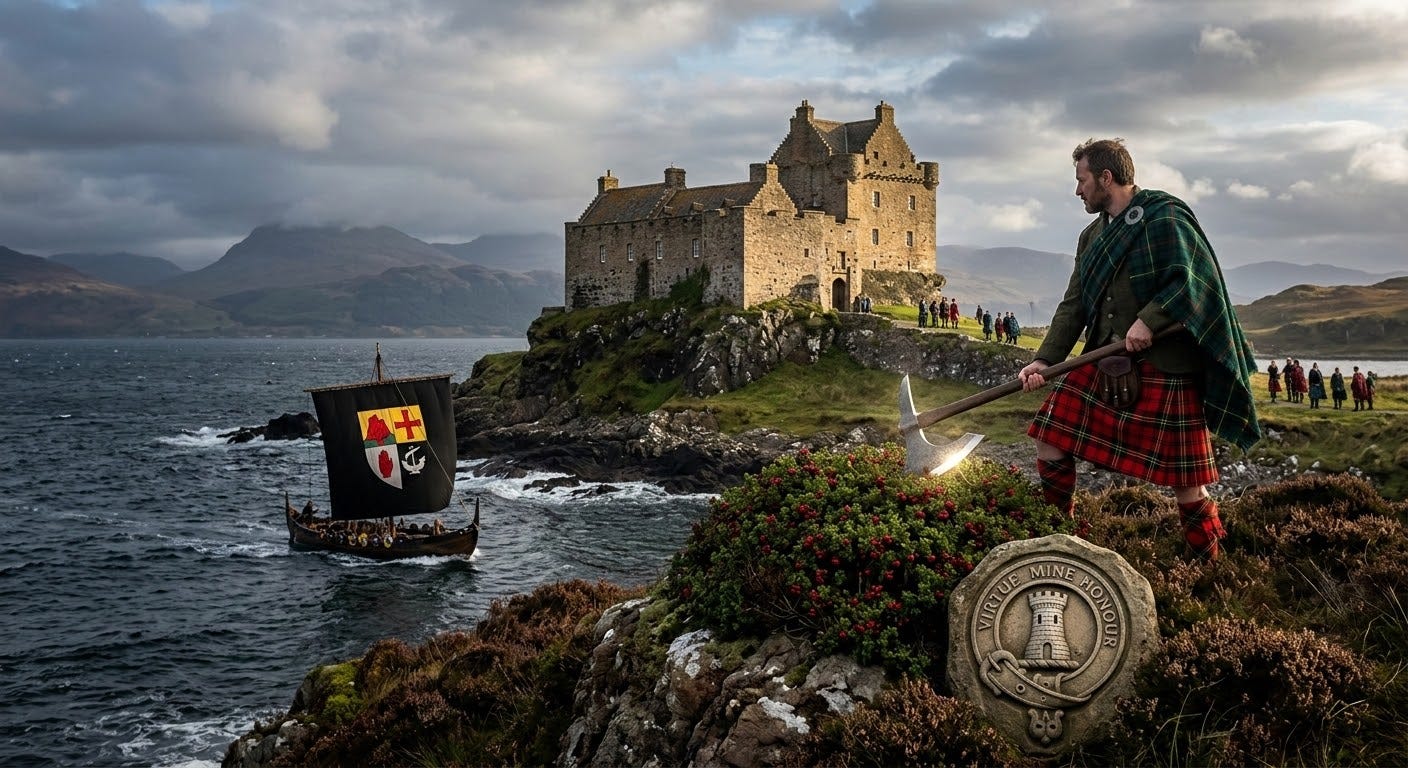
The rugged landscapes of the Scottish Highlands and the Inner Hebrides have long been shaped by the legendary Clan Maclean, a family whose history is as dramatic as the crashing waves of the Atlantic. The clan’s name is an anglicization of the Scottish Gaelic MacGilleEathain, which translates to “Son of the Servant of Saint John,” hinting at early religious devotion and deep ties to the ancient monastery of Iona. While romantic nineteenth-century myths sometimes claimed the clan descended from the Cambro-Norman FitzGerald dynasty, historical documentation firmly rejects this, placing their roots squarely in Gaelic Dál Riadic heritage. Verifiable lineage traces the clan back to Old Dugald of Scone, a judge and councillor to King David I of Scotland in the mid-eleventh century. However, the clan as a distinct warrior kindred truly emerged with its famed founder, Gillean of the Battle-Axe, a formidable thirteenth-century warlord who fought against the Norsemen at the Battle of Largs in 1263.

Gillean’s legacy lives on in the clan’s profound and recognizable symbols. According to legend, after wandering lost in a thick mist for days during a stag hunt, an exhausted Gillean planted his beloved battle-axe in a cranberry bush before collapsing. His companions found him by the glint of the axe head, forever linking the battle-axe and the cranberry bush to the clan’s identity. Today, the crowberry serves as the plant badge for the chiefly line, while other branches use holly or blaeberry. The clan’s primary crest badge features an embattled silver tower, representing their fortified island strongholds, accompanied by the proud motto “Virtue Mine Honour.” The chiefly heraldry further illustrates their rich heritage, dividing a shield to display a red rock of resilience, a red hand holding a cross crosslet representing faith, a black lymphad reflecting their seafaring prowess, and a salmon denoting wisdom. The Macleans also boast some of the oldest recorded tartans in Scotland, with the green, black, and blue Duart Hunting tartan documented in a land charter as far back as 1587, sitting alongside the vibrant red Duart Dress tartan.
The acquisition of the clan’s ancestral territories was achieved through a potent mix of military might and strategic marriages. In the fourteenth century, Lachlan Lubanach Maclean secured a papal dispensation to marry Mary MacDonald, daughter of the powerful Lord of the Isles. Her dowry included the formidable Duart Castle on the Isle of Mull, which became the eternal heart of the clan. The Macleans subsequently expanded their holdings across Tiree, Coll, Jura, Morvern, and Ardgour, establishing a network of major seats like Moy Castle, Cairnburgh, and Breachacha. This territorial expansion led to the formation of a complex genealogy. The House of Duart remained the primary chiefly line, but notable independent cadet branches emerged, such as the Maclaines of Lochbuie, the Macleans of Coll, Ardgour, Torloisk, and the northern branch of Dochgarroch. Countless other families aligned themselves with the Macleans as septs, sharing in their protection and heritage, including the Blacks, MacCormicks, Pattons, and Rankins.
Within these vast territories, the daily economic life of the clan revolved heavily around the sea and the land. They commanded a powerful fleet of galleys to control Hebridean trade routes and project military strength, while the broader populace engaged in crofting, fishing, and cattle farming. Clan culture was deeply enriched by hereditary arts; the Rankin family served as the traditional pipers to the Maclean chiefs, while the Beaton kindred acted as their esteemed physicians, scholars, and bards. Religious shifts also swept through the clan over the centuries. Originally Catholic protectors of Iona Abbey, the Macleans later embraced Protestantism. In a famously pragmatic conversion on the Isle of Coll, the laird reportedly guided his reluctant tenants to the Protestant church using a cane, leading locals to affectionately dub Presbyterianism the “religion of the gold-headed stick.”
The Macleans were fiercely martial, frequently embroiled in bloody clan feuds and national politics. Their rivalry with the encroaching Clan Campbell was notoriously bitter, exacerbated by the cruelty of the eleventh chief, Lachlan Cattanach Maclean. In a dark chapter of clan history, Lachlan abandoned his Campbell wife on a tidal skerry known as Lady’s Rock, expecting her to drown. She was rescued by passing fishermen, and her brother ultimately assassinated Lachlan in Edinburgh, igniting centuries of hostility. The Macleans also clashed heavily with the MacDonalds over lands on Islay. On the national stage, the clan consistently supported the Scottish Crown and the Royalist cause. Their fierce loyalty was immortalized at the Battle of Inverkeithing in 1651, where seven Maclean brothers sacrificed their lives to shield their chief from Cromwell’s forces, each stepping forward with the enduring battle cry, “Another for Hector!” This unswerving devotion extended into the Jacobite Risings, where the Macleans shed the first blood for the Stuart cause in 1689 and fought valiantly at Sheriffmuir in 1715.
However, their Jacobite loyalties ultimately led to the clan’s decline. At the tragic Battle of Culloden in 1746, the Maclean regiment, led by Charles Maclean of Drimnin, suffered devastating losses. In the post-Culloden repression, the traditional clan structure was aggressively dismantled. The Campbells leveraged decades of Maclean military debts to legally seize Duart Castle, forcing the chiefs into exile and leaving the ancient fortress to fall into ruin. Dispossessed of their lands and later swept up in the tragedy of the Highland Clearances, countless Maclean crofters and villagers were forced to leave their ancestral glens. This sparked a massive wave of global emigration, scattering the Children of Gillean across the world to the United States, Canada, Australia, and New Zealand.
Yet, the spirit of the clan could not be extinguished, leading to a remarkable renaissance in the modern era. In 1911, the twenty-sixth chief, Sir Fitzroy Donald Maclean, achieved the impossible by repurchasing the ruined Duart Castle and dedicating his fortune to restoring it to its former glory. Today, the twenty-eighth hereditary chief, Sir Lachlan Hector Charles Maclean, resides at Duart, serving as the unifying figurehead for a thriving global diaspora. Modern clan societies, united under the Clan Maclean International Association and the Clan Maclean Heritage Trust, actively preserve the family’s history, genealogies, and ancient monuments. This worldwide kinship is celebrated during massive global gatherings on the Isle of Mull, where thousands of descendants return to the shadow of Duart Castle, ensuring that the legacy of Gillean of the Battle-Axe will endure for generations to come.
--------------------------------------------------------------------------------
References
Ardgour Estate. (n.d.). A history of Ardgour estate and the Maclean family.
Clan Maclean Association. (n.d.). About Clan Maclean.
Clan Maclean Association. (n.d.). Clan Maclean history.
Clan Maclean Association in the United States. (n.d.). Clan Maclean – Association in the United States.
Duart Castle. (n.d.). History - Duart castle.
Duart Castle. (2018, June 21). The Clan Maclean ‘Virtue Mine Honour’.
Electric Scotland. (n.d.). Clan MACLEAN.
Frederick-Johnson, S. (2018, October 31). MacLean clan chiefs of Scotland. Clan MacLean Genealogy.
Historic Environment Scotland. (n.d.). Battle of Culloden (BTL6).
House of Labhran. (2022, April 16). Culloden moor & the Clan MacLaren - Scottish highland wear & kilt accessories.
Johncock, G. (2026, January 21). Visiting Duart Castle - Fascinating stories from Mull’s MacLean stronghold. Scotland’s Stories.
Johncock, G. (n.d.). Duart Castle and the lady of the rock. Hidden Scotland.
Kiddle Encyclopedia. (2025, October 17). Chiefs of Clan Maclean facts for kids.
Kiddle Encyclopedia. (2025, October 17). Clan Maclaine of Lochbuie facts for kids.
Kiddle Encyclopedia. (2025, October 17). Lachlan Cattanach Maclean, 11th chief facts for kids.
Maclean Clan Worldwide. (n.d.). Clan Maclean international association.
Maclean History Project. (n.d.). Branches of the Clan Maclean.
Maclean History Project. (n.d.). Ewan the headless.
Maclean History Project. (n.d.). House of Duart.
Maclean History Project. (n.d.). House of Lochbuie.
Maclean History Project. (n.d.). Origins of the Clan Maclean.
Maclean History Project. (n.d.). Sir Lachlan Maclean, Bt, CVO, 28th chief of Clan Maclean.
Maclean History Project. (n.d.). Tartans of the Clan Maclean.
Maclean History Project. (n.d.). The Jacobite risings.
Mull Directory. (2025, May 27). Lady’s Rock Mull legend.
Mull Directory. (2025, August 4). Moy Castle on Mull: A ruined stronghold of the Clan MacLaine.
Mull Directory. (2026, January 7). Lochbuie House history: Castles, ghosts, and the Clan Maclaine.
Notebook of Ghosts. (n.d.). Beyond Sleepy Hollow: Other headless horsemen.
Smith, T. (2024, April 13). Clan Maclean: Warriors of the western isles. Tartan Vibes Clothing.
Wikipedia. (2024, September 15). Gillean of the Battle Axe.
Wikipedia. (2025, December 30). Clan Maclaine of Lochbuie.
Wikipedia. (2026, March 3). Battle of Culloden.
WikiTree. (2026, March 5). Clan MacLean.