Uncover the complete history and origin of Clan Gunn - https://fairbairncrests.com/products/the-complete-history-of-clan-gunn
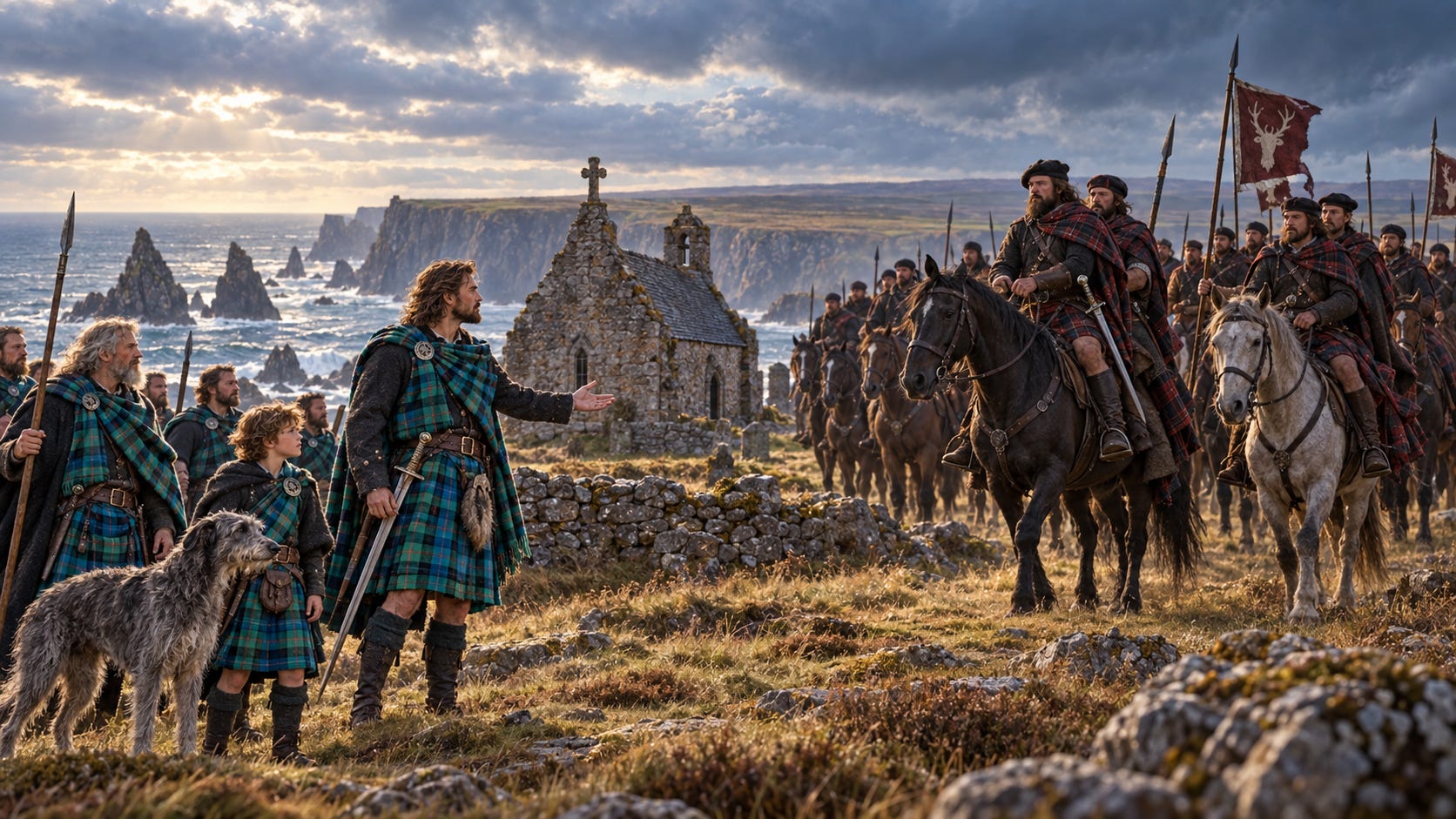
The agreement sounded simple: twelve horses on each side, and a meeting to settle a quarrel. In the best-known Gunn–Keith tradition, that apparent safeguard became the means of betrayal. The Gunns came expecting twelve opponents, but the Keiths arrived with two men riding every horse. What was supposed to bring reconciliation ended with the Coroner Gunn and his companions dead inside a chapel.
At the centre stands George Gunn, remembered as the Coroner or Crowner and associated with Clyth on the Caithness coast. His title belonged to an older world of local authority, not merely the modern investigation of unexplained deaths. Family tradition also remembered him through a great brooch, an ornament associated with his standing. These details give the story its human centre: a leading household whose loss shaped later family memory.
The chapel account survives in a feud history first published in 1764 from an earlier manuscript, and reprinted in Alexander MacGregor’s 1907 collection. It places the reconciliation at St Tayre, also called St Tears, near Girnigoe in Caithness. This is a later telling, not an eyewitness report, but its sequence is stark. A meeting is arranged, each party is limited in size, and the protection those limits seem to offer is undermined.
The Coroner arrives with sons and principal kinsmen, making a party of twelve. They enter the chapel and are at prayer when their opponents appear. The Keith leader has brought the agreed number of horses, but twice the number of riders the Gunns expected. The narrative presents that distinction as his justification: the animals have been counted correctly, even though the human balance has been overturned.
Here lies the story’s most memorable cruelty. The arrangement seems to promise equality, yet its wording is turned against the people who trusted it. Twelve horses still stand for twelve horses, but they no longer mean twelve men. The betrayal is therefore more than a surprise attack; it is the use of an agreement to destroy the security that agreement was meant to provide.
In the account, the twenty-four men rush through the chapel door and attack the Gunns unawares. The defenders resist fiercely despite their disadvantage, and the narrator claims that most of the Keiths die alongside them. The Coroner’s whole company is said to be killed. The prayerful setting sharpens the contrast: a place associated with devotion becomes the scene of violence, and a meeting intended to end hostility produces another grievance.
The story even supplies an apparent trace of the encounter, claiming that blood could still be seen on the chapel walls. For a listener, that detail brings the distant event suddenly close, as though the building itself could bear witness. Yet the statement is part of the transmitted narrative, not an authenticated examination of surviving bloodstains. Its importance lies in how firmly it fastens the memory of betrayal to a particular place.
The date is much less secure than the familiar plot. The feud history places the encounter around 1478, while John Henderson’s Caithness Family History gives 1464 for the Coroner’s death. Donald Sage’s Kildonan tradition places the fatal feud in 1511. These are not interchangeable dates: they span nearly half a century and affect which generations could have taken part.
The figures also need to be read as reported details rather than verified totals. Twelve against twenty-four makes the imbalance instantly understandable, while heavy losses among the attackers preserve the defenders’ reputation for courage. That combination helps explain the tale’s lasting appeal without proving that anyone invented it. A community could remember a defeat through the bravery of those who fell and the unfairness of the circumstances, rather than through defeat alone.
The cause of the feud is harder to recover than the trick with the horses. Later retellings connect the hostility with land, local standing and the tragic story of Helen Gunn, whose alleged abduction and death became attached to the rivalry. These strands should not be stitched together as though they formed a single documented chain of events. Helen’s story deserves attention in its own right, but it cannot safely be presented as the proven reason for the chapel meeting.
Nor does the older chapel narrative finish with the Coroner’s death. It identifies William Mackames as his grandson and describes him taking revenge upon George Keith of Ackergill and his son at Drummuie in Sutherland. This gives the Gunn side a response to the catastrophe, carrying the feud into another encounter rather than resolving it. The movement from attempted peace to killing and retaliation is what makes the story so bleak: each act supplies a reason for the next.
Sage preserves a different version rooted in Kildonan tradition. His account emphasises Henry recovering his father’s armour and badge of office, then quarrelling with his brother James over their possession. This aftermath helps explain the separation of descendants and the Henderson connection. It is not a missing scene to insert into the chapel narrative, but another telling shaped around different family questions.
For later Gunn families, the Coroner’s loss helped explain changes in leadership and the spread of branches across Caithness and Sutherland. His death did not mean that every Gunn household had vanished. Families continued through settlement, marriage and relationships that cannot all be explained by one encounter. The story remembers a catastrophe within the clan, not the end of the clan itself.
The Keiths, equally, should not become permanent villains simply because this version casts particular opponents in that role. A surname cannot make every household, generation or descendant responsible for the actions attributed to one armed company. Later generations found another use for the shared memory. On 28 July 1978, representatives of the Gunns and Keiths signed a bond of friendship at the traditional site of St Tears.
That ceremony did not establish an uncertain medieval date, nor did it mean the two clans had been fighting continuously for five hundred years. It offered a new relationship with an old story: remembrance without inherited hostility. The contrast with the chapel account is striking, because another meeting at the remembered place now expressed friendship. The past could remain part of both clans’ identities without dictating their future.
Explore the wider story in The Complete History of Clan Gunn: Caithness, Kildonan and the Northern World. This illustrated book follows the clan beyond its famous feud, through family branches, military service, migration and modern heritage, while distinguishing inherited tradition from documented history. Add it to your digital library and discover the people behind a name whose story is larger than any single battle.
References
Bagtown Clans. (2026). The complete history of Clan Gunn: Caithness, Kildonan and the northern world. Rigby Publishing. The_Complete_History_of_Clan_Gu…
Clan Gunn Society of North America. (n.d.). Gunn history. Clan Gunn Society
Henderson, J. (1884). Caithness family history. David Douglas. Fiona Sinclair
MacGregor, A. (1907). The feuds of the clans, together with The history of the feuds and conflicts among the clans. Eneas Mackay. Internet Sacred Text Archive
Sage, D. (1899). Memorabilia domestica; or, Parish life in the north of Scotland (2nd ed.). W. Rae.