Uncover the epic history of Clan Gordon - https://fairbairncrests.com/products/the-complete-history-of-clan-gordon-digital-edition
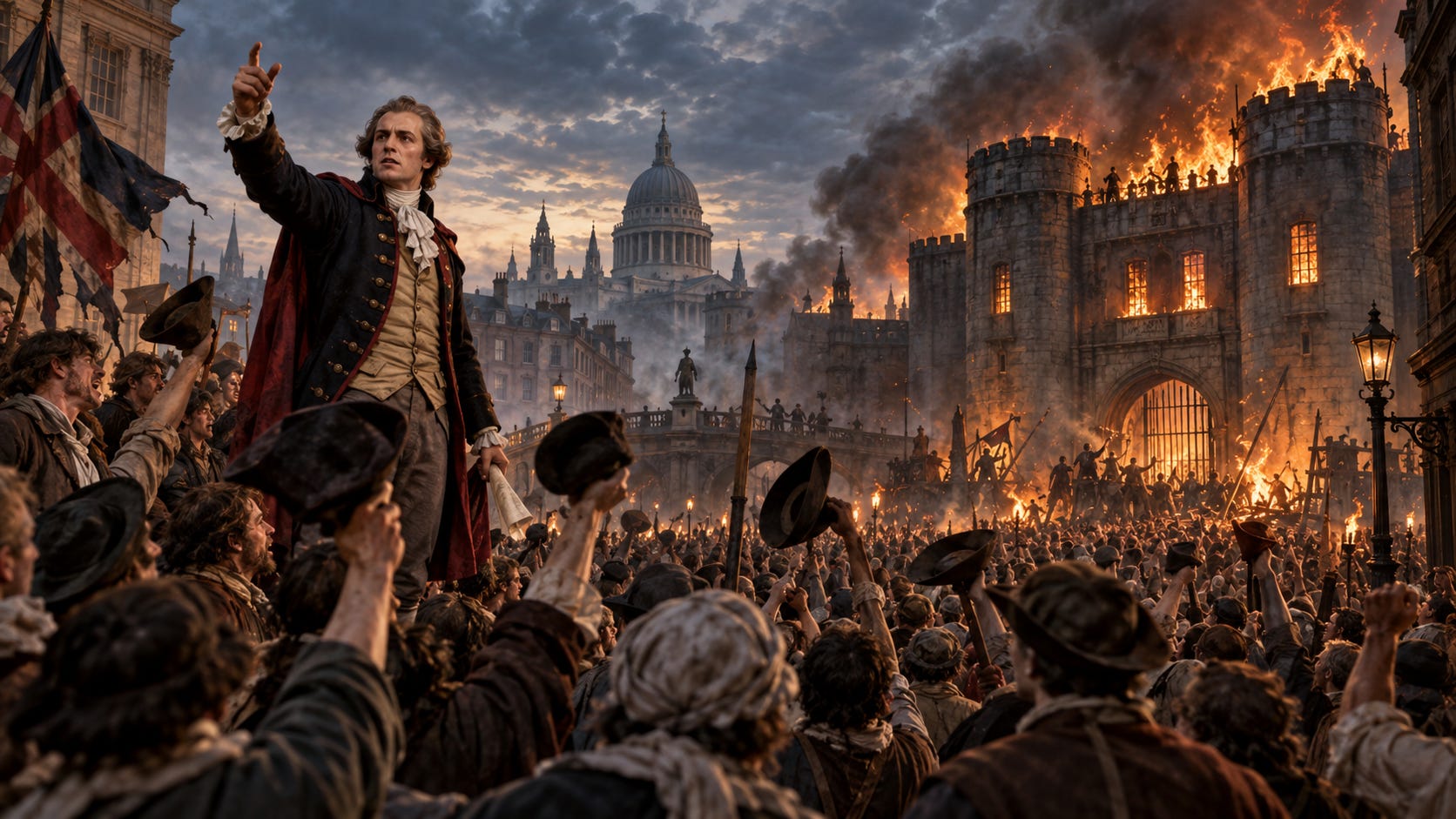
In June 1780, London descended into days of violence that shocked Britain and left parts of the capital in flames. What began as a mass protest against limited legal concessions to Roman Catholics became a sprawling urban crisis involving attacks on Catholic chapels and homes, the burning of prisons, the freeing of prisoners, looting and an assault on the Bank of England. At the centre of the story stood Lord George Gordon, younger brother of the fourth Duke of Gordon, whose name became permanently attached to the upheaval. The irony was striking: a member of a family long associated with powerful Catholic nobles in Scotland had become the public face of a movement built around militant Protestant opposition.
The immediate background lay in the Catholic Relief Act of 1778, sometimes called the Papists Act. The measure did not create full religious equality, but it relaxed some of the harsher legal restrictions imposed upon Catholics, including restrictions affecting property and penalties associated with Catholic clergy. Catholics who took an oath of allegiance could also benefit from concessions that made military service possible. To supporters, the legislation represented a limited easing of old disabilities, but opponents feared that Parliament had begun retreating from Britain’s Protestant settlement.
Out of that fear grew the Protestant Association, which campaigned for repeal of the 1778 legislation. Lord George Gordon, already a Member of Parliament, became president of the London Protestant Association in 1779. His aristocratic title, famous family name and parliamentary position gave the movement a highly visible spokesman who could take its demands directly into Westminster. Gordon helped turn anti-Catholic resentment into an organised public campaign centred upon persuading Parliament to reverse the relief legislation.
By the spring of 1780, the association had gathered roughly 45,000 signatures for a petition demanding repeal. Gordon wanted that petition presented with a dramatic demonstration of public support, and on 2 June an enormous crowd assembled at St George’s Fields in Southwark before marching towards Parliament. Estimates placed the gathering at roughly 50,000 to 60,000 people, an extraordinary mobilisation in an eighteenth-century city. Gordon carried the petition into the House of Commons while crowds packed the approaches to Parliament and the atmosphere became increasingly tense.
The protest did not remain a controlled political demonstration for long. Anti-Catholic attacks began that evening, and over the following days violence spread through London as Catholic chapels, homes and other targets were attacked. Newgate Prison was burned, prisoners were freed, other prisons came under attack, and the houses of prominent figures associated with law and government were targeted. The destruction eventually moved well beyond the original religious grievance as looting, hostility towards authority and other motives became mixed with the anti-Catholic campaign.
This is one reason the Gordon Riots cannot be explained simply as the story of Lord George Gordon commanding an obedient mob. Gordon’s speeches, organisation and determination to bring a mass petition to Parliament helped create the political circumstances in which the crisis began, but the crowds that subsequently filled London’s streets did not remain under his control. Different participants attacked different targets and appear to have acted from a mixture of religious, political, social and opportunistic motives. Modern scholarship accordingly treats the disturbances as a complicated urban insurrection rather than a single centrally directed conspiracy.
The scale of the crisis became terrifyingly clear during the nights of 6 and 7 June. Newgate was set ablaze, other prisons were attacked, and the Bank of England became a sufficiently serious target that armed force was required to protect it. Troops were eventually deployed on a large scale to restore order, and the suppression produced substantial casualties alongside hundreds of arrests. Contemporary observers described a capital illuminated by fires as the disturbances reached their height, helping to explain why the Gordon Riots remained embedded in London’s historical memory long after the streets had quietened.
Lord George Gordon’s own legal fate was more complicated than the name “Gordon Riots” might suggest. He was arrested and prosecuted for high treason, a far more serious accusation than simply organising a controversial protest or making inflammatory speeches. At his trial in 1781, the prosecution attempted to connect his political agitation with an attack upon established government, while his defence disputed that he had intended the subsequent violence. Gordon was ultimately acquitted of treason, even though the protest movement he had led remained inseparably associated with the events that followed.
For anyone interested in Clan Gordon, one of the most fascinating aspects of the story is how dramatically Lord George’s religious politics differed from those associated with earlier generations of the leading Gordon family. Earlier Huntly chiefs had been famous for their Catholic affiliations, while the first Duke of Gordon’s position was closely connected with the Catholic James VII during the political upheavals of the late seventeenth century. Yet in 1780 the fourth duke’s own brother was at the head of an organisation campaigning against concessions to Britain’s Catholics. The contrast is a powerful reminder that a clan surname did not impose one permanent political or religious identity upon every generation.
Lord George’s life after 1780 remained turbulent. His reputation never escaped the riots, despite his acquittal on the treason charge, and later legal difficulties eventually resulted in imprisonment. He died in Newgate Prison in 1793, while other members of the Gordon family continued along very different paths through aristocratic politics, military service and estate life. His career became an extraordinary example of how one individual could attach an entirely new historical association to a surname already carrying centuries of Scottish history.
The Gordon Riots also demonstrate how quickly a political campaign could escape the intentions of the people who organised it. Petitioning Parliament was an established way of expressing grievances, and the Protestant Association originally presented its campaign as an effort to persuade legislators to repeal a law. Yet the enormous demonstration, intense anti-Catholic feeling and inadequate early control of the streets created circumstances in which organised protest became sustained violence. What began as a dispute over a limited measure of religious relief ended with prisons burning, soldiers in the streets and Britain confronting difficult questions about popular mobilisation, parliamentary authority and religious intolerance.
The episode is even more revealing when compared with the wider history of the Gordons. Lord George was not representative of every Gordon, just as earlier Catholic Huntlys did not determine the beliefs of every later member of the family. Across the centuries, Gordons could be Catholics or Protestants, Jacobites or government supporters, soldiers, politicians, estate owners or emigrants, sometimes finding themselves on opposite sides of the same national crisis. The family history becomes more interesting, rather than less coherent, when those contradictions are recognised.
That larger story is explored in The Complete History of Clan Gordon, which follows the family from its medieval Border origins through the rise of Huntly, religious conflict, the Jacobite era, the Gordon Highlanders, the great estates and the modern clan world. The Gordon Riots occupy only one dramatic episode in a much broader history of warfare, religion, inheritance, politics and changing identity. Seen within that longer story, Lord George Gordon becomes more than simply the man whose name became attached to London’s extraordinary upheaval of 1780: he is a vivid example of how unpredictable the history of a great Scottish family could become.
References
Haywood, I., & Seed, J. (Eds.). (2012). The Gordon riots: Politics, culture and insurrection in late eighteenth-century Britain. Cambridge University Press.
Rigby Publishing. (2026). The complete history of Clan Gordon. Rigby Publishing.
Rudé, G. F. E. (1956). The Gordon Riots: A study of the rioters and their victims. Transactions of the Royal Historical Society, 6, 93–114. https://doi.org/10.2307/3678842
UK Parliament. (2019, September 20). The Gordon petition and riots. Petitions Committee.
UK Parliament. (n.d.). Emancipation: Catholics and the Catholic Relief Acts. Living Heritage.
UK Parliament. (n.d.). Royal proclamation for the suppression of the Gordon Riots. Parliamentary Archives.