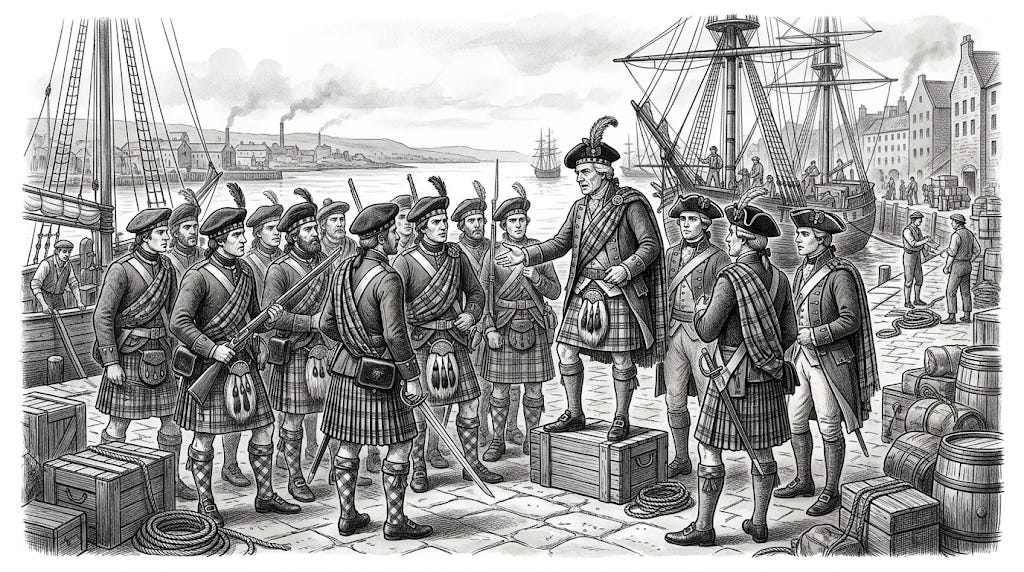
In the raw spring damp of April 1776, the cobbled streets of Glasgow echoed with the tramp of more than two thousand newly mustered Highland soldiers preparing to sail down the Clyde to Greenock and cross the Atlantic. They belonged to the two battalions of the newly raised 71st Regiment of Foot, known across Scotland as Fraser’s Highlanders. Yet amid the pipes, the barked orders of low-country drill sergeants, and the creak of baggage carts bound for the transport ships, a sudden, ominous stillness fell over one particular company of the 1st Battalion. One hundred and twenty tall, weather-beaten men from the rugged glens of Lochaber grounded their muskets and refused to take another step toward the boats. To the bewildered British embarkation officers, it looked like open mutiny on the eve of war. To the Gaelic-speaking soldiers standing shoulder to shoulder in the Glasgow mist, it was simply a matter of ancient honour: they had been raised as the personal company of their chief, Charles Cameron of Lochiel, and not a man among them would board a vessel for America until they saw Lochiel standing at their head.
This extraordinary standoff on the Clyde is one of the most poignant episodes preserved in Highland Regiments & Loyalists in America: A Compiled Biographical Dictionary of 193 Scottish Officers, Soldiers, and United Empire Loyalists in the Seven Years’ War and the American Revolution, 1756–1788, a work synthesizing the 1822 regimental annals of Colonel David Stewart of Garth alongside the original Audit Office Loyalist depositions. The confrontation at Glasgow laid bare a profound paradox at the heart of eighteenth-century British military power. Only thirty years after the Hanoverian government had crushed the Jacobite clans at Culloden, outlawed their tartan, and confiscated their ancestral estates, the Crown was relying on the very same feudal devotion to hold its fractious American empire together.
The Shadow of the Gentle Lochiel and the Forfeited Estates
To understand why 120 Lochaber tenants were willing to risk the lash or the firing squad in April 1776, one must look back a single generation to the catastrophe of 1745. Their fathers had marched out of the West Highlands behind Donald Cameron of Lochiel, universally remembered in Scottish history as “the Gentle Lochiel”. When Prince Charles Edward Stuart landed in Moidart in the summer of 1745, Lochiel had famously warned the young prince against rising without French regular support; yet when Charles insisted on raising his standard regardless, Lochiel pledged his life, his clan, and his lands to the cause. After the rout at Culloden in April 1746, Hanoverian troops swept through Lochaber, burning Lochiel’s seat at Achnacarry to the ground and driving the wounded chief into French exile, where he died in 1748.
Under the terms of the post-Culloden forfeiture acts, the ancient estates of Lochiel were seized by the Crown and placed under government commissioners. For nearly three decades, the clansmen of Lochaber lived under the shadow of the Disarming Act, paying their rents to factors of King George while quietly sending a second, voluntary tribute across the sea to support their exiled chief’s family. When the Gentle Lochiel’s son, Charles Cameron of Lochiel, came of age, he possessed neither a single acre of legal land in Inverness-shire nor a penny of rental income from the glens his ancestors had ruled for centuries.
Then came the explosion of armed rebellion in the thirteen American colonies in 1775. Desperate for hardy infantry capable of enduring the forests and mountains of North America, King George III and his ministers turned once more to the strategic blueprint first pioneered by William Pitt in 1757. In the autumn of 1775, the Crown issued letters of service to Major-General Simon Fraser of Lovat—himself the pardoned son of the old Jacobite Lord Lovat who had been beheaded on Tower Hill in 1747—to raise a massive two-battalion Highland regiment of 2,340 men. General Fraser understood Highland psychology intimately. Rather than recruiting through impersonal bounty sergeants, he secured commissions for six traditional Highland clan chiefs, including Roderick Chisholm of Strathglass, Sir Aeneas Mackintosh of Mackintosh, Norman MacLeod of Dunvegan, and Charles Cameron of Lochiel.
Word travelled swiftly through the braes of Lochaber that young Lochiel had been promised a captain’s commission in the 1st Battalion of the 71st Regiment if he could bring a full company of men to the muster. Even though their chief held no legal authority over them and owned not a clod of Lochaber soil, the response of the tenantry was instantaneous. Out of pure ancestral attachment to the house of Lochiel, the families of the forfeited estate raised 120 prime young Highlanders and marched them south to the regimental rendezvous at Glasgow so that their chief might win his company and restore the fortunes of his name.
Mutiny on the Clyde and the Eloquence of Lovat
When the 120 Lochaber men arrived in Glasgow in April 1776, however, their chief was nowhere to be seen. Captain Charles Cameron of Lochiel had been detained in London by a severe and debilitating illness. Weakened by fever and confined to his quarters in the capital, he had been physically unable to travel north in time for the spring muster.
As long as the regiment remained in barracks at Glasgow, the Lochaber recruits drilled quietly alongside the men of Lovat, Strathglass, Badenoch, and Skye. The crisis erupted the moment embarkation orders arrived from London directing the battalions to march down to the transports waiting to carry them to New York. Suspicious of government promises and fiercely protective of their absent leader, the Cameron soldiers feared they were being tricked into regular line service under stranger officers while their chief was cast aside. They halted in their ranks and flatly refused to move toward the ships.
When officers attempted to enforce discipline, the clansmen answered in Gaelic with unyielding resolve. As Colonel David Stewart of Garth recorded in his military annals, the men declared with one voice that “they were Lochiel’s men; with him at their head they were ready to go to any part of the world,” but without him they would not set foot upon a transport deck.
In any ordinary British regiment of the line, such collective defiance on the point of embarkation for a war zone would have triggered immediate court-martial proceedings and the cat-o’-nine-tails. Fortunately for the Camerons, the colonel of the regiment was Simon Fraser, Master of Lovat. Having raised 800 men on his own forfeited Lovat estates in 1757 and fought beside them on the Plains of Abraham and at Sainte-Foy, Fraser knew that threatening Highland clansmen who believed they were defending their honour would only end in bloodshed.
Stepping directly in front of the angry Lochaber company, General Fraser addressed them in their native Gaelic. With the persuasive warmth and traditional eloquence of a great Highland chief, he explained the true cause of Lochiel’s absence, assuring them that their chief’s honour was spotless and that only dangerous sickness kept him in London. To prove that they would not be handed over to strangers, Fraser announced on the spot that he was placing their company under the immediate command of Captain Charles Cameron of Fassafearn, a son of John Cameron of Fassafearn in Lochaber and a near kinsman of Lochiel himself, who held a commission in the 2nd Battalion.
The combination of General Fraser’s Gaelic address and the appointment of a trusted kinsman from their own glen broke the tension immediately. Satisfied that they would cross the ocean under a gentleman of Lochiel’s blood, the 120 Camerons gave way. One aged Highlander in the crowd stepped forward, grasped General Fraser warmly by the hand, and exclaimed in Gaelic, “Simon, you are a good soldier, and speak like a man; so long as you live, Simon of Lovat will never die”.
The Fatal Ride North
While Captain Charles Cameron of Fassafearn reconciled the clansmen at Glasgow, an express courier was already riding hard down the Great North Road to London carrying urgent dispatches of the near-mutiny. When the news reached the sickbed of Charles Cameron of Lochiel, the young chief was horrified. To a man raised in the strict chivalric code of the Jacobite diaspora, the thought that his devoted tenants might be branded as mutineers—or that his own absence might be misconstrued as reluctance to share their dangers in America—was unbearable.
Against the urgent warnings of his physicians, and while still terribly frail from his illness, Lochiel rose from his bed in London and ordered post-horses for Scotland. For days he endured the bone-jarring agony of eighteenth-century coach travel northward, determined to reach the Clyde before the transport fleet weighed anchor, show himself to his faithful Lochaber men, and thank them in person for their loyalty.
The exertion proved fatal. Exhausted by the long, cold journey north and the emotional strain of the crisis, Lochiel suffered a catastrophic relapse upon reaching Scotland. Within a few weeks of his arrival, before he could ever draw his sword at the head of the company his tenants had raised for him, the young Chief of Clan Cameron died, universally lamented across the Highlands.
The Fate of Lochiel’s Men in America
Across the Atlantic, the 120 Lochaber men who had demanded a Cameron at their head fulfilled their pledge in blood. Under the command of their chief’s kinsman, Captain Charles Cameron of Fassafearn, they disembarked at Staten Island in the summer of 1776 and fought through the fierce campaigns of Brooklyn, New Jersey, and Pennsylvania.
In late 1778, Captain Cameron of Fassafearn and the light infantry accompanied Lieutenant-Colonel Archibald Campbell’s southern expeditionary force to Georgia. On December 29, 1778, as the British troops landed below Savannah and pushed up from the river, Captain Cameron led his Highland light infantrymen at the very point of the column to storm the advanced American post. As the Rebels delivered their first concentrated musket volley from cover, Captain Charles Cameron of Fassafearn—”an officer of high spirit and great promise”—was struck down and killed alongside three of his men in the opening minutes of the victory that captured the capital of Georgia.
Neither Charles Cameron of Lochiel nor his kinsman Charles Cameron of Fassafearn ever returned to the glens of Lochaber. Yet the story of the 120 clansmen who stood fast on the stones of Glasgow in April 1776 remains an unforgettable testament to the twilight of the old clan world, when a Highlander’s word was bound not to a distant parliament, but to the living person of his chief.\
Adapted from: Fairbairn's Crests Digital Publishing. (2026). Highland regiments & Loyalists in America: A compiled biographical dictionary of 193 Scottish officers, soldiers, and United Empire Loyalists in the Seven Years' War and the American Revolution, 1756–1788. Fairbairn's Crests.