When the Dutch clerks of the Council of State at The Hague opened their vellum registers in the mid-eighteenth century to record the officers of the Scots Brigade, they were accustomed to the great baronial surnames of Lowland and Highland Scotland. For nearly two hundred years, the Staten van Oorlog and the annual Naam-Registers had been filled with the names of Balfour, Halkett, Mackay, Douglas, Colyear, and Stewart. Yet among the subalterns and company commanders who marched through the barrier fortresses of the Low Countries between 1747 and 1783 appeared a short, unusual surname from the far northern cliffs of Caithness: Captain John Budge.
Preserved in the compiled archival rolls of Lions of the United Provinces: A Compiled Biographical Dictionary of the Scots Brigade in the Service of the Netherlands, 1572-1782, the career of John Budge offers a rare window into how the ancient bloodlines of the Scottish clans found their way into the professional armies of continental Europe. Though Dutch scribes recorded him simply as a commissioned officer of the Republic, Scottish tradition remembered his name as something far older and fiercer. The Budges of Caithness were a northern sept of Clan Donald, descended from a Macdonald fugitive who had fled northward centuries earlier, shed his proscribed patronymic, and rooted a new house of warriors on the treeless moors above the Pentland Firth.
From the Cliffs of Caithness to the Bloodlines of Clan Donald
In the clan history of the Scottish Highlands, geography and survival frequently reshaped a family’s name. Across the centuries of feuding that followed the forfeiture of the Lordship of the Isles, kinsmen of the great western house of Macdonald who found themselves on the wrong side of a blood feud or royal warrant often sought sanctuary beyond the reach of their enemies. Pushing past the straths of Ross and the rugged mountains of Sutherland—lands dominated by the Mackays of Strathnaver and the Earls of Sutherland—one such fugitive of Clan Donald crossed the Ord of Caithness into the windswept northeastern corner of the Scottish mainland.
There, where the red sandstone cliffs of Caithness drop sheer into the North Sea, the exiled Macdonald established a distinct sept under the surname Budge. Over generations in Caithness, the Budges became respected landholders and tacksmen, particularly associated with Toftingall and Murray. While the coastal towns of Wick and Thurso looked outward toward the Baltic and the Low Countries, the interior parishes of Caithness retained the long memory of clanship. Even in the eighteenth century, when a young gentleman of the name of Budge buckled on a broadsword, his neighbours knew that behind the short Caithness surname ran the lineage of the Macdonalds.
For a young Caithness gentleman coming of age in the 1740s, the military profession offered the most honourable path to advancement. The northern shires had long been a prime recruiting ground for the Scots Brigade in the Netherlands. Neighbouring Sutherland and Caithness families—the Mackays of Scourie, the Sinclairs, the Gunns, and the Sutherlands—had sent generation after generation of officers to garrison Breda, Namur, and Bergen-op-Zoom. When the War of the Austrian Succession brought a desperate crisis to the Dutch frontier in 1747, John Budge stepped directly from that northern martial world onto the stage of European warfare.
The Raising of Drumlanrig’s Regiment in 1747
The spring of 1747 was a season of alarm in the United Provinces. French armies under Marshal Maurice de Saxe were overrunning the Austrian Netherlands, and the ancient Barrier fortresses garrisoned by the Dutch and their Scottish regiments were falling one after another. In Scotland, the smoke of Culloden had barely cleared following the Jacobite Rising of 1745. The prisons and glens were filled with restless, battle-hardened men, while young gentlemen from both Whig and Jacobite families were eager for foreign commissions.
Seizing the moment, the States-General at The Hague entered into a formal capitulation in June 1747 with a twenty-four-year-old Scottish nobleman, Henry Douglas, Earl of Drumlanrig, eldest son and heir of the 3rd Duke of Queensberry. Having already proved his courage in the Sardinian army during the Italian campaigns, Lord Drumlanrig agreed to raise an entire fourth regiment for the Scots Brigade. Unlike the older single-battalion establishments of earlier wars, Drumlanrig’s Regiment was authorized as a massive two-battalion corps of twenty companies.
With the express sanction of King George II, recruiting parties beat their drums from the Borders to the northern Highlands in the summer of 1747. Drumlanrig’s levy was a remarkable cross-section of eighteenth-century Scotland. Alongside Lowland gentry and veteran soldiers from the British establishment—such as Captain Robert Murray Keith of Craig, Captain Charles Leslie (second son of the 9th Earl of Rothes), and Ensign John MacLeod—the new regiment enlisted scores of Highlanders and pardoned Jacobite prisoners from the 1745 Rising. Among the young subalterns commissioned to lead these twenty companies across the North Sea was John Budge of Caithness.
By the autumn of 1747, when Drumlanrig’s two battalions disembarked in the Netherlands, the Scots Brigade had just endured its bloodiest ordeal of the century. In September 1747, French troops had stormed the supposedly impregnable fortress of Bergen-op-Zoom. Inside the burning town, the Scottish battalions of Major-General John Marjoribanks and the ninety-year-old Field-Marshal Walter Philip Colyear had fought street by street to cover the retreat of the garrison commander, losing more than two-thirds of their men. Stepping into the shattered defensive line along the Dutch frontier, young subaltern John Budge and the newly arrived companies of Drumlanrig’s Regiment stood guard over the Republic through the closing months of the war.
The Reduction at Bergen-op-Zoom and the Long Garrison Years
The signing of the Peace of Aix-la-Chapelle in 1748 brought an end to the fighting, and with peace came the inevitable austerity of the Dutch treasury. In 1749, the States-General reduced one battalion of the Earl of Drumlanrig’s Regiment, leaving the remaining battalion in garrison until March 1752, when the final reduction incorporated Drumlanrig’s surviving officers and men into the three permanent regiments of the Scots Brigade—commanded by Generals Charles Halkett, Hugh Mackay, and Charles William Stewart.
It was a bitter moment for many young officers who saw their companies disbanded and their pay curtailed. At Bergen-op-Zoom in March 1752, Budge’s fellow Drumlanrig officer, Captain Robert Murray Keith, sat beside the river with his head propped on a leather knapsack and composed his famous lament on the reduction, mourning the “poor pensioned captain” and the lieutenants and ensigns who “stood mournfully murmuring by”. Keith himself eventually left the Dutch service in 1758 to command Highlanders in Germany and serve for twenty years as British Ambassador in Vienna. Tragedy also struck their former chief: in October 1754, barely three months after marrying Lady Elizabeth Hope, the thirty-one-year-old Earl of Drumlanrig was killed by the accidental discharge of his own pistol while travelling from Scotland to London.
John Budge, however, did not leave. Possessing the patient, dogged endurance of his Caithness forebears, he transferred from Drumlanrig’s reduced establishment into the permanent ranks of the Scots Brigade. Throughout the 1750s and 1760s, as his name climbed steadily through the official Dutch Naam-Registers, Budge served across the circuit of Dutch garrison cities and Barrier towns—Breda, Namur, Tournay, Nijmegen, Venlo, and Maastricht.
In those peacetime decades, seniority in the Scots Brigade moved at a glacial pace, advancing only when an older officer died of fever, retired to a Scottish estate, or exchanged his company. Yet Budge’s reputation as a thorough, dependable tactical officer steadily set him apart among his peers in the Third Regiment, commanded successively by Lieutenant-General Charles Halkett, Major-General James Gordon, and Major-General Ralph Dundas.
Captain-Commandant of the Grenadiers and the Final Crisis
On May 23, 1769, after more than twenty years of service under the House of Orange, John Budge received one of the most coveted tactical appointments in a Scottish battalion: he was commissioned Captain-Commandant of the Grenadier Company.
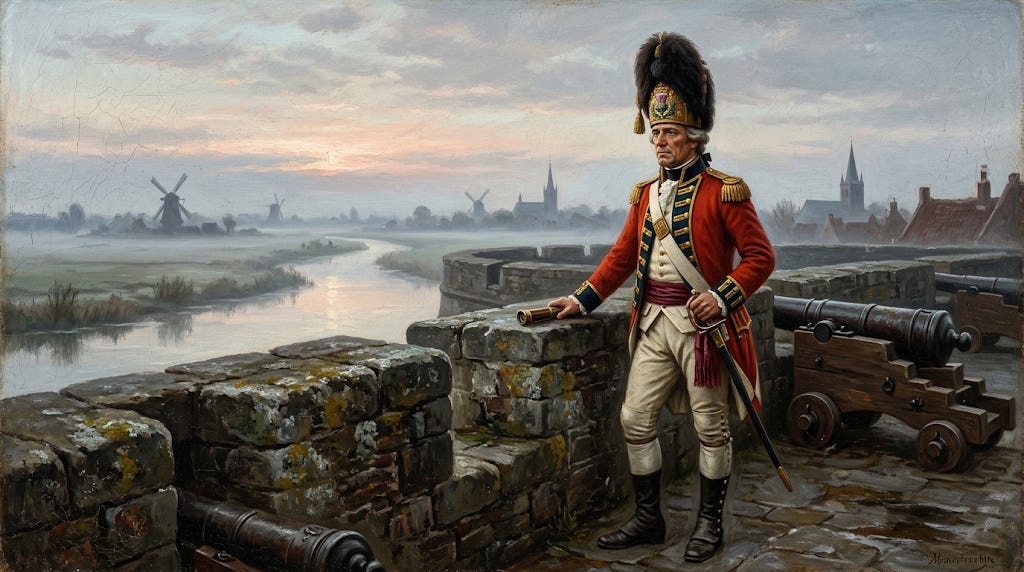
In the administrative structure of the Scots Brigade, as defined in the archives of the Council of State, the Capitain-Commandant was the actual field and tactical commander of a senior field officer’s titular company—most notably the elite Grenadier Company, which stood on the right of the battalion line and led every assault on a fortress breach. Wearing the tall grenadier cap and scarlet coat of the Brigade, Captain-Commandant Budge drilled the tallest, most seasoned soldiers of the regiment for six years before receiving his commission as full Captain of his own line company on July 12, 1775.
Budge’s promotion to company command came on the eve of the final, fatal crisis of the Scots Brigade. As the American War of Independence widened into a global conflict, relations between Great Britain and the Dutch Republic deteriorated into open hostility during the Fourth Anglo-Dutch War. Stationed in the Dutch frontier garrisons alongside fellow northern officers like Roderick MacLeod, Alexander Gordon, and Aeneas Mackay, the veteran Caithness captain watched the world he had served for thirty-five years unravel.
In November and December 1782, the States-General issued their fateful decree: the three regiments of the Scots Brigade were to be stripped of their scarlet British uniforms, clothed in Dutch blue, deprived of their royal British colors, and required to swear a new oath renouncing all allegiance to King George III. While younger field officers like Lieutenant-Colonels Ilay Ferrier, George Cuninghame, and Frederick Halkett organized the walkout of the fifty-four loyal officers who returned to Britain in the spring of 1783, the strain of the Brigade’s dissolution weighed heavily on its oldest veterans.
Captain John Budge did not live to see the long years of half-pay exile or the eventual restoration of the corps as the 94th Foot. He died in 1783, in the very year that the two-hundred-year-old Scots Brigade was formally dissolved. Along with fellow veterans Captains John Erskine and Robert Buchanan, who also passed away in that watershed year of 1783, the old grenadier commander from Caithness closed his eyes just as the scarlet coats of the Scots Brigade vanished from the ramparts of the Netherlands forever—leaving his name in the Hague archives as a lasting testament to the fugitive sept of Clan Donald that marched from the northernmost cliffs of Scotland to the heart of Europe.
Adapted from: Fairbairn's Crests. (2026). Lions of the United Provinces: A compiled biographical dictionary of the Scots Brigade in the service of the Netherlands, 1572–1782. Fairbairn's Crests.