Uncover the epic history of Clan Macrae - https://fairbairncrests.com/products/the-complete-history-of-clan-macrae-digital-edition
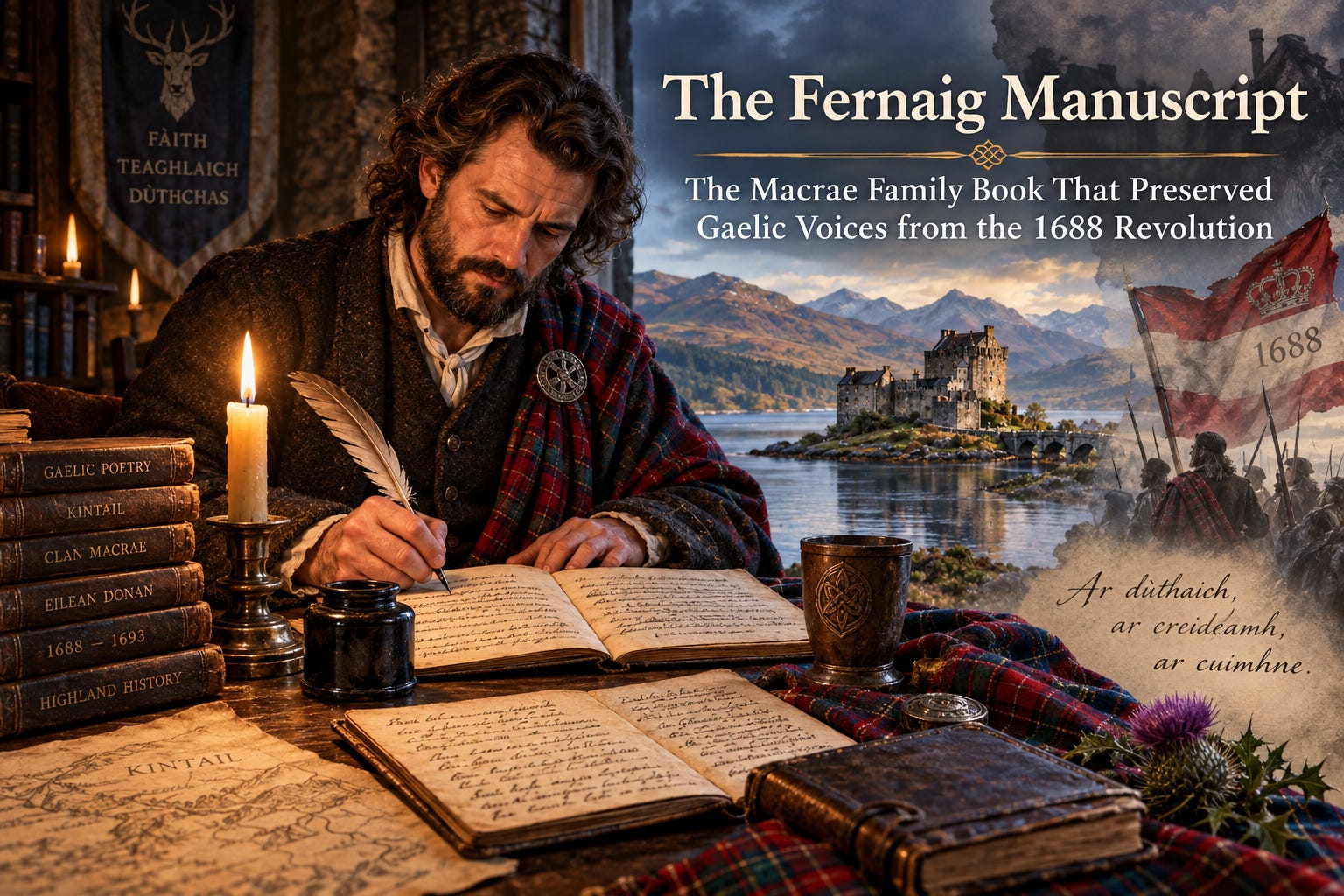
Some of the most valuable historical records are not great state papers, battlefield reports or royal proclamations. Sometimes they are small books kept inside a family home, filled with words that someone believed were worth preserving. One of the most remarkable survivals in Clan Macrae history is the Fernaig Manuscript, a collection of Gaelic poetry begun by Duncan Macrae in 1688 and continued into 1693. Created during one of the most turbulent political and religious periods in Scottish history, it preserves something far more personal than a later account of events: it preserves reactions formed while those events were still unfolding.
Duncan Macrae, also known by his Gaelic name Donnchadh MacRath, belonged to the Macraes of Inverinate in Kintail. His family had long been connected with the Mackenzies of Seaforth through land, service and estate administration, placing him close to the political world of the western Highlands. Tradition also remembered him as Donnchadh nam Pìos, often translated as “Duncan of the cups,” a name associated with the prosperity and hospitality of his household. Yet it is the little books he filled with Gaelic verse that provide his most important legacy.
The Fernaig Manuscript survives as two narrow volumes containing roughly 4,200 lines of poetry. Physically, the books were modest objects, small enough to belong naturally within a household rather than a great institutional library. What Duncan placed inside them, however, reached far beyond family affairs. Religious verse, political poetry, personal reflections and works associated with other writers created a record of a Gaelic-speaking intellectual community responding to a changing world.
The timing could hardly have been more significant. Duncan began compiling the collection in 1688, the year in which the rule of James VII of Scotland and II of England collapsed during the Revolution. The arrival of William of Orange and the displacement of James transformed the political order of Britain and created intense arguments over kingship, allegiance and religion. In the Highlands, these changes were not distant events discussed only in Edinburgh or London. They affected families whose loyalties, religious beliefs and relationships with powerful patrons had developed over generations.
That is what makes Fernaig so valuable. Later histories often know how a political crisis ended before they begin telling its story, making it easy to arrange events into a neat sequence leading towards an inevitable conclusion. Duncan and the poets whose work he preserved did not possess that advantage. Their hopes, fears and judgements developed while the future remained uncertain, allowing modern readers to encounter political feeling before later generations had reshaped it into legend.
The manuscript also reveals how complicated Highland political loyalties could be. Duncan’s world was Protestant, yet the poetry preserves sympathy for the displaced James and hostility towards the new political settlement. This makes it difficult to reduce Jacobitism simply to a struggle between Catholic supporters of James and Protestant opponents. Loyalty could grow from ideas about lawful kingship, inherited obligation, religious government and personal relationships as much as from denominational identity.
Religion lies at the heart of much of the political verse. The writers did not treat politics as a completely separate sphere of life but interpreted public events through the language of Scripture and Christian duty. Biblical stories supplied ways of understanding rebellion, suffering, betrayal and hopes of deliverance. A king could be imagined not merely as a political ruler but as a father, while resistance to him could be judged through ideas of obedience already familiar from family and religious life.
One poem associated with the crisis of 1688 reflects on a world in which people change their professions of belief when circumstances make it advantageous. From that sense of instability, the writer turns towards Christ and asks for protection of a religious and political order believed to be endangered. Biblical examples then help explain contemporary events, demonstrating how deeply scriptural language shaped political argument. These were not decorative references added to make poetry sound learned; they provided a framework through which writers could interpret the crisis surrounding them.
The story of David and Absalom was particularly useful because it combined rebellion against a king with rebellion against a father. For a writer concerned with the treatment of James by members of his own family, the comparison gave political disobedience an intimate moral dimension. The execution of Charles I earlier in the century also remained part of this memory, showing how wounds from the civil wars could still influence political thought decades later. To people living through the Revolution, 1688 was not necessarily the beginning of an entirely new argument but another chapter in conflicts remembered across generations.
Fernaig also brings the politics of the kingdom directly into the geography of northern Scotland. The poetry names regional families and interests, demonstrating that the Revolution could change how neighbours were judged as well as how distant rulers were understood. National events altered the balance of influence among people already connected through land, rivalry, marriage and patronage. For Duncan and his literary circle, the fate of a king and the behaviour of familiar Highland families belonged within the same political landscape.
The Battle of Killiecrankie in 1689 created another moment of hope for supporters of the displaced Stuart interest. Jacobite forces won the battle, although their commander, Viscount Dundee, was killed, complicating the meaning of the victory almost immediately. Poetry preserved in the Fernaig collection reflects reactions developing as events changed rather than presenting one unchanging opinion from beginning to end. That makes the manuscript particularly valuable as a record of political emotion under pressure.
Yet Fernaig should not be treated simply as a book of Jacobite propaganda. Religious reflection, devotional concerns and family connections stand beside political anger. Duncan collected works by several writers rather than filling every page only with his own compositions, turning the manuscript into a small literary archive. The variety suggests that he was interested in preserving poetry he considered valuable for more than one reason.
Its language is another reason the manuscript matters. Duncan wrote Gaelic using spelling conventions influenced by Scots or English rather than relying entirely on the orthography most familiar to later Gaelic readers. To modern eyes, this can make the manuscript difficult to approach. Instead of suggesting a lack of literacy, however, the unusual spelling reveals how a multilingual Highland writer found a practical way of putting the sounds of his own language onto the page.
That detail challenges another old stereotype about the Highlands. Gaelic culture was not simply an oral world in which songs existed only through memory until outsiders eventually wrote them down. Manuscripts could circulate within households, and educated Gaelic speakers could combine spoken tradition with writing. Fernaig survives as direct evidence that Gaelic intellectual and literary life could operate through the written page even when relatively little of that material reached contemporary print.
Family life also enters the manuscript’s wider story. Duncan married Janet Macleod, connecting the Inverinate Macraes with the Macleods of Raasay and drawing property, kinship and literary memory together. An elegy traditionally associated with Janet’s mourning for Duncan gives bereavement a place beside political and religious verse. Such material reminds us that the people debating kings and revolutions were simultaneously living within marriages, households and families affected by their own losses.
Other traditions surrounding Duncan show how easily documented literary achievement and later folklore could coexist around the same individual. He was remembered as mechanically skilled, and stories credited him with helping repair a ship’s damaged mast. Another tradition connected a silver object with the appearance of herring in Loch Duich, moving from practical accomplishment into local legend. The contrast is fascinating because in Duncan’s case we possess not only stories told about him but pages associated with his own literary world.
The survival of those pages was itself an achievement. Small family manuscripts are vulnerable to fire, damp, dispersal, neglect and changing ownership, and countless comparable collections must have disappeared. Fernaig survived because successive people considered it worth keeping, eventually bringing the manuscript into the attention of scholars interested in Gaelic language, literature and history. Every generation that preserved it became part of the chain linking Duncan’s seventeenth-century household with readers centuries later.
By the nineteenth and twentieth centuries, scholars approached the manuscript with questions very different from those of the family that originally kept it. Gaelic specialists examined its spelling and poetry, while historians looked for evidence of political attitudes during the Revolution. Clan historians saw connections with prominent Macrae families and the wider cultural life of Kintail. The same small books could therefore become simultaneously a family inheritance, a literary document and a source for understanding Scottish political history.
For Clan Macrae, Fernaig is particularly important because it expands the clan’s story beyond castles and battles. The Macraes certainly became famous for their association with Eilean Donan, military service and episodes of Highland conflict, but Duncan’s manuscript reveals another kind of strength. Here was a family capable of preserving poetry, debating politics through Gaelic, reflecting on religion and participating in a literary culture that connected Kintail with a much wider intellectual world.
The manuscript also gives us something that many clan histories cannot provide: voices closer to the events themselves. Traditions recorded centuries after a battle can reveal what descendants remembered, but a poem written while a political crisis is still developing tells us what someone could hope, fear or condemn without knowing how the story would end. Fernaig therefore narrows the distance between modern readers and the people who experienced the Revolution. Its writers stop looking like names in a genealogy and begin to sound like individuals struggling to understand events around them.
That may ultimately be the greatest value of the Fernaig Manuscript. It preserves a moment when Gaelic-speaking Highlanders were not simply subjects of history but observers and interpreters of it. They watched rulers fall, armies rise, religious settlements change and neighbouring families choose sides, then used poetry to make sense of what they saw. More than three centuries later, the little books begun by Duncan Macrae in 1688 still allow those voices to be heard.
The story of Fernaig forms an important part of The Complete History of Clan Macrae, which follows the Macraes from their early traditions and service in Kintail through Eilean Donan, the Jacobite era, Gaelic literature, migration and the modern clan revival. The manuscript shows why the history of a clan cannot be understood through warfare alone. Macrae heritage was preserved not only in castles and battle stories, but also in language, poetry and the fragile pages someone once decided were worth keeping.
References
MacCoinnich, A. (2025). Clanship, faith and Jacobitism: A Scottish Gaelic poetry collection, 1688–93. In L. Davis & K. J. James (Eds.), Shaping Jacobitism: Memory, culture, networks (pp. 59–73). Edinburgh University Press.
MacRae, A. (1910). History of the Clan Macrae with genealogies (Enlarged large-paper ed.). George Souter. (Original work published 1899)
Rigby Publishing. (2026). The complete history of Clan Macrae: A history of the Kintail kindred. Rigby Publishing.