Discover the full story of Clan Baird —get your digital copy of The Complete History of Clan Baird here:
https://fairbairncrests.com/products/the-complete-history-of-clan-baird-digital-edition
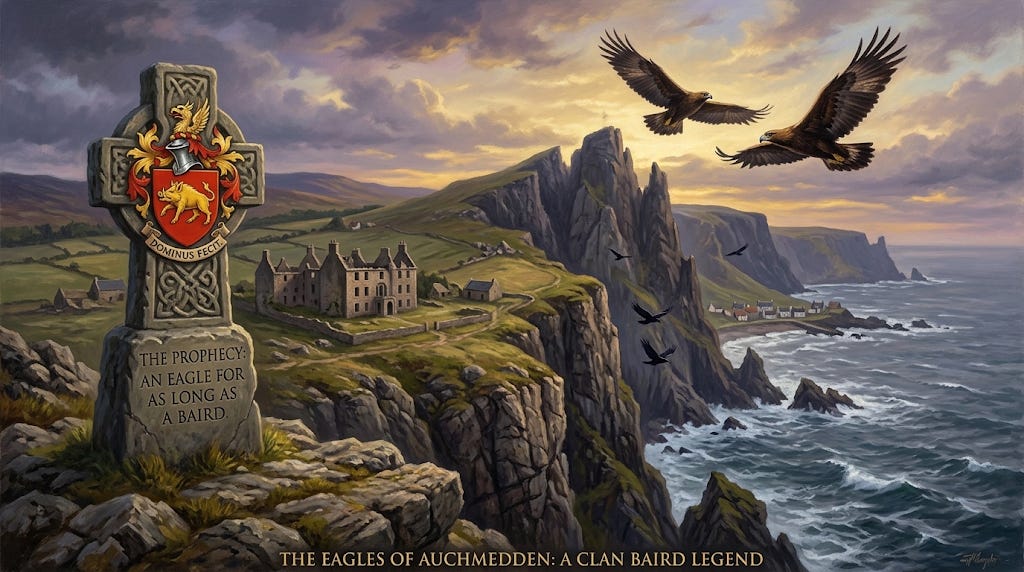
Along the rugged coast of north-eastern Scotland, where cliffs fall toward the North Sea and generations of Bairds once managed the lands of Auchmedden, one of the clan’s most haunting traditions took shape. It was said that eagles nested among the crags overlooking the estate and that their presence was connected to the fortunes of the family itself. According to tradition, the birds were more than inhabitants of the cliffs; they had become living signs of the Bairds’ possession of their ancestral lands. Their appearance, disappearance, and reported return eventually produced one of the most memorable supernatural stories associated with Clan Baird.
The prophecy was attributed to Thomas the Rhymer, the legendary Scottish seer whose name became attached to predictions concerning families, castles, and events throughout Scotland. According to the Baird tradition, Thomas foretold that there would be an eagle in the crags of Auchmedden for as long as there was a Baird in Auchmedden. The prediction was simple, but its meaning was unmistakable: the birds and the family were bound together. As long as the Bairds remained upon the estate, the eagles would remain above them.
The story gains much of its power from the landscape in which it was set. Auchmedden lay along the exposed coast in the parish of Aberdour, within a region historically associated with Banffshire and Aberdeenshire, where rocky cliffs and the nearby settlement of Pennan created an imposing maritime setting. This was not the secluded Highland glen commonly imagined in romantic clan stories, but a working north-eastern estate dependent upon farming, mills, coastal resources, and local trade. Against this practical background, the sight of great birds nesting in inaccessible coastal crags could easily acquire symbolic meaning.
The Baird connection with Auchmedden itself can be placed on much firmer historical ground than the prophecy. On 28 October 1534, Andrew Bard of Laveroklaw purchased Glencuthill, its mill, and Auchmedden from John, Earl of Buchan. The transaction established a documented territorial base that became the centre of the principal chiefly-associated Baird house for more than two centuries. Through successive generations, the estate became so closely identified with the family that Auchmedden and the Baird name were almost inseparable in later genealogical tradition.
The family did not simply possess the estate; its members became embedded in the political and economic life of the north-east. They managed agricultural property, participated in sheriff-court business, cultivated relationships with neighbouring families such as the Keiths and Gordons, and maintained interests connected with the coast near Pennan. By the seventeenth century, the standing of the Auchmedden house was also expressed through heraldry. In 1672 Sir James Baird of Auchmedden registered arms featuring a gold boar on a red field, together with a griffin’s head crest and the motto Dominus fecit, meaning “The Lord made.”
Yet the eighteenth century brought growing difficulties to the old northern estate. Financial pressures accumulated over a period of years, and the aftermath of the Jacobite era later encouraged romantic explanations for the family’s troubles. A popular version of events claimed that Auchmedden was lost because of debts arising from Jacobite loyalty, but the surviving evidence points toward a more complicated combination of family expenditure, estate economics, changing agricultural conditions, and financial strain. In 1755, after more than two centuries of Baird possession, Auchmedden passed out of the family’s hands.
It is at this moment that history and prophecy become entwined. Later tradition claimed that when the Bairds lost Auchmedden, the eagles that had occupied the nearby crags disappeared. To those who believed the old prediction, their departure was not coincidence but fulfilment. The land had ceased to belong to the Bairds, and the birds that supposedly guarded or represented their tenure had gone with them.
Had the legend ended there, it would already have been a striking piece of Scottish family folklore. Instead, later accounts added an even stranger episode, claiming that a Baird descendant eventually repurchased the property and that the eagles returned to the crags. Their reappearance seemed to confirm the prophecy in reverse, as though the birds somehow recognised that the old family had returned. According to the same tradition, when the property subsequently left Baird possession once more, the eagles vanished again.
There is no documentary evidence demonstrating that Thomas the Rhymer actually delivered the prophecy in the thirteenth century, nor can the reported movements of the eagles be treated as established supernatural events. The account survives as family and regional tradition, preserved and repeated by later generations who were interested in the history of the Auchmedden house. This distinction is important because the historical Bairds left behind substantial documentary evidence in charters, court records, heraldic registers, estate papers, and genealogical manuscripts. The prophecy belongs to a different category of evidence: not proof of medieval events, but evidence of how descendants understood and remembered their family’s relationship with the land.
That does not make the story historically unimportant. Family folklore frequently preserves emotions and ideas that legal documents cannot capture, particularly the feeling that a family belongs to a particular landscape. A charter can establish when land was purchased, while an estate account can record rents and expenses, but neither explains what generations of descendants felt when they looked toward the cliffs associated with their ancestors. The eagles transformed those cliffs from geographical features into symbols of continuity, possession, loss, and possible restoration.
The legend also became increasingly meaningful once the Baird name spread far beyond Auchmedden. During the nineteenth century, Bairds emigrated to Canada, the United States, Australia, New Zealand, and other parts of the world, while Victorian interest in Scottish clans encouraged the preservation of tartans, crests, genealogies, legends, and ancestral places. For descendants who might never see the north-eastern coast of Scotland, stories such as the Eagles of Auchmedden provided an imaginative connection with a distant homeland. The birds could therefore represent something larger than one landed family: they became part of the cultural inheritance carried by people bearing the Baird name around the world.
There is something particularly effective about the eagle as the centre of this tradition. Unlike a castle that can fall into ruin or an estate that can be sold, a wild bird cannot be inherited, purchased, or controlled through legal documents. Its presence appears voluntary, making the reported loyalty of the Auchmedden eagles to the Bairds seem all the more mysterious. Whether their movements were coincidence, later embellishment, or folklore created after the loss of the estate, the story gave nature itself a role in remembering the family.
For genealogists, the Eagles of Auchmedden also offer a useful reminder that clan history contains several different kinds of inheritance. There is genealogical inheritance established through births and marriages, territorial inheritance documented through charters, and heraldic inheritance regulated through Scottish law. Alongside them exists cultural inheritance: the stories families preserve because they express something meaningful about who they believe themselves to be. The prophecy belongs to this last category, where its value does not depend upon proving that a medieval prophet literally foretold the behaviour of birds centuries into the future.
Today the cliffs and coastal landscape associated with Auchmedden remain among the strongest geographical links to the historic Baird house. The family’s possession of the estate ended long ago, yet the prophecy continues to be repeated because it gives that loss a dramatic and almost supernatural meaning. The Bairds may have departed, estates may have changed owners, and descendants may now live thousands of miles from Scotland, but the image of eagles circling the crags has survived. In that sense, the legend achieved something even more enduring than the prophecy promised: it ensured that Auchmedden would remain connected with the Baird name long after the family ceased to possess the land.
The story of the Eagles of Auchmedden is only one part of a much larger history. The Complete History of Clan Baird explores the documented origins of the surname, the medieval Bairds of the Scottish Lowlands, Auchmedden, Newbyth and Saughtonhall, Baird heraldry and tartan, General Sir David Baird, the Gartsherrie iron dynasty, migration overseas, John Logie Baird, and the traditions that helped create modern Clan Baird identity. For anyone researching Baird ancestry or interested in the mixture of genealogy, history, landscape, and folklore that surrounds Scotland’s old families, the prophecy of the eagles provides a memorable doorway into a story spanning more than seven centuries.
References
Baird, W. (1770). Genealogical collections, concerning the sir-name of Baird, and the family’s of Auchmedden, Newbyth, and Saughtonhall in particular [Manuscript, Adv.MS.32.6.12]. National Library of Scotland.
Baird, W. (1870). Account of the surname of Baird, particularly of the families of Auchmedden, Newbyth, and Sauchtonhall (W. N. Fraser, Ed.). J. C. Hotten.
Bulloch, J. M. (1934). The Bairds of Auchmedden and Strichen, Aberdeenshire. The Buchan Club.
Littlejohn, D. (Ed.). (1904–1907). Records of the Sheriff Court of Aberdeenshire (Vols. 1–3). University of Aberdeen & New Spalding Club.
National Records of Scotland. (1534, October 28). Charter of sale by John, Earl of Buchan, to Andrew Bard of Laveroklaw of Glencuthill, its mill, and Auchmedden (GD86/106) [Charter]. National Records of Scotland.