Uncover the epic history of Clan Douglas - https://fairbairncrests.com/products/the-complete-history-of-clan-douglas-digital-editon
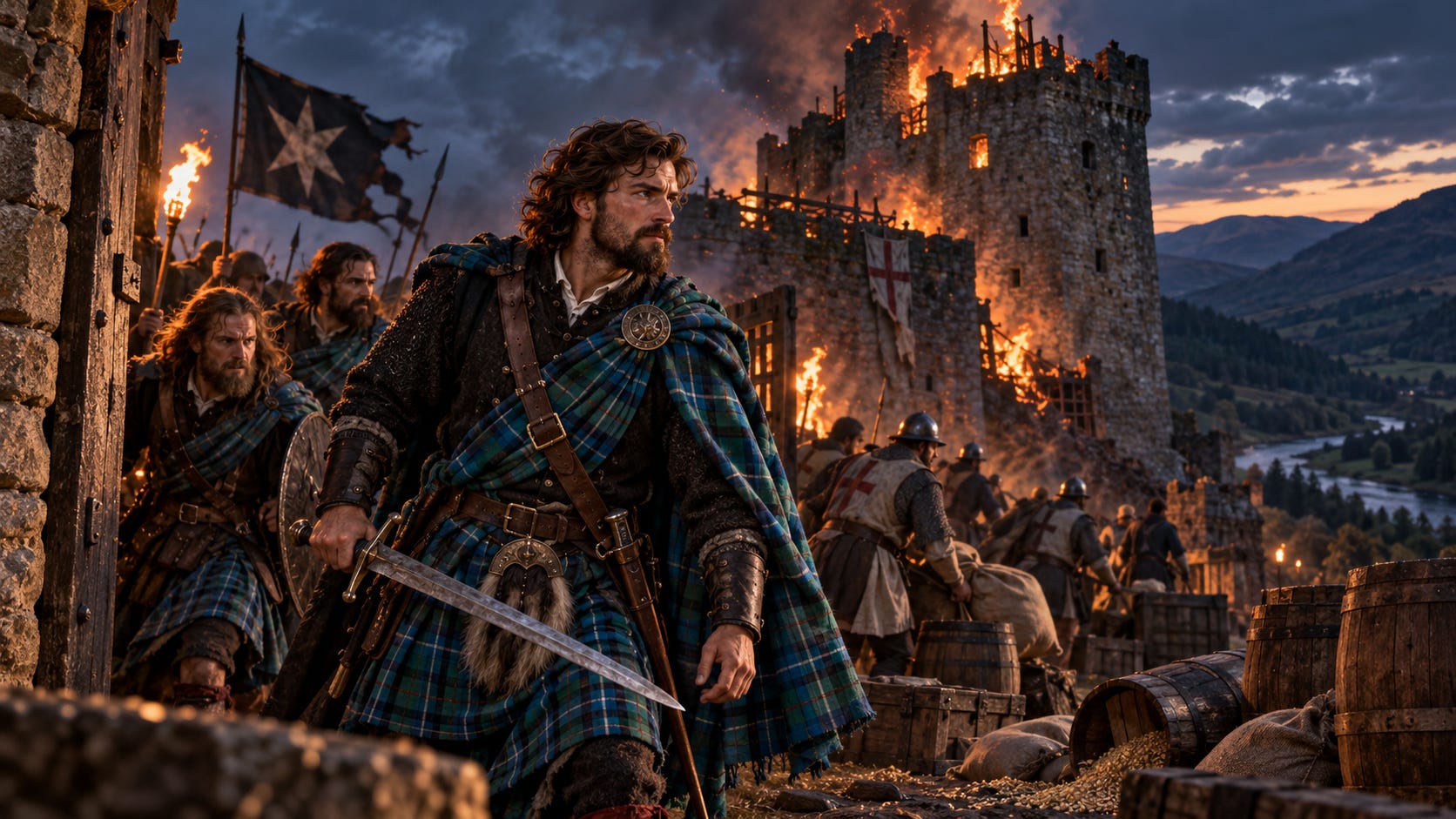
Few episodes from Scotland’s Wars of Independence are as violent, memorable, or difficult to separate from legend as the story known as the Douglas Larder. According to the traditional account, James Douglas returned secretly to his ancestral lands in 1307, surprised the English garrison occupying Douglas Castle, killed its defenders, and destroyed the supplies stored inside. The most gruesome version claims that bodies were thrown together with food, wine, fuel, and other provisions before the castle was set alight. It is the sort of medieval story that sounds almost deliberately designed to be remembered, and that is precisely why historians have to approach it carefully.
To understand why James Douglas would attack his own castle, it is necessary to understand what had happened to his family. His father, William Douglas, remembered as William “le Hardi,” had resisted English authority during the upheavals that followed Edward I’s intervention in Scotland. William was captured and died in English imprisonment, while the Douglas estates were forfeited and granted to the English commander Sir Robert Clifford. James therefore inherited a famous territorial name but not the land, castle, revenues, or political position that traditionally belonged with it. When he returned to Scotland, Douglas Castle was effectively an enemy stronghold sitting in the middle of his own ancestral territory.
The situation changed dramatically after Robert Bruce claimed the Scottish throne in 1306. Bruce desperately needed supporters who knew the countryside and possessed local connections, while James needed a king capable of restoring his inheritance. Their interests aligned, and Douglas became one of Bruce’s most important followers during the difficult years when the new king’s survival was far from certain. Instead of possessing a large army capable of confronting English forces directly, men such as Douglas increasingly relied upon speed, local knowledge, ambushes, surprise attacks, and attacks against enemy supply systems. Douglasdale was particularly suited to that type of warfare.
By 1307, James Douglas had returned to the country surrounding the Douglas Water with a relatively small force. He could not simply march against a defended castle as the head of a conventional army, nor could he necessarily capture and permanently garrison every stronghold he attacked. His advantage was knowing the valleys, woods, tracks, communities, and people surrounding the fortress better than the occupying troops did. Rather than fighting the English on their preferred terms, Douglas could make possession of the countryside increasingly dangerous. Douglas Castle became an obvious target because removing or disrupting its garrison would weaken English control over the entire district.
Our most famous narrative of what happened comes from John Barbour’s The Bruce, one of the great literary accounts of Robert Bruce and the Scottish struggle for independence. Barbour describes Douglas using surprise to penetrate the castle during a religious observance, overpowering the defenders and taking control of the fortress. The prisoners were reportedly killed, while the stores accumulated by the garrison were gathered together with wine and other materials. The bodies and provisions were then supposedly mixed into a horrific heap before the building was burned. Later generations remembered this grisly destruction as the “Douglas Larder.”
It is here that the distinction between history and storytelling becomes especially important. Barbour was not standing at Douglas Castle recording events as they occurred in 1307, and The Bruce was composed decades later. His work contains material that almost certainly preserves genuine memories and traditions, but it is also a great literary poem constructed around themes of courage, loyalty, cleverness, sacrifice, and heroic warfare. Dramatic speeches, perfectly staged confrontations, and gruesome details cannot automatically be read as eyewitness reporting. The further we move from the basic military action into the theatrical details of the Douglas Larder, the more cautious we should become.
That does not mean the entire episode should simply be dismissed as fiction. In fact, the basic strategic purpose of an attack on Douglas Castle fits extremely well with what we know about the warfare being conducted by Bruce and his followers during this period. Scottish forces often lacked the resources necessary to capture, repair, provision, and permanently defend every fortress they encountered. A castle that could not safely be held might be damaged or “slighted” so that the enemy could not immediately use it again. James Douglas therefore had a perfectly rational military reason for attacking an English-held fortress even though it was his own ancestral home.
Destroying provisions would have been equally logical. Medieval garrisons depended upon food, fodder, drink, equipment, and reliable supply routes, and a castle without those resources quickly became more of a liability than an asset. Douglas’s campaigns repeatedly demonstrated an understanding that defeating an occupying army did not always require defeating it in a large pitched battle. If its troops could not move safely, obtain supplies, communicate easily, or rely upon fortified bases, their hold over the countryside weakened. Seen from this perspective, the Douglas Larder was not simply an act of revenge but part of a developing strategy of irregular warfare.
There was also an important psychological dimension. Whether every grisly detail recorded by Barbour happened exactly as described mattered less to medieval soldiers if the story was believed. Imagine being an English soldier ordered to serve at a remote garrison in Douglasdale after hearing that the dispossessed lord of the valley could appear unexpectedly, overwhelm a castle, destroy its stores, and kill its defenders. James Douglas was building a military reputation at the same time that he was recovering political authority. Fear itself could become a weapon, and stories surrounding Douglas increasingly portrayed him as an enemy who might strike without warning.
The attack also carried enormous symbolic significance for the people living in Douglasdale. Sir Robert Clifford might possess a royal grant to the estate, and an English garrison might occupy the castle, but James Douglas was demonstrating that legal possession and military control were not necessarily the same thing. His return told tenants and local followers that the old lordship had not disappeared simply because Edward I had transferred it to somebody else. Every successful raid strengthened Douglas’s credibility and weakened the appearance of permanence surrounding English occupation. The fight for Douglas Castle was therefore also a fight over who truly controlled the valley.
James would refine these methods over the following years and become one of the most formidable commanders associated with Robert Bruce. His operations across southern Scotland relied heavily upon mobility, surprise, knowledge of terrain, and the destruction of enemy logistical networks. His capture of Roxburgh Castle in 1314 provides another example of the same preference for deception and sudden attack rather than conventional siege warfare. By the time of Bannockburn, the dispossessed young noble who had once struggled to recover Douglasdale had become one of the most important military figures in Bruce’s kingdom.
So what really happened during the Douglas Larder? The safest conclusion is that the story probably preserves the memory of a genuine and strategically plausible attack by James Douglas against the English occupation of his ancestral stronghold. The destruction of supplies and denial of the castle to the enemy make excellent military sense within the wider Bruce campaign. What cannot be accepted with equal confidence are all of the macabre details that later made the episode famous, particularly when those details depend heavily upon a literary source written decades afterward. The historical James Douglas does not need every legendary embellishment to remain an extraordinary figure.
In many ways, separating fact from legend makes the story more interesting rather than less. The Douglas Larder was not merely the savage revenge of an angry medieval noble; it represents the moment when a dispossessed heir began turning knowledge of his homeland into military power. James Douglas would eventually recover his position, become one of Robert the Bruce’s closest commanders, fight at Bannockburn, participate in the political defence of Scottish independence, and die in Spain while carrying the heart of his king. The attack on Douglas Castle belongs near the beginning of that remarkable transformation, when the future Good Sir James was still fighting to reclaim the valley from which his family took its name.
The Douglas Larder is only one chapter in the much larger story of a family that rose from Douglasdale to become one of the greatest political and military powers in medieval Scotland. The rise of Good Sir James, the creation of the Earldom of Douglas, the Black Douglases, the Black Dinner, the struggle with James II, the rise of the Red Douglases, and the family’s later transformation are explored in The Complete History of Clan Douglas by Bagtown Clans. For anyone interested in Clan Douglas, Robert the Bruce, Scotland’s Wars of Independence, or the difference between Scottish legend and documented history, the story extends far beyond the walls of Douglas Castle.
References
Bain, J. (Ed.). (1881–1888). Calendar of documents relating to Scotland preserved in Her Majesty’s Public Record Office, London (Vols. 1–4). General Register Office, Scotland.
Barbour, J. (1997). The Bruce (A. A. M. Duncan, Ed. & Trans.). Canongate.
Brown, M. (1998). The Black Douglases: War and lordship in late medieval Scotland, 1300–1455. Tuckwell Press.
Fraser, W. (1885). The Douglas book (Vols. 1–4). T. and A. Constable.
Maxwell, H. (1902). A history of the House of Douglas from the earliest times down to the legislative union of England and Scotland (Vols. 1–2). Freemantle & Co.
Penman, M. (2014). Robert the Bruce: King of the Scots. Yale University Press.