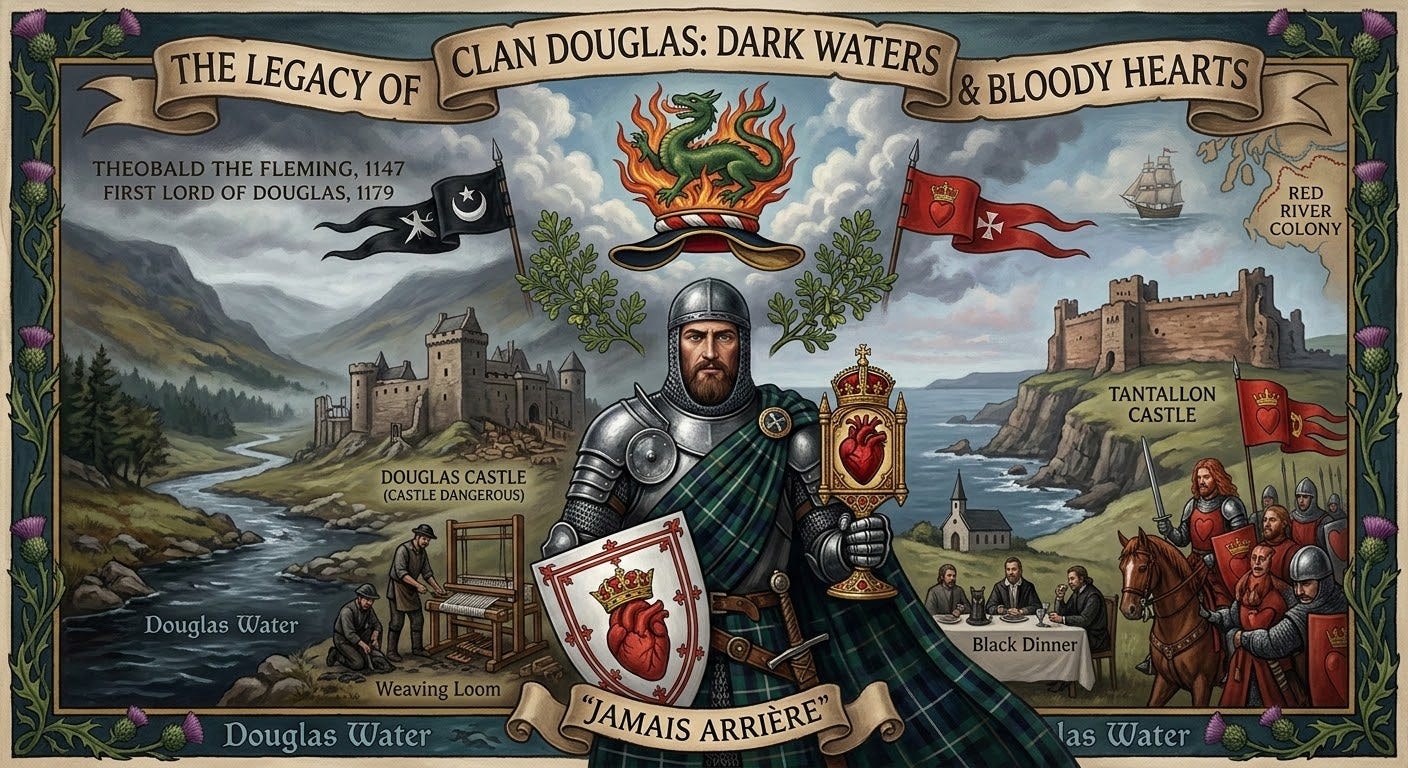
The story of the Douglas clan flows like the dark waters of the Lanarkshire stream from which they take their name. Derived from the Scottish Gaelic words “dubh” meaning dark or black, and “glas” meaning stream, the Douglas name has echoed through centuries of Scottish history. For generations, romanticized mythology suggested the clan was founded in 767 AD by a heroic warrior named Sholto Douglas, who was supposedly granted vast lands after saving King Solvathius in battle. However, documented facts point to a more grounded, though equally fascinating, origin. The true progenitor is widely believed to be a Flemish knight named Theobaldus Flammatius, or Theobald the Fleming, who was granted lands near the Douglas Water in 1147. By 1179, his descendant William de Douglas emerged in official charters as the first Lord of Douglas, setting the foundation for what would become one of the most powerful noble houses in Europe.

As the family’s influence grew, so did their rich tapestry of symbols, which served to unite the clan and intimidate their enemies. The clan’s crest badge features a green salamander wreathed in flames standing upon a ceremonial chapeau, a powerful emblem of their ability to endure and survive the fires of adversity. This resilience is echoed in their plant badge, the hardy rue, and their defiant motto, “Jamais Arrière,” meaning “Never Behind.” To the rallying war cry of “A Douglas! A Douglas!” and the traditional pipe music of Dumbarton’s Drums, the clan marched into countless battles clad in their tartan—a deeply understated and practical sett of dark green, blue, and black, accented by fine white stripes. Perhaps their most famous heraldic symbol is the bloody heart topped with an imperial crown, added to the chiefly arms to honor “The Good Sir James” Douglas, who famously died carrying the embalmed heart of King Robert the Bruce on a crusade to Spain.
From their ancestral origins in Lanarkshire, the Douglases rapidly expanded their territorial grip across the Scottish Borders, Angus, Lothian, Dumfriesshire, Galloway, and Moray. Their power was cemented in stone through a network of formidable castles and seats. Douglas Castle, their original stronghold in South Lanarkshire, was famously destroyed and rebuilt multiple times, earning the moniker “Castle Dangerous.” As their dominance shifted and fractured over the centuries, they established other magnificent fortresses, including the impregnable coastal Tantallon Castle in East Lothian, the magnificent Bothwell Castle, the island fortress of Threave Castle, and the grand Drumlanrig Castle.
As their lands expanded, the genealogy of the clan grew complex, eventually bifurcating into two rival dynastic branches. The senior line became known as the “Black Douglases,” who held the Earldom of Douglas and wielded power that frequently rivaled the Scottish Crown itself. Following their violent downfall, the junior line, the “Red Douglases” or Earls of Angus—often noted for their red hair and ruddy complexions—rose to prominence. Over time, notable cadet branches emerged, including the Earls of Morton, the Marquesses of Queensberry, and even noble offshoots in Sweden and Germany. Recognizing the immense power of the Douglas chiefs, many smaller families sought their protection, binding themselves through marriage or bonds of manrent. These septs and allied families, which include names like Agnew, Bell, Carmichael, Carruthers, Kirkpatrick, and Sandilands, became an integral part of the wider Douglas community.
The sheer ambition of the Douglases inevitably led to bloody conflicts, clan feuds, and a deeply turbulent role in national Scottish politics. Their power reached a boiling point in the 15th century, leading to the infamous “Black Dinner” of 1440, where the young 6th Earl of Douglas and his brother were executed at Edinburgh Castle on trumped-up charges. Tensions culminated in 1452 when King James II personally stabbed the 8th Earl of Douglas to death at Stirling Castle. This sparked a civil war that ended at the Battle of Arkinholm in 1455, where the Red Douglases actually fought alongside the King to crush their Black Douglas cousins, leading to the latter’s total forfeiture. Centuries later, during the Jacobite Risings of 1715 and 1745, the Douglases once again shaped national politics. Unlike many Highland clans that rallied behind the exiled Stuarts, the prominent Douglas lines largely supported the British Government, with the Duke of Douglas leading volunteer horsemen at Sheriffmuir and suffering the burning of Douglas Castle by Bonnie Prince Charlie’s forces.
Beyond the battlefield, the daily economic and cultural life of the Douglas territories experienced profound shifts. In the early medieval period, life in the Douglas valleys revolved around agricultural tenancies and the feudal service owed to the lords. By the 18th and 19th centuries, the local economy transitioned heavily into weaving and then into deep coal mining, which sustained the local populations but eventually caused such severe land subsidence that the remnants of Douglas Castle had to be demolished in 1938. Religiously, the clan shifted from deep medieval Catholicism—burying their lords in the ancient St. Bride’s Church—to becoming intertwined with the Presbyterian Covenanters. It was the Earl of Angus who raised the Cameronian Regiment in 1689 to fight for religious freedom. Throughout these eras, the culture was kept alive by clan arts; pipers heralded their movements, while bards and poets immortalized the terrifying and heroic deeds of the Black Douglas, ensuring their legacy outlasted their political supremacy.
Despite their survival, the traditional clan structure faced a steep decline. While the Lowland Douglases were not subjected to the exact same post-Culloden cultural repressions as the Highland clans, the broader modernization of Scotland, agricultural shifts, and the Highland Clearances drove mass global emigration. Thomas Douglas, the 5th Earl of Selkirk, became a defining figure of this era, using his wealth to sponsor displaced Scottish emigrants and establish farming colonies in North America, most notably the Red River Colony in present-day Canada. This wave of emigration spread the Douglas name and its allied families across the globe, rooting their legacy deeply in the Americas, Australia, and beyond.
In the modern era, Clan Douglas occupies a unique position as an armigerous clan, meaning it currently has no recognized chief. The rightful heir to the chiefdom is the Duke of Hamilton, but because he bears the hyphenated surname Douglas-Hamilton, the rules of the Lord Lyon King of Arms prevent him from matriculating the undifferenced Douglas arms. Nevertheless, the spirit of the clan thrives through modern clan societies. Organizations like the Clan Douglas Society of North America, founded in 1975, actively preserve the heritage through quarterly newsletters, scholarships, and a strong presence at Highland games. Today, whether at triennial global gatherings or local Celtic festivals, descendants of the dark stream gather to celebrate a lineage of unparalleled ambition, survival, and impact.
References
Brown, M. (1998). The Black Douglases: War and Lordship in Late Medieval Scotland 1300-1455. Tuckwell Press.
Clan Douglas Society of North America. (n.d.). About Us. Clan Douglas Society. https://www.clan-douglas-society.org/about-4
Clan Douglas Society of North America. (n.d.). Septs & Allied Families. Clan Douglas Society. https://www.clan-douglas-society.org/sept-allied-families
Clanscape. (n.d.). Complete History of Clan Douglas: Origins, Castles, Stories. Clanscape. https://clanscape.scot/blogs/clans/the-complete-history-of-clan-douglas-origins-castles-and-stories
Historic Environment Scotland. (n.d.). Bothwell Castle: History. Historic Environment Scotland. https://www.historicenvironment.scot/visit-a-place/places/bothwell-castle/history/
Historic Environment Scotland Blog. (2024, February 21). James II and The Black Douglases. Historic Environment Scotland. https://blog.historicenvironment.scot/2024/02/james-ii-and-the-black-douglases/
Maxwell, H. (1902). A History of the House of Douglas from the Earliest Times Down to the Legislative Union of England and Scotland. Freemantle & Co.
ScotClans. (n.d.). Clan Douglas Places & People. ScotClans. https://www.scotclans.com/blogs/clans-d/clan-douglas-places-people
St. Kilda Store. (2023, September 1). Crest Meaning: Douglas. St. Kilda Kilts. https://stkildastore.com/articles/clan-crest-meanings/crest-meaning-douglas
USA Kilts. (n.d.). Clan Douglas - Power, Intrigue and Courage. USA Kilts. https://www.usakilts.com/blog/clan-douglas.html