Uncover the epic history of Clan Ross - https://fairbairncrests.com/products/the-complete-history-of-clan-ross-digital-edition
The history of Clan Ross is filled with royal service, disputed inheritances, shifting alliances and violent struggles over land. Few episodes capture the danger of late medieval Highland politics better than the long-running conflict between the Rosses and the Mackays, a rivalry that eventually culminated in the bloody Battle of Allt a’ Charais, better known in later accounts as the Battle of Altcharrish, in 1487. The story is not simply one of two clans who hated each other for generations. At its heart were valuable lands, competing claims of possession, changing political authority and the brutal consequences that followed when legal arguments and armed force became inseparable.
By the fifteenth century, the Rosses of Balnagown had become an important landed family in northern Scotland. Their ancestors had once been closely connected with the powerful Earldom of Ross, but the earldom itself had passed through other dynastic lines. The Balnagown branch nevertheless retained substantial lands and considerable regional influence. Their position depended on defending those holdings against neighbours who had claims and ambitions of their own.
One of the most important areas of dispute lay in the northern lands associated with Ferincoskry. These territories were valuable not because of some abstract idea of clan prestige, but because land meant rents, grazing, resources, influence and the ability to support followers. Ross interests in the region brought them into direct competition with the Mackays, another powerful northern family whose strength was rooted farther north. When rival families believed that inherited rights, grants or actual occupation supported their claims, disagreement could continue for generations.
The political situation was made even more complicated by the presence of greater regional powers. During much of the fifteenth century, the Lords of the Isles and the holders of the Earldom of Ross exercised enormous influence over northern affairs. Local families often had to secure their position through relationships with these greater lords while simultaneously protecting themselves against neighbouring rivals. A decision made by a superior lord could favour one family’s claim while leaving another convinced that its traditional rights had been ignored.
This was the environment in which the Ross–Mackay struggle developed. The dispute was therefore not simply a private blood feud in the romantic sense later associated with Highland history. Legal title, political allegiance and physical possession all mattered. A family might obtain a formal grant and still face determined opposition from another group already occupying or using the land. When neither side was prepared to surrender, the written charter and the sword could become two different weapons in the same conflict.
Later clan traditions connected some of the most dramatic episodes of the feud with Tarbat. Religious buildings appear prominently in these stories, adding another layer of horror to the memory of the conflict. One strand of tradition describes violence involving Angus Mackay and associates his death with fighting in the Tarbat area, while other versions connect church violence with events much closer to 1487. These accounts were repeated and reshaped over generations, making it difficult to combine them into one perfectly secure sequence of events.
The uncertainty does not make the traditions meaningless. Stories involving men pursued into churches or killed in places associated with sanctuary carried enormous emotional power. A church was supposed to represent worship, protection and sacred ground, so violence committed there could be remembered as something more shocking than ordinary battlefield killing. Such stories helped later generations explain why hostility between neighbouring families became so bitter and why revenge could appear justified.
What historians must resist is the temptation to turn every surviving tradition into a precise eyewitness report. Dates, names, casualty numbers and dramatic speeches often became more elaborate as stories were retold. The surviving evidence does not allow every Tarbat episode to be reconstructed with certainty. What it does show is that the traditions developed within a real environment of competition, retaliation and insecurity involving Ross and Mackay interests in northern Scotland.
By the later fifteenth century, the political structure surrounding the Rosses was itself changing. The MacDonald Lords of the Isles had once combined enormous western power with possession of the Earldom of Ross. That position increasingly alarmed the Scottish Crown, which sought to reduce the independence of powerful regional magnates. The forfeiture of the Earldom of Ross in the 1470s and the eventual destruction of MacDonald political dominance changed the network of authority under which families such as the Rosses of Balnagown operated.
For the Rosses, royal authority could provide useful legal confirmation of their possessions. Yet the collapse of an older political order also created opportunities for rivals to press competing claims. Old agreements could be questioned, and families that had once relied on the protection of a powerful superior might suddenly need new forms of support. Far from ending local violence, political change could actually make disputed property more dangerous.
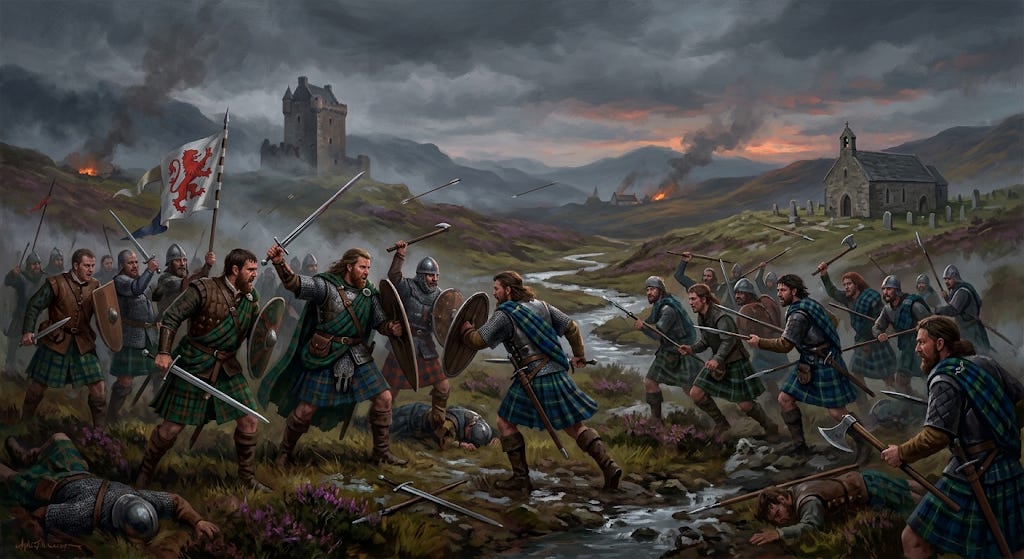
The struggle reached one of its bloodiest moments in 1487 at the battle known as Allt a’ Charais or Altcharrish. The surviving record makes clear that important members of the Ross leadership were killed. Later narratives supplied increasingly detailed descriptions of the opposing forces and the course of the fighting, but the exact numbers involved remain uncertain. What matters most for understanding the history of Clan Ross is the severe damage the battle inflicted upon the family’s leadership and succession.
A medieval battle could have consequences far beyond the men who fell on the field. A dead laird, heir or close relative left lands to be administered, widows and children to be supported, debts to be paid and alliances to be reconsidered. A family that survived militarily could still emerge politically weakened if several important men were killed at once. The losses at Altcharrish therefore threatened not merely the fighting strength of the Rosses but the stability of the network around Balnagown.
This is one reason the Battle of Altcharrish remained significant in later Ross memory. The battle represented the violent result of a dispute that had been building around land and power for years. It showed how a quarrel on the geographical edges of an estate could eventually damage the family at its centre. Remote property was valuable, but defending it required local supporters and placed the owner in direct competition with families whose own authority rested upon the same territory.
The Mackays faced the same underlying reality. They were not simply enemies appearing from nowhere to attack the Rosses. Their own power depended upon northern lands, alliances and the ability to defend claims against neighbouring lords. From their perspective, Ross expansion or continued possession in contested areas could appear just as threatening. The feud becomes more understandable when both families are seen as participants in a regional political system rather than characters in a simple story of heroes and villains.
The aftermath of Altcharrish also reveals something important about how Clan Ross survived. Violence alone did not preserve Balnagown. In 1490, John Ross arranged for the Balnagown lands to pass to his grandson David, using formal legal mechanisms and royal recognition to protect the succession. After years remembered for fighting, the future of the family was secured through documents, inheritance arrangements and the authority of the Crown.
That contrast is one of the most revealing features of the entire feud. Highland lordship depended on the ability to use force when necessary, but it also required charters, agreements, marriages, inheritance planning and cooperation with government. A family that relied only on military strength could lose everything through one disastrous generation. The Rosses survived because their history contained negotiation and administrative skill alongside warfare.
The Ross–Mackay conflict is therefore more interesting than the popular image of two clans simply fighting because their ancestors had always been enemies. The feud grew from specific disputes over property and influence. Political changes surrounding the Earldom of Ross and the Lordship of the Isles repeatedly altered the balance between the families. Violence became part of that struggle, but it was never the only way power was exercised.
The Tarbat traditions and the Battle of Altcharrish also remind us how clan memory is created. Dramatic events survive because they are easy to remember and retell. A killing in a church, a bloody battle or the death of a prominent leader naturally receives more attention than a land charter or inheritance settlement. Yet those quieter documents often explain why the violence happened in the first place.
For descendants of Clan Ross today, Altcharrish stands as one of the darker episodes in a much larger history. It reveals a northern Scotland in which land could determine wealth, security and political survival, and where a disputed claim might remain dangerous across generations. It also shows the cost of maintaining a powerful Highland house in a region filled with equally determined neighbours. The bloodshed was dramatic, but the deeper story concerns the struggle to preserve land, family and authority.
The feud did not define Clan Ross forever. Balnagown survived, the Ross name continued, and later generations faced entirely different challenges involving royal government, religious conflict, debt, migration and changing forms of clan identity. Yet the events surrounding Tarbat and Altcharrish remain essential because they reveal the world from which that later history emerged. They show a clan not as a romantic military brotherhood but as a collection of households trying to preserve their future in an unstable political landscape.
This story is explored in greater depth in The Complete History of Clan Ross, which follows the clan from its medieval origins and the Earldom of Ross through Balnagown, the Wars of Independence, the Jacobite era, Highland social change, overseas migration and the modern clan. The Ross–Mackay struggle is only one episode in that much larger history, but it is one of the clearest examples of how land, politics and memory could combine to produce generations of conflict. Readers interested in Scottish clan warfare, genealogy and Highland history will find that the story of Clan Ross extends far beyond any single battlefield.
References
Adam, R. J. (Ed.). (1991). The calendar of Fearn: Text and additions, 1471–1667. Scottish History Society.
Cochran-Yu, D. K. (2016). A keystone of contention: The earldom of Ross, 1215–1517 [Doctoral dissertation, University of Glasgow].
MacGill, W. (1909–1911). Old Ross-shire and Scotland, as seen in the Tain and Balnagown documents (Vols. 1–2). Northern Counties Newspaper and Printing and Publishing Company.
Munro, J. (1986). The earldom of Ross and the lordship of the Isles. In J. R. Baldwin (Ed.), Firthlands of Ross and Sutherland (pp. 59–67). Scottish Society for Northern Studies.
Munro, J., & Munro, R. W. (Eds.). (1986). Acts of the Lords of the Isles, 1336–1493. Scottish History Society.
Read, H. P. (1908). Rossiana: Papers and documents relating to the history and genealogy of the ancient and noble house of Ross, of Ross-shire, Scotland. Argus Company.
Tain and District Museum. (n.d.). Clan Ross history. Tain and District Museum.