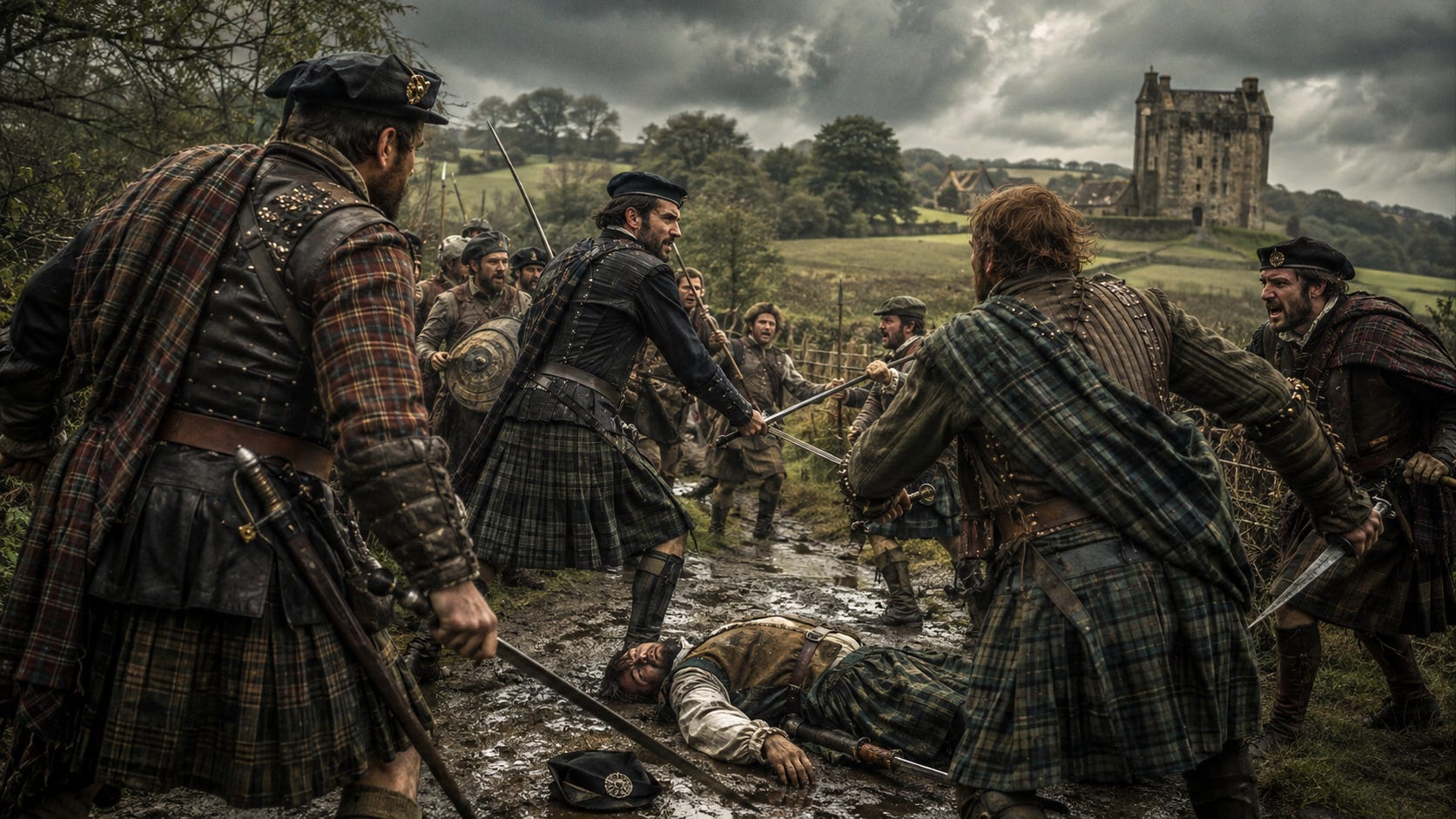
In the middle of the sixteenth century, the green farmland of Renfrewshire could be a dangerous place. The region west of Paisley was divided among landed families whose wealth and influence depended on control of estates, tenants, mills, roads, and local rights. Among them were the Houstouns of that Ilk and the neighbouring Mures of Caldwell. Their rivalry would erupt into one of the darkest episodes in Clan Houston history: a killing in April 1550, an execution only weeks later, and a feud whose consequences lingered for thirty years.
The Houstouns entered this period from a position that was far from secure. Political conflict and debt had already placed serious pressure on the ancestral estate. By 1529, interests in Houston Nethirmaynis, the castle, and its park had been alienated as the family struggled with creditors. When Patrick Houstoun succeeded in 1542, he inherited a territorial position that had to be defended and rebuilt. In sixteenth-century Lowland Scotland, that meant protecting boundaries, controlling revenues, and making certain ambitious neighbours did not exploit weakness.
The Mures of Caldwell were formidable neighbours, with landed interests, kinship networks, and political connections of their own. The precise beginning of the hostility is difficult to reconstruct, but the dispute appears to have grown from familiar ingredients of Lowland rivalry: land, access, jurisdiction, influence, and competing local authority. What began as tension between two landed houses developed into a climate in which both sides could call upon relatives, dependants, and armed supporters.
This was not simply the romantic clan warfare later imagined by Victorian writers. A feud could be brutally practical. A laird had to consider whether tenants would continue to pay rents, whether crops and livestock could be protected, and which neighbouring houses might support an enemy. Armed readiness cost money, while lawsuits and legal disputes could drain an estate almost as effectively as raids. For the Houstouns, still recovering from financial strain, the struggle with Caldwell threatened the stability they had spent years trying to restore.
The confrontation finally turned deadly on 11 April 1550. Robert Mure, a prominent member of the Caldwell family, was killed, and surviving documentary evidence directly implicated Sir Patrick Houstoun and several armed associates in the fatal assault. The killing transformed a territorial quarrel into a serious criminal matter. A member of an important landed family was dead, the Crown’s authority had been challenged by private violence, and both houses now faced retaliation as well as prosecution.
The aftermath reveals the harsh realities of the system. Sir Patrick, as a laird, had the standing to navigate the political and legal consequences. Archibald Houstoun, one of the men implicated in the assault, was not so fortunate. He was apprehended, tried, condemned, and around June 1550 was beheaded for his part in Robert Mure’s death. Within roughly two months, the feud had produced two deaths: Robert Mure through private violence and Archibald Houstoun through royal justice.
Archibald’s execution sent a message beyond the Houston lands. Scotland’s government might struggle to prevent every feud, but it could intervene after blood had been spilled. Service to a powerful house did not guarantee protection when the Crown wanted an example. Blood had been answered with blood, yet the dispute itself remained unresolved.
For the next generation, the shadow of 1550 hung over relations between the families. The killing created questions of compensation, honour, responsibility, and security that could survive long after the men involved were gone. Continuing hostility forced both sides to devote attention and resources to protection. This is one reason the Houston–Mure story is so revealing: feuds were not always sequences of spectacular battles. Their damage could be measured in decades of vigilance, legal expense, political manoeuvring, and distrust.
Scotland was also changing. As the sixteenth century advanced, royal and ecclesiastical authorities increasingly attempted to restrain private warfare among landed families. There was growing pressure to replace revenge with written agreements, arbitration, and financial compensation. The older practice of answering an injury through kin and armed supporters was gradually being forced into a more regulated legal framework. Eventually, the Houstouns and Mures were pushed toward exactly that kind of solution.
The breakthrough came on 7 December 1580, thirty years after Robert Mure’s death. A formal written arbitration was concluded to settle compensation arising from the killing. Preserved among the Caldwell Papers, the agreement shows how a feud that began in violence ultimately ended through documentation, negotiation, and restitution. Neutral arbiters determined what was required to satisfy the aggrieved Caldwell interest, turning a question once answered with weapons into one settled through binding legal terms.
The feud began in a Scotland where local power could still be enforced by armed households and violence could become an extension of politics. It ended in a Scotland increasingly determined to make landed families submit their quarrels to formal arbitration. The Houston–Mure settlement captures the gradual movement from private vengeance toward stronger institutional control.
For Clan Houston, the agreement offered more than peace with Caldwell. It allowed the family to redirect attention toward its estates and regional position. The Houstoun name remained established in Renfrewshire, with cadet branches at places including Colt, Wester Southbar, and Commonside. Having survived the financial problems of the 1520s and the bloodshed of the 1550s, the family entered the closing decades of the century with an opportunity to consolidate rather than fight.
Centuries later, the feud was retold in the romantic language often applied to Scotland’s clan past. Murder, revenge, rival houses, and execution made irresistible material. Yet the surviving records reveal something more interesting than a simple tale of heroic enemies. They show the fragile economics of landed power, the importance of alliances, the reach of royal justice, and the slow replacement of blood feud with legal settlement. The deaths of Robert Mure and Archibald Houstoun are therefore more than a dark family anecdote; they offer a window into how authority actually worked in sixteenth-century Lowland Scotland.
The Houston–Mure feud is only one dramatic episode in a much longer story. The Complete History of Clan Houston follows the family from its medieval roots in Renfrewshire and the origin of “Hugh’s Town” through the Wars of Independence, the Reformation and Covenanting age, the Nova Scotia baronetcy, the loss of the ancestral estate, and the spread of the Houston name through Ulster and North America. For readers with Houston ancestry—or anyone fascinated by the real history behind Scotland’s landed families—the book explores the people, places, conflicts, heraldry, and migrations that carried the Houston name from medieval Renfrewshire into the modern world.
Discover the complete story in The Complete History of Clan Houston, available as a digital edition from Bagtown Clans.
References:
Crawfurd, G. (1818). A general description of the shire of Renfrew: Including an account of the noble and ancient families. J. Neilson. (Original work published 1710)
Metcalfe, W. M. (1905). A history of the county of Renfrew from the earliest times. Alexander Gardner.
Mure, W. (Ed.). (1854). Selections from the family papers preserved at Caldwell. Maitland Club.
Pitcairn, R. (1833). Ancient criminal trials in Scotland: Compiled from the original records and manuscripts, with historical illustrations (3 vols.). Bannatyne Club.