

Bring a piece of this remarkable history into your own home. Download your own copy of The Cumming Crest Badge. It’s a high-quality instant download—perfect for framing, crafting, or your family archives!
Heraldry is far more than a collection of aesthetic designs and antiquated symbols. It is a visual language that records the triumphs, tragedies, and enduring legacies of history’s greatest families. Among the storied clans of Scotland, few have a history as dramatic—or a crest badge as deeply symbolic—as Clan Cumming, historically known as Clan Comyn. Featuring a golden lion rampant grasping a dagger, underscored by the solitary word “Courage,” the Cumming crest badge is a masterpiece of historical commemoration. To truly understand this emblem, one must journey back through a thousand years of royal ambition, catastrophic betrayal, and remarkable resilience.
From Continental Nobility to Scottish Royalty
The story of the Cumming crest begins long before the family ever set foot in the Scottish Highlands. The clan’s origins are rooted in the Norman and Flemish knightly classes of the eleventh century. The name itself is widely believed to be locational, derived from the town of Comines near Lille on the modern border of France and Belgium, or possibly from Bosc-Bénard-Commin in Normandy. The family even boasted a legendary claim of direct descent from the Roman Emperor Charlemagne, cementing their perception of themselves as a lineage of imperial standing.
The family arrived in Britain during the Norman Conquest of 1066 when Robert de Comyn rode alongside William the Conqueror. However, the family’s true rise to power occurred during the “Davidian Revolution” in the twelfth century, when King David I of Scotland invited Anglo-Norman nobles north to help modernize his kingdom. Richard Comyn established the family’s formidable Scottish presence, serving as Chancellor of Scotland.
The most pivotal moment in the clan’s early history was Richard’s marriage to Hextilda of Tynedale, the granddaughter of the Celtic Scottish King Donald III. This brilliant alliance infused the Norman Comyns with ancient royal blood from the House of Dunkeld. From this union, every subsequent Comyn would derive a legitimate claim to the Scottish throne.
The Era of the Wheat Sheaves
By the thirteenth century, the Comyns were arguably the most powerful magnates in Scotland. Through strategic marriages and political maneuvering, they acquired the earldoms of Buchan, Menteith, and Atholl, and the Lordship of Badenoch. They dominated the Scottish government, acting as the de facto rulers during the minority of King Alexander III, and controlled a vast network of impregnable fortresses, including Lochindorb and Inverlochy Castles.
During this golden age of supreme power, the clan’s primary heraldic identifier was not the lion and dagger we know today, but rather a blue shield bearing three golden wheat sheaves, known in heraldry as “garbs.” These garbs were a symbol of the agricultural wealth and prosperity of the Earldom of Buchan. Furthermore, they served as a heraldic pun—known as canting arms—on the name “Comyn,” associating the family name with cumin seeds or grain. The transition from these peaceful, golden sheaves of wheat to the aggressive, weapon-wielding lion of the modern crest perfectly mirrors the violent political collapse the family was about to endure.
Blood at the Altar: The Fall of the Comyns
The apex of Comyn power shattered during the Scottish Succession Crisis. Following the tragic deaths of King Alexander III and his young heir, the Maid of Norway, Scotland was left without a monarch. John “the Black” Comyn, a Guardian of Scotland, was a leading claimant to the throne, though the crown eventually went to his brother-in-law, John Balliol.
When the Wars of Scottish Independence erupted, John “the Red” Comyn—son of the Black Comyn—became a primary leader of the Scottish resistance against the English. However, a bitter and deadly rivalry festered between the Red Comyn and another claimant to the throne: Robert the Bruce.
On February 10, 1306, the two rivals met at Greyfriars Church in Dumfries to negotiate an alliance. The meeting devolved into a heated quarrel, culminating in Bruce drawing his weapon and stabbing the Red Comyn before the high altar. This act of sacrilegious murder fundamentally altered Scottish history. Bruce subsequently launched a ruthless campaign to obliterate the Comyns, stripping them of their vast lands, titles, and castles. The survivors of the Badenoch and Buchan lines were driven into exile or reduced to a minor Highland clan, with the leadership eventually passing to the Cummings of Altyre, who descended from the Red Comyn’s uncle.
Decoding the Modern Crest Badge
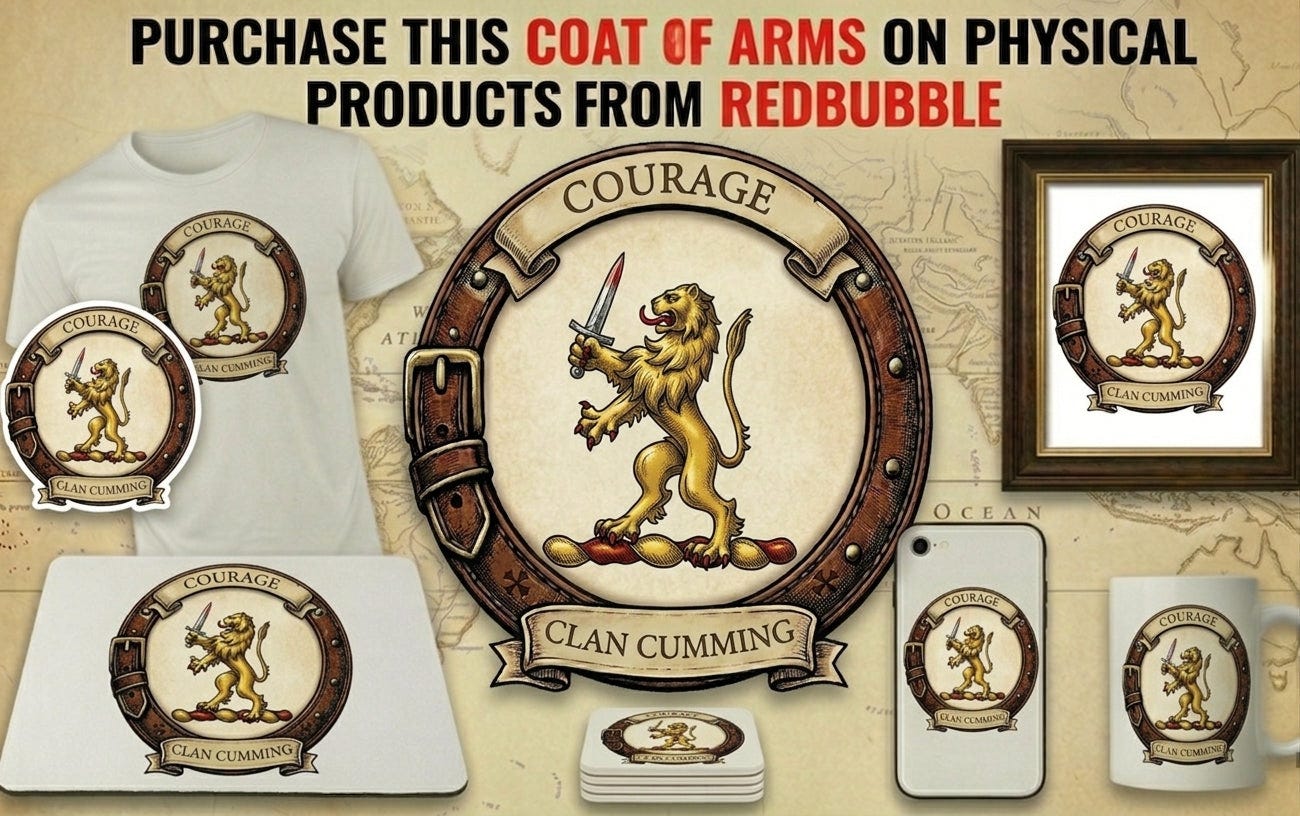
It is within the ashes of this spectacular downfall that the modern Clan Cumming crest badge was forged. Every element of the badge—a lion rampant holding a dagger—speaks to the family’s survival and unyielding pride.
The Lion Rampant is the quintessential heraldic symbol of sovereignty, nobility, and valor. By adopting a golden lion for their crest, the Cummings made a permanent, defiant visual declaration of their royal Celtic bloodline. Even though the Bruces ultimately won the Scottish throne, the Cummings’ golden lion served as a timeless reminder to all of Scotland that they, too, belonged to the kingly caste and possessed a legitimate right to rule.
The Dagger clutched in the lion’s right paw is an incredibly poignant addition. In the specific context of the clan’s history, the dagger is a direct commemoration of the murder of the Red Comyn at Greyfriars. While Robert the Bruce’s allies adopted bloody daggers in their heraldry to boast of the assassination, the Cummings adopted the dagger as a symbol of their own resilience. It was a message to their enemies: though their chief had been struck down by a blade, the clan remained armed, vigilant, and unbowed.
A Philosophy of Survival: The Motto and Plant Badge
This narrative of survival is perfectly encapsulated in the clan’s single-word motto: “Courage.” While many Scottish families adopted elaborate Latin phrases to project academic or ecclesiastical prestige, the Cummings chose a direct, powerful word in the common tongue. For a family that had lost thirteen earldoms and was forced to rebuild their legacy in the Highlands of Moray, “Courage” was not just a motto; it was a daily mandate for survival.
This pragmatic shift is also seen in the clan’s plant badge. Historically, heraldic texts associated the clan with the cumin plant, tying back to the pun on their name. However, because cumin is a Mediterranean herb that does not grow in the Scottish Highlands, practical clansmen could not wear it into battle. Instead, the clan adopted the common sallow, or pussy willow, which grew abundantly on their estates. Wearing a sprig of pussy willow behind their silver crest badge, clansmen would charge into battle shouting their war cry, “An Cuimeanach! An Cuimeanach!”
Wearing the Crest Today
Today, the striking crest of the lion and the dagger remains a vital part of Clan Cumming’s identity. Under the strict heraldic laws of Scotland, monitored by the Court of the Lord Lyon, the actual crest and motto are the exclusive personal property of the Clan Chief—currently Sir Alastair Gordon-Cumming of Altyre. However, clansmen and clanswomen around the world are permitted to wear the chief’s crest in the form of a crest badge. By enclosing the lion and dagger within a silver strap and buckle, wearers proudly declare their loyalty and kinship to the chief.
The Clan Cumming crest badge is a masterful piece of living history. From the peaceful wheat sheaves of their medieval supremacy to the defiant lion and dagger of their Highland endurance, the badge tells a complete story. It is a symbol worn not just with pride, but with the very courage it demands.
--------------------------------------------------------------------------------
References
Bain, G. (1893). History of Nairnshire. Nairn Telegraph Office.
Celtic Studio. (n.d.). Cumming Coat of Arms: Family Clan Crest, Motto. Celtic Studio.
Clan Central. (n.d.). Clan Finder. Clan Central.
Clan.com. (n.d.). Cuming Family | Tartans, Gifts & History. CLAN.
Court of the Lord Lyon. (n.d.). The Court of the Lord Lyon - Scottish Crest Badges. Information Leaflet No. 2.
Coventry, M. (2008). Castles of the Clans: The Strongholds and Seats of 750 Scottish Families and Clans. Goblinshead.
Mac a’ Ghobhainn, C. (2023). Cumming Clan - Bagtown Clans. Bagtown Clans.
St Kilda Store. (n.d.). Crest Meaning: Cumming. St Kilda Kilts & Scottish Gifts.
The Beautiful Times. (n.d.). Scottish Clans (List). The Beautiful Times.
Way, G., & Squire, R. (1994). Collins Scottish Clan & Family Encyclopedia. HarperCollins.