

Among the many legends attached to Scotland’s historic clans, few are as gruesome—or as memorable—as the tale associated with Clan MacLellan and its famous motto, “Think On.” The story involves a dangerous outlaw, a lost estate, a royal promise, a violent confrontation, and the presentation of a severed head before the Scottish king. It is exactly the kind of medieval tale that seems designed to survive around firesides for centuries. Whether every detail happened as later storytellers claimed is another question entirely, but the Black Morrow legend became one of the defining traditions of Clan MacLellan.
The story is rooted in Galloway, the southwestern region of Scotland where the MacLellans established themselves as an important landed family. Their principal territorial association became the lands of Bombie near Kirkcudbright, a royal burgh on the River Dee. Over generations, the MacLellans built influence through landownership, royal service, civic office, marriage, and military obligation. Yet later clan tradition preferred to explain the family’s possession—or recovery—of Bombie through a far more dramatic episode involving a notorious outlaw remembered as the Black Morrow.
According to the traditional version of the tale, the MacLellans had somehow lost possession of the barony of Bombie. Around this time, an outlaw known as the Black Morrow was said to be terrorising Galloway and creating such disorder that royal authority was challenged. The Scottish Crown supposedly offered a remarkable reward: whoever could destroy the outlaw would receive the lands of Bombie. For a MacLellan hoping to recover his family’s position, the offer represented far more than a bounty—it was a chance to restore the family’s territorial fortunes.
The identity of the man called the Black Morrow becomes increasingly difficult to establish as the story moves from folklore into history. Later versions describe him as an exceptionally dangerous bandit whose reputation had spread throughout the countryside, but contemporary medieval records do not provide a secure biography for him. His very name is part of the mystery, and generations of retelling transformed him into an almost archetypal villain. What matters to the legend is that ordinary attempts to defeat him had supposedly failed and that removing him required courage, violence, and determination.
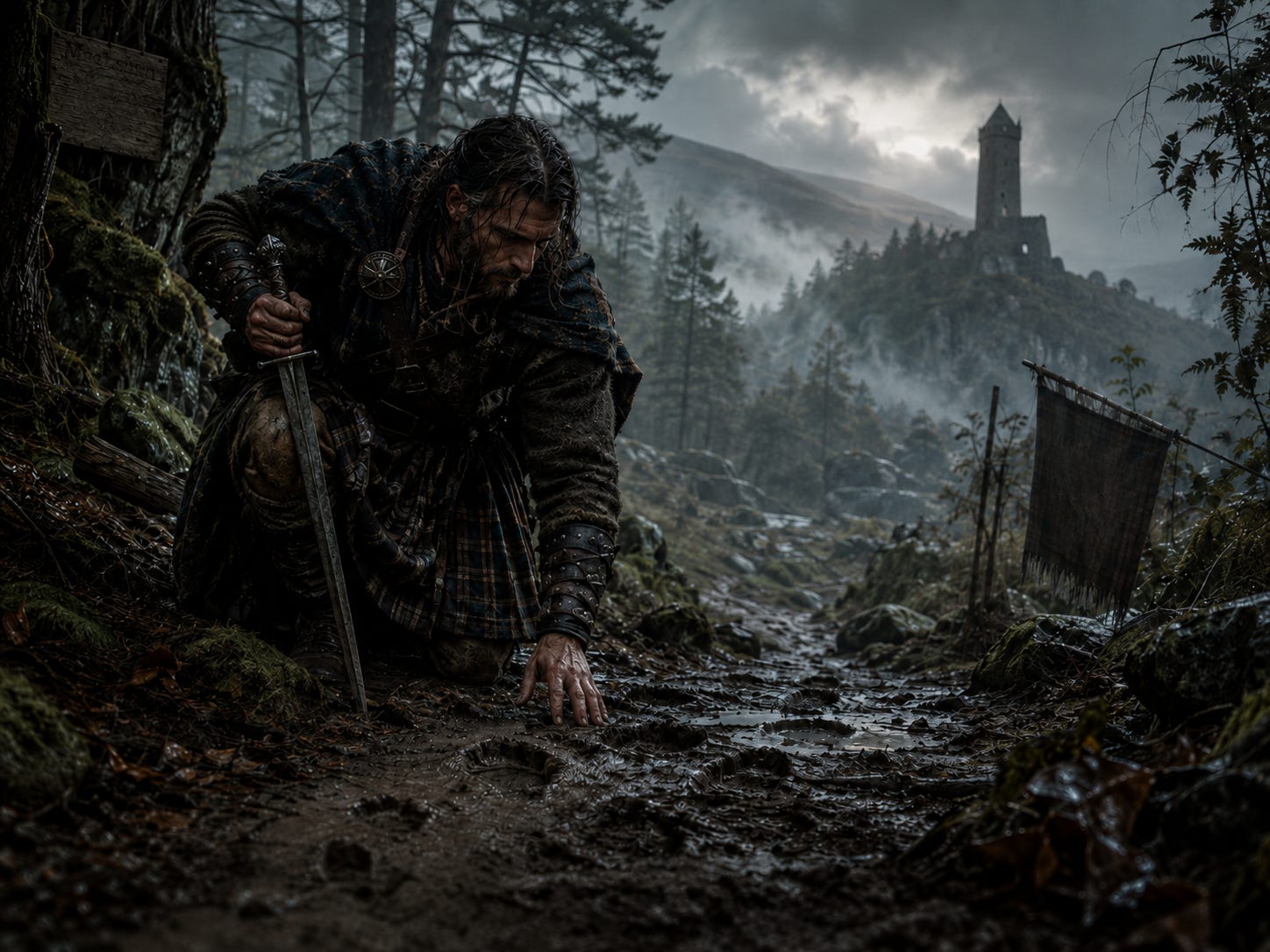
A MacLellan accepted the challenge and set out to find the outlaw. The tradition does not merely portray him as a soldier carrying out royal orders; it casts him as a man attempting to recover the honour and property of his family through personal bravery. Eventually he found the Black Morrow, confronted him, and killed him. To prove beyond any doubt that the task had been completed, MacLellan cut off the outlaw’s head and carried the grisly trophy back to the royal court.
It is at this point that the story becomes unmistakably MacLellan. The victorious clansman appeared before the king carrying the severed head as proof that the outlaw who had terrorised Galloway was dead. The reward, according to the original bargain, was supposed to be the restoration of Bombie. Yet when the moment came to fulfil the promise, the king is said to have hesitated.
MacLellan was not prepared to allow the bargain to be forgotten. Standing before his monarch after completing the bloody task demanded of him, he supposedly reminded the king of the promise with two simple words: “Think On.” In modern English, the phrase can be understood as “remember,” “consider what you promised,” or perhaps more forcefully, “do not forget your word.” The king remembered, Bombie was restored, and according to tradition those two words became permanently associated with the MacLellan name.
The legend also supplied an explanation for some of the most striking imagery associated with MacLellan heraldic tradition. Later descriptions of the family’s heraldry incorporated a severed head carried on the point of a weapon, visually connecting the arms and crest tradition with the killing of the Black Morrow. It is difficult to imagine a more dramatic symbol for a clan identity. Long after the details of medieval land disputes became obscure, the combination of a severed head and the command “Think On” provided a story almost impossible to forget.
That memorability may help explain why the legend survived so successfully. Clan traditions were not preserved only because they offered precise records of legal transactions; they survived because they told later generations what sort of people their ancestors were believed to have been. In the Black Morrow story, the MacLellan hero is courageous, persistent, loyal to the Crown, determined to recover his inheritance, and willing to remind even a king that a promise carried obligations. Those qualities created a powerful family narrative regardless of whether every episode can be demonstrated through surviving medieval documents.
The difficulty comes when legend is treated as documentary history. No known contemporary charter, parliamentary record, or Exchequer account confirms the Black Morrow episode in the form later generations told it. The surviving records concerning the MacLellans’ rise and their possession of lands in Galloway instead point toward the less theatrical world of royal grants, civic office, political alliances, and changing regional power. In particular, the family’s fortunes were deeply affected by the destruction of Black Douglas power in the fifteenth century, after which the MacLellans expanded their position within Kirkcudbrightshire.
This does not mean that the Black Morrow story should simply be discarded as false. Oral traditions can preserve distant memories while dramatically changing names, motives, chronology, and dialogue during centuries of retelling. It is possible that some forgotten conflict, outlaw episode, military service, or recovery of property lies somewhere behind the legend, although the surviving evidence cannot demonstrate such a connection. The responsible approach is therefore to appreciate the tale as an important part of MacLellan cultural memory without presenting its colourful details as proven medieval fact.
Much of the version familiar today owes its survival to the nineteenth-century antiquarian revival of Scottish history. Writers such as P. H. M’Kerlie and Sir Andrew Agnew collected enormous quantities of Galloway history, genealogy, property traditions, folklore, and stories about the region’s old families. Their work preserved material that might otherwise have disappeared, but Victorian historical writing frequently blended documentary evidence with inherited tradition more confidently than modern historians would. Once stories such as the Black Morrow appeared in respected printed histories, they acquired a permanence that oral tradition alone could rarely provide.
The rise of Victorian clan culture also encouraged readers to search for dramatic explanations behind crests, mottos, castles, tartans, and surnames. A mysterious heraldic emblem invited a story, and the Black Morrow narrative supplied a magnificent one. The severed head explained the imagery, while “Think On” supplied the perfect dialogue for the moment when the MacLellan hero demanded his reward. Over time, the legend and the symbols reinforced one another until separating one from the other became almost impossible in popular clan memory.
Scottish heraldry, however, is more complicated than the popular idea of a single “family coat of arms.” Arms traditionally belong to particular armigers rather than automatically to everyone sharing a surname, and historical descriptions associated with the Lords Kirkcudbright require caution. The Scots Peerage noted that arms attributed to the MacLellan lords by heraldic writers were not recorded in the Lyon Register in the manner that might be expected. This uncertainty makes the development of the Black Morrow tradition even more fascinating, because it demonstrates how heraldry, folklore, antiquarian writing, and clan identity could grow together over centuries.
For modern MacLellans and McLellans around the world, the motto has arguably become more important than the literal historical accuracy of the legend that explains it. “Think On” is short enough to be remembered instantly but broad enough to carry many meanings. It can suggest remembering one’s promises, remembering one’s ancestors, considering the consequences of one’s actions, or simply refusing to forget where one came from. For a family whose name eventually travelled far beyond Galloway through migration and diaspora, that message possesses an obvious emotional power.
The survival of the story is particularly remarkable because the political world that created the old MacLellan landed power eventually disappeared. The Bombie estates passed away from the family’s control, the Lords Kirkcudbright suffered severe financial decline, the peerage eventually became dormant, and MacLellan’s Castle itself fell into ruin. Yet the Black Morrow and “Think On” survived when estates and titles did not. Stories proved more portable than castles, allowing descendants in Scotland, North America, Australasia, and elsewhere to carry a fragment of Galloway with them.
Perhaps that is the real significance of the Black Morrow legend. The most important question may not be whether a medieval MacLellan literally walked into a royal court carrying the head of an outlaw and spoke exactly two words to a hesitant king. The deeper historical question is why generations of MacLellans continued to tell the story and what it expressed about the identity they wished to preserve. It transformed the loss and recovery of land into a tale about courage, memory, royal obligation, and the restoration of family honour.
Today, the ruined MacLellan’s Castle at Kirkcudbright provides a physical reminder of the family’s former power, while “Think On” carries the story into the present in only two words. One belongs to stone and documented history; the other belongs partly to folklore and inherited memory. Together they demonstrate why Scottish clan history is often most fascinating at the point where archival evidence and centuries-old storytelling meet. The Black Morrow may remain hidden behind the uncertainties of the medieval past, but the legend created in his name has unquestionably become part of the enduring heritage of Clan MacLellan.
For readers who would like to go beyond the legend, The Complete History of Clan MacLellan explores the MacLellans of Bombie, the family’s deadly conflict with the Black Douglases, MacLellan’s Castle, the Lords Kirkcudbright, the Covenanter era, migration, heraldry, tartan, genealogy, and the development of modern clan identity. It also examines the difference between popular traditions and what the surviving historical evidence can actually establish. The result is the broader story behind the famous name, the ruined castles, and the unforgettable command that has travelled through generations: Think On.
References
Agnew, A. (1893). The hereditary sheriffs of Galloway: Their “forebears” and friends, their courts and customs of their times, with notes of the early history, ecclesiastical legends, the baronage and place-names of the province. David Douglas.
Balfour Paul, J. (Ed.). (1908). The Scots peerage, founded on Wood’s edition of Sir Robert Douglas’s peerage of Scotland (Vol. 5). David Douglas.
M’Kerlie, P. H. (1870–1879). History of the lands and their owners in Galloway. William Paterson.
Scotland. (1878–1908). Rotuli scaccarii regum Scotorum: The Exchequer rolls of Scotland (Vols. 1–23). H.M. General Register House.
Scotland. (1882–1914). Registrum magni sigilli regum Scotorum: The register of the Great Seal of Scotland. H.M. General Register House.