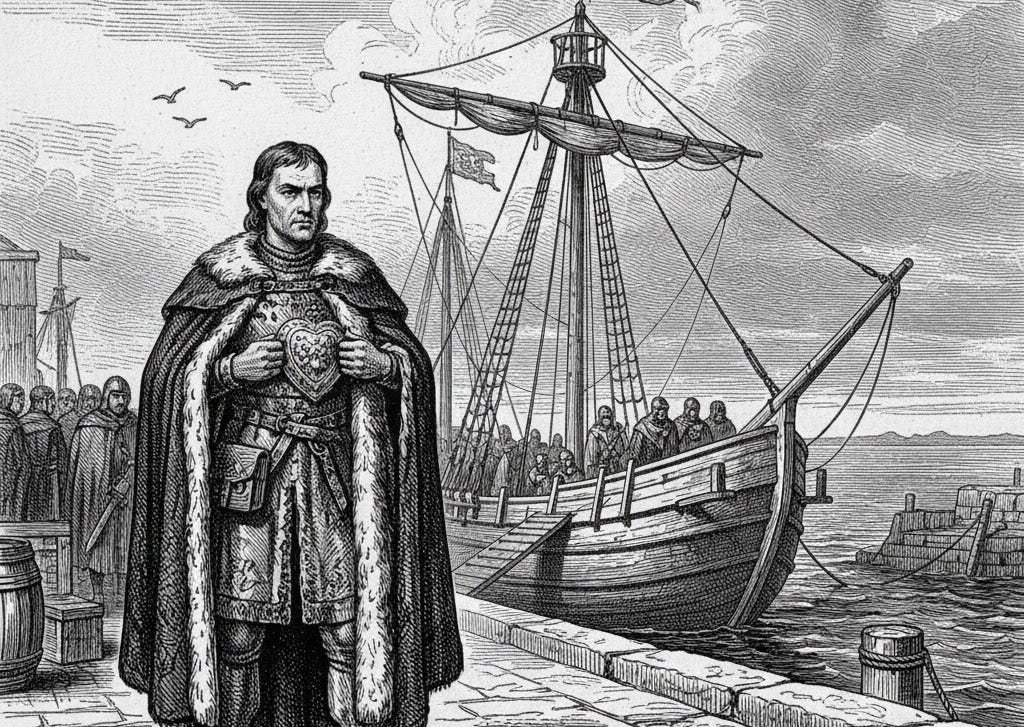
The Black Douglas: The Epic Story of Good Sir James Douglas—now available on Amazon— tells the unforgettable tale of the knight who carried not only the fate of a nation on his shoulders, but the literal heart of its king. Few stories in medieval history are as haunting, heroic, and emotionally powerful as James Douglas’s final mission: to bear Robert the Bruce’s heart toward the Holy Land and fulfill the king’s dying wish.
A Promise Made at the Edge of Death
In 1329, as King Robert the Bruce lay dying, he called for the man who had stood with him through every hardship of the Wars of Independence. James Douglas—Bruce’s most trusted lieutenant, his “right hand,” his shadow in battle—sat by the king’s bedside during the final hours. Their bond went far beyond commander and knight; they were, in every meaningful sense, family.
Bruce had one last wish:
That his heart, once removed and embalmed, be carried to the Holy Sepulchre in Jerusalem.
Too sick to travel himself, the king entrusted the task to the one man whose loyalty had never wavered. Douglas accepted the charge without hesitation. It was an oath that would take him across continents—through storms, foreign courts, holy wars, and ultimately into legend.
Bruce’s heart was placed inside a beautiful silver and enamel casket, hung on a chain so that Douglas could wear it close to his own chest. And so the knight who had carried Scotland through fire now carried its king.

Leaving Scotland Behind
Early in 1330, Douglas gathered a band of hand-picked companions—men who had fought beside him for years—and set sail from Berwick. The ship cut through the cold North Sea, leaving behind the land that Douglas had defended since youth.
For the first time in decades, he was not riding to raid an English garrison or defend a Scottish fort. He was riding for a spiritual mission. A vow. A farewell.
At sea, Douglas spent long nights at the prow, the wind whipping his cloak, one gauntleted hand resting over the silver casket. Companions later said that he often whispered to it, speaking to Bruce as if the king still rode at his side.
Perhaps, in a way, he did.
A Knight in a Strange Land
The crusading world Douglas expected to find in the East had changed dramatically. The long wars had exhausted armies and fractured kingdoms, and it quickly became clear that reaching Jerusalem directly would be close to impossible. But word reached him that King Alfonso XI of Castile was preparing a campaign against the Muslim kingdom of Granada—a cause that many European knights viewed as part of the same sacred struggle.
Douglas, believing this aligned with Bruce’s dying wish to fight “against God’s foes,” decided to ride south. The Scots sailed to the port of Sluys, then traveled across Europe to the sun-drenched courts of Castile.
Here, Douglas and his men found themselves stunned by new languages, foods, and customs: richly colored banners, Moorish-influenced architecture, and bright sun that felt almost alien to warriors raised on mist-covered glens. Yet wherever they rode, they carried Scotland’s pride—and Bruce’s heart—with them.
When they arrived at King Alfonso’s court, the young king was astonished by the tale they brought: a band of northern knights carrying the embalmed heart of a dead king across the world to fulfill a final oath. Douglas, already legendary in Britain, now became a figure of wonder on the Continent.
Toward Teba—and Destiny
In the summer of 1330, the Castilian army marched south to confront the Granadan forces around the fortress town of Teba. Douglas and his Scots rode with them, their dark armor and rugged demeanor setting them apart from the brilliantly dressed Iberian knights.
For days they fought in unfamiliar heat, chasing skirmishers and maneuvering across dusty hills. At last, during a chaotic engagement near the town, a small force of Granadan cavalry pretended to flee. Douglas—ever bold, ever eager to seize the enemy’s weakness—pursued with only a handful of his closest men.
The retreat was a trap.
As Douglas crested a ridge, a much larger force swept in behind him, cutting him off from the Castilian lines. The Scots fought desperately, blades flashing under the burning sun. Douglas, realizing escape was impossible, made one final, fateful decision.
The Legend of the Heart
Later chroniclers would tell the moment differently: some said Douglas pulled the casket from around his neck and hurled it into the enemy ranks with the cry, “Lead on, brave heart, I follow thee!” Others said he simply pressed it to his chest as he charged.
Whether the dramatic gesture truly happened or was born from the imagination of poets like John Barbour and, centuries later, Sir Walter Scott, the meaning remains the same:
In his final charge, Douglas followed his king one last time.
The Scots were overwhelmed. Douglas fell in battle, far from the glens he loved, with Bruce’s heart lying against his own until the final breath left him.
Homeward Bound—A Journey Completed
After the battle, surviving Scots recovered Douglas’s body and the precious silver casket. Among them was Sir William Keith, who had missed the battle due to injury—an absence that fatefully preserved him for his last duty.
Keith carried Douglas’s bones back to Scotland, where they were laid to rest at St Bride’s Church in Douglas. Bruce’s heart was interred at Melrose Abbey, where pilgrims still visit his memorial today.
Douglas’s family later incorporated a crowned, bloody heart into their coat of arms—a symbol still recognized as one of the most striking emblems in Scottish heraldry.
The Black Douglas Lives On
Today, James Douglas remains two figures in memory:
Good Sir James, beloved of the Scots—loyal, courageous, and steadfast.
The Black Douglas, whispered about by the English—a phantom knight of the night, the terror of border castles.
Yet beyond legend and myth is something deeper:
a man who carried two hearts—his own, fierce and loyal, and the one entrusted to him by his king.
His final journey is a reminder that heroism is not always measured by victory. Sometimes it is measured by fidelity, by the weight of a promise carried across the world, by a man who held loyalty above life.
And if you would like to experience James Douglas’s story in full depth—from his youth in Douglasdale to his final charge in Spain—be sure to read The Black Douglas: The Epic Story of Good Sir James Douglas, now available on Amazon. It’s the definitive telling of one of Scotland’s greatest heroes and the oath that defined him.