Uncover the epic history of Clan Farquharson - https://fairbairncrests.com/products/the-complete-history-of-clan-farquharson
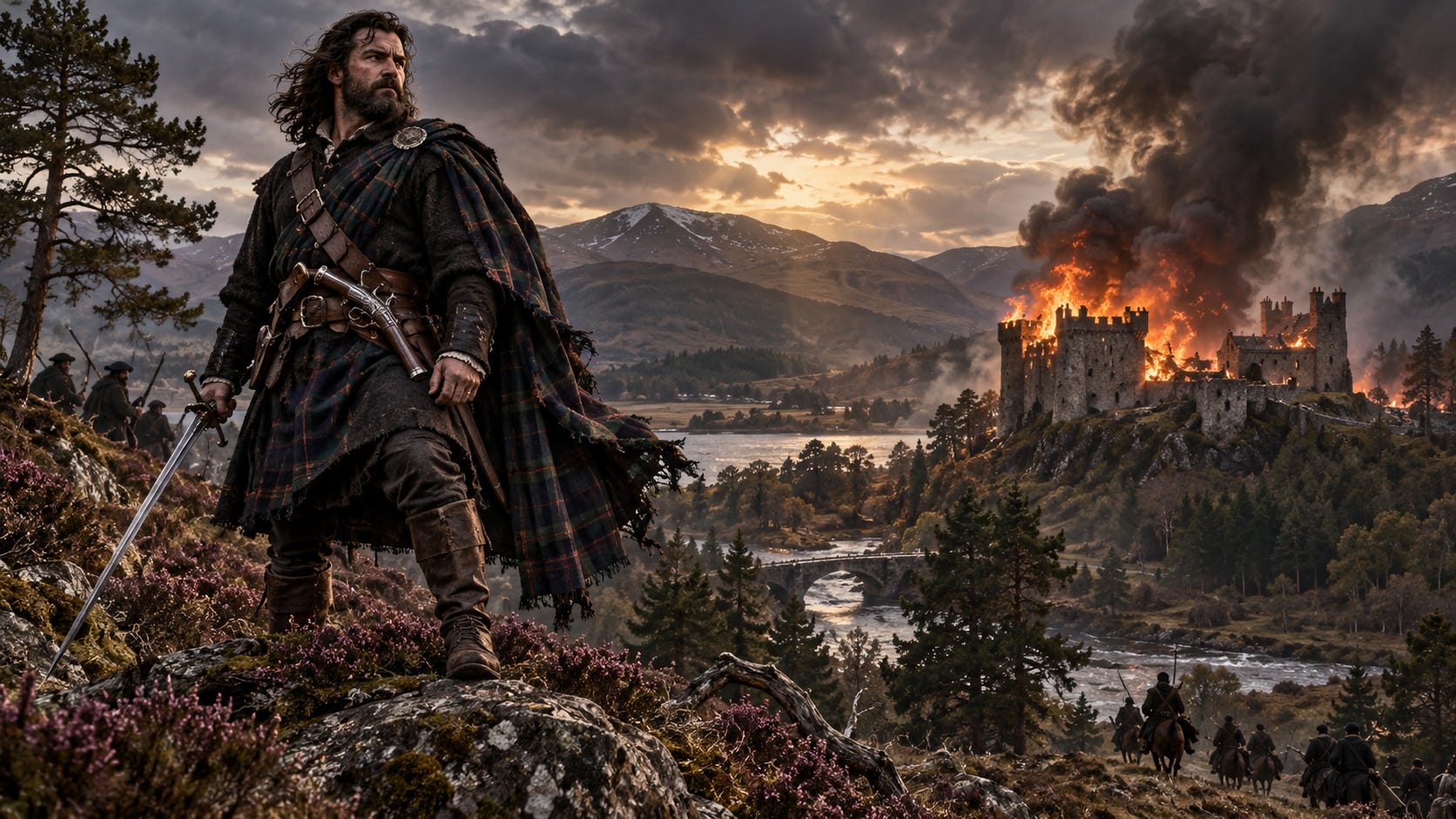
The history of Clan Farquharson contains soldiers, Jacobites, landowners and larger-than-life personalities, but few figures are as compelling as John Farquharson of Inverey. Remembered to later generations as the Black Colonel, he became connected with killing, outlawry, rebellion, the destruction of Braemar Castle and a remarkable collection of escape stories. His life stands at the point where documented history begins to merge with Highland folklore, making it difficult to separate the man completely from the legend. What can be established is dramatic enough: John lived during one of the most unstable periods in Scottish history and repeatedly found himself on the dangerous side of disputes involving law, politics and armed force.
John belonged to the Inverey branch of the Farquharsons, a family already associated with royalist military service during the seventeenth century. That background mattered because Inverey was not simply another farm or minor household in Deeside. The branch possessed a reputation for producing men willing to take up arms, and John inherited both that reputation and the expectations that accompanied it. His famous nickname, the Black Colonel, has been explained in different ways, including references to his complexion or dark hair, but no single explanation can be demonstrated with certainty. Whatever its original meaning, the name eventually became inseparable from the image of a formidable Highland leader.
The event that first pushed John into lasting notoriety occurred in September 1666 and involved John Gordon of Brackley. The dispute appears to have grown from the enforcement of fines, the seizure of livestock and disagreement over the way local authority was being exercised. According to one version, Gordon was carrying out legitimate enforcement when Inverey and his companions deliberately provoked a confrontation by taking cattle. According to the Farquharson account, however, attempts had been made to negotiate and Gordon was the aggressor when violence finally broke out. The encounter ended with deaths and created the foundation for one of Deeside’s most enduring stories.
The disagreement over what happened at Brackley is part of what makes the episode so fascinating. The Gordon tradition portrayed Inverey’s party as violent attackers, while the Farquharson defence presented them as men responding to unfair treatment and sudden aggression. Both accounts were shaped by people who had reasons to defend one side, and neither can simply be accepted because it produces the more exciting version of the story. What seems clear is that a dispute over fines and livestock escalated into an armed confrontation in which men were killed. For John Farquharson, the consequences helped establish a reputation that would follow him for the rest of his life.
The killing eventually entered popular culture through the ballad usually known as The Baron of Brackley. Like many traditional ballads, the story did not remain a straightforward report of an event but developed into a powerful drama filled with betrayal, danger and domestic tragedy. Brackley’s wife became an important character in some versions, where she was accused of encouraging her husband towards danger and later welcoming his enemy. Surviving property records tell a quieter story, showing Margaret Burnet managing the affairs of the Brackley estate after her husband’s death rather than confirming the sensational accusations of the song. The contrast demonstrates how quickly real violence could become transformed into legend.
John’s later career placed him in an even larger conflict. In 1688, King James VII was displaced and William and Mary assumed the throne, producing the political cause that became known as Jacobitism. For men such as John Farquharson, the struggle was not simply a distant argument about who should rule in London or Edinburgh. Loyalty to the displaced Stuart monarchy could draw Highland families into military action, forcing them to decide how far they were willing to risk property, liberty and life. Inverey chose active resistance and became associated with the rising led in Scotland by John Graham of Claverhouse, Viscount Dundee.
The Jacobite Rising of 1689 gave the Black Colonel the military setting for which he is best remembered. Dundee gathered supporters from several Highland districts in an attempt to restore James VII, and Inverey became one of the Farquharsons connected with that movement. It is important, however, not to imagine that every Farquharson automatically followed him. The clan consisted of different branches and households with their own interests, and Inverey’s participation did not amount to a unanimous declaration by every person bearing the name. John’s importance came partly from the military reputation of his particular branch and his willingness to act when others faced different circumstances.
One of his most dramatic actions took place surprisingly close to home. Braemar Castle had been constructed earlier in the century for the Earl of Mar and stood as a visible expression of authority in Upper Deeside. During the rising, a substantial building like Braemar Castle could provide accommodation and a useful base for troops supporting the new government. Inverey and his party therefore burned the castle in 1689, denying its straightforward use to their opponents. The act connected a national struggle over the monarchy with the destruction of a familiar building in the heart of Farquharson country.
Burning Braemar Castle also demonstrates the complicated nature of clan politics. Farquharson households had long operated within relationships involving the Earls of Mar, neighbouring landowners and the Scottish government. Those older ties did not prevent a Farquharson leader from attacking property associated with Mar when political circumstances changed. The Black Colonel’s actions show how national crises could overturn relationships that had previously helped maintain local order. His Jacobitism was therefore not an abstract romantic loyalty but a political choice with visible consequences in his own district.
Dundee’s forces won a famous victory at the Battle of Killiecrankie in July 1689, but the victory came at an enormous cost when Dundee himself was killed. His death weakened a movement that depended heavily upon personal leadership and alliances among different Highland interests. For men such as Inverey, the disappearance of the rising’s most effective commander changed the prospects of the entire cause. The Jacobite struggle continued, but the opportunity created by the victory could not be turned easily into political restoration. John was left associated with a defeated movement and vulnerable to the authorities who now regarded such resistance as rebellion.
It is after this point that the Black Colonel’s story moves most dramatically into folklore. Traditions describe him hiding among the rocks, ravines and remote places around Inverey while government forces searched for him. The best-known location associated with these stories became known as the Colonel’s Bed, a natural hiding place in the landscape near Inverey. According to later tradition, local knowledge and the assistance of sympathetic residents allowed him repeatedly to evade capture. Whether every narrow escape happened exactly as later storytellers described it is impossible to establish, but the persistence of the stories reveals how strongly John became connected with the landscape.
The image of the fugitive Black Colonel has everything required for a Highland legend. He was an armed Jacobite leader pursued by a government he refused to recognise, hiding within mountains and glens he knew better than his pursuers. Local people could become part of the drama by sheltering him, warning him or helping him disappear into country inaccessible to outsiders. Over generations, the story naturally accumulated colourful details, and some versions gave John an almost supernatural ability to escape danger. The historical man gradually became a folk hero whose survival seemed to demonstrate the power of local loyalty and intimate knowledge of the Highlands.
Yet reducing the Black Colonel to a romantic outlaw would miss much of what makes him historically interesting. The surviving evidence places him at the centre of genuine violence in 1666 and later connects him to armed Jacobite resistance and the deliberate burning of Braemar Castle. The accusations against him were not merely invented by later enemies, but neither were all the heroic stories told by admirers contemporary eyewitness accounts. His life survives through a mixture of legal arguments, family memory, ballad, political history and local folklore. That mixture is precisely why he remains one of the most intriguing figures in the Farquharson story.
Was John Farquharson of Inverey really the most dangerous Farquharson of Deeside? The question may never have a simple answer, because “dangerous” depends upon whether he is viewed by his relatives, his opponents, government officials or later storytellers. To his enemies he could appear a violent rebel and outlaw; to sympathetic tradition he became a courageous defender of family, country and Stuart loyalty. What cannot be denied is that few Farquharsons left such an extraordinary combination of bloodshed, rebellion, castle destruction and legend behind them. More than three centuries later, the Black Colonel still occupies the shadowy territory between history and folklore where some of the Highlands’ most memorable stories were born.
The story of the Black Colonel is only one episode in the much larger history of Clan Farquharson. The Complete History of Clan Farquharson follows the clan from its origins in the Braes of Mar through the rise of Invercauld and its cadet branches, the civil wars, the Jacobite risings, Culloden, estate development, migration, tartan, heraldry and modern clan life. Readers who want to understand how figures such as John of Inverey fit into the broader history of Deeside will find the battles and legends placed alongside the land, families and surviving records that shaped them. The result is a story that reaches far beyond the Black Colonel while showing exactly why men like him became impossible to forget.
References
Child, F. J. (Ed.). (1965). The English and Scottish popular ballads (Vol. 4). Dover Publications. (Original work published 1890–1892)
Michie, J. G. (Ed.). (1901). The records of Invercauld, MDXLVII–MDCCCXXVIII. New Spalding Club.
Michie, J. G. (1908). Deeside tales: Or men and manners on Highland Deeside since 1745. D. Wyllie & Son.
Fraser-Mackintosh, C. (1898). Minor septs of Clan Chattan: No. XVII, the Farquharsons, Clan Fionlay, part first. The Celtic Monthly, 7, 11–12.