Want to discover the complete story of Clan Carmichael? - get your digital copy of The Complete History of Clan Carmichael ebook
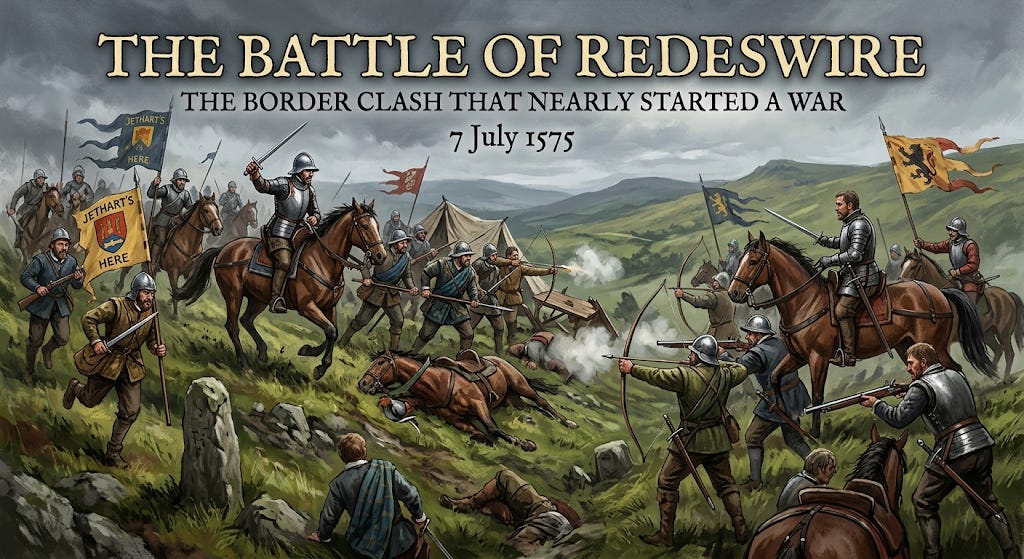
On 7 July 1575, two groups of armed men climbed toward Carter Bar on the Anglo-Scottish frontier. They had assembled for a Day of Truce intended to settle cross-border crimes, not for a raid or declared battle. Sir John Carmichael represented Scotland, while Sir John Forster came as the English Warden of the Middle March. Before the meeting ended, blood covered the hillside, Forster was a prisoner and two kingdoms faced a dangerous diplomatic crisis.
The Anglo-Scottish Border was not simply a line on a map, but a frontier where loyalty to a surname or riding family could matter more than obedience to a distant monarch. Reivers crossed the hills to steal cattle, burn farms, collect blackmail and avenge old injuries. England and Scotland divided the region into Marches governed by wardens who recovered property, delivered fugitives and tried to stop local feuds from becoming international conflicts. At formal Days of Truce, officials met under promises of safe conduct to hear complaints and dispense justice. Yet everyone arrived armed and accompanied by men with unresolved grudges, concentrating the very feuds the meeting was supposed to control.
Sir John Carmichael of that Ilk was a Lanarkshire landholder whose career had been shaped by service to the Scottish Crown. After supporting the king’s party during the civil war, he earned the confidence of Regent Morton and received authority on the frontier. Across from him stood Sir John Forster, one of northern England’s most seasoned and formidable officers. Both wardens understood the Border’s tangled alliances and the danger of appearing weak before the riding families. At Redeswire they carried the prestige of their governments into a discussion surrounded by men ready to interpret compromise as dishonour.
The meeting apparently proceeded for some time before it reached the dispute that broke its fragile order. Carmichael demanded the delivery of an English fugitive accused in a Scottish complaint, but Forster maintained that the wanted man had escaped and could not be produced. The disagreement widened into accusations about which warden administered justice more honestly and effectively. Words sharpened into insults, voices rose among the armed crowds, and the authority of both officers began to dissolve into the resentments gathered around them.
Contemporary reports and later traditions do not agree on the precise blow or shot that began the violence. Some accounts place responsibility upon men in the English party, while others describe a Crozier firing at Forster or emphasise challenges shouted by hostile Border families. That uncertainty is itself revealing, because no commander had arrived with a formal plan for battle. The fight erupted from confusion, wounded pride and private feud, spreading faster than either warden could contain it.
The first rush appears to have favoured the English. Gunfire and arrows struck the Scottish company, two Scots were killed, and Carmichael’s followers were driven back. Carmichael was reportedly struck by a shot that failed to disable him. Forster’s men seemed likely to control the field, but the retreating Scots soon met fresh support approaching from Jedburgh.
The arrival of the Jedburgh men transformed the skirmish. Border tradition preserved their intervention in the defiant cry of “Jethart’s here,” although the famous ballad shaped much of the event’s later memory. Reinforced and angered by the deaths of their companions, the Scots turned back toward the ridge. The English advance stalled, the fighting became close and personal, and men who had assembled to discuss stolen livestock now fought with the intensity of soldiers defending their country.
The reversal was devastating for the English party. Sir George Heron of Chipchase was killed, along with other Englishmen whose numbers vary in surviving accounts, while Sir John Forster, Francis Russell and several gentlemen were captured. Carmichael had achieved an unexpected victory, but mistreatment of his valuable prisoners could have turned a frontier brawl into a cause for national war. He therefore became a peacekeeper again almost as soon as the fighting ended. The captives were taken safely into Scotland, and the senior prisoners eventually reached Regent Morton at Dalkeith, where they received conspicuous hospitality. English officials nevertheless regarded them as men seized during a violation of truce, making every meal, message and movement politically important.
Queen Elizabeth I’s government reacted with anger and demanded satisfaction. The capture of an English warden was an affront to royal authority, and failure to answer it could suggest that Scotland approved an attack made under safe conduct. Morton faced an awkward choice: defend Carmichael and risk confrontation with England, or sacrifice a valuable officer and appear to admit complete Scottish guilt. He chose a calculated middle course, releasing the English prisoners while arranging for Carmichael to enter English custody as part of the settlement.
Carmichael’s detention was more diplomatic theatre than ruin. He was sent south under honourable conditions rather than treated as a common reiver. He eventually returned to Scotland without lasting disgrace. Redeswire became one episode in a career that later included royal diplomacy, renewed Border command and difficult attempts to impose the king’s law upon the riding families.
The confrontation is often called the last battle between the independent kingdoms of England and Scotland, although the label requires caution. Redeswire was an accidental fray rather than a declared campaign, and later armed incidents continued along the frontier. Its importance lies in the speed with which a legal proceeding became an international emergency, exposing how one fugitive and a few insults could defeat the institutions designed to keep two crowns at peace. The event endured through official documents and a Border ballad that transformed administrative failure into a story of Scottish resistance. The Redeswire Stone now marks the ridge associated with the encounter. What began as confusion on a July hillside became part of Border identity and a defining episode in the history of Clan Carmichael.
For Sir John Carmichael, the victory demonstrated both the power and danger of royal service on the frontier. He had stood against an English warden, survived the fighting, captured leading officers and then endured the political consequences of success. His story did not end at Redeswire, and the same uncompromising commitment to Border justice later placed him in conflict with some of the most feared riding families in Scotland. Readers can follow that wider story in The Complete History of Clan Carmichael, which traces the family from its Upper Clydesdale origins through war, royal service, diplomacy, migration and the modern clan revival.
References
Bain, J. (Ed.). (1894). Calendar of border papers relating to the affairs of the borders of England and Scotland preserved in Her Majesty’s Public Record Office, London (Vol. 1). H.M. General Register House.
Blakeway, A. (2015). Regency in sixteenth-century Scotland. Boydell Press.
Boyd, W. K. (Ed.). (1907). Calendar of the state papers relating to Scotland and Mary, Queen of Scots, 1574–1581 (Vol. 5). H.M. General Register House.
Fraser, G. M. (1971). The steel bonnets: The story of the Anglo-Scottish border reivers. Barrie & Jenkins.
Groundwater, A. (2010). The Scottish Middle March, 1573–1625: Power, kinship, allegiance. Boydell Press.
Hewitt, G. R. (1982). Scotland under Morton, 1572–80. John Donald Publishers.