Discover the full story of Clan Hay and explore your Scottish heritage—get your digital copy of The Complete History of Clan Hay here: https://fairbairncrests.com/products/the-complete-history-of-clan-hay-digital-book
Every great Scottish family has stories connecting its name to the distant past, but few are as dramatic as the traditional origin of Clan Hay. It is a tale of an invading Danish army, a defeated Scottish king, and three ordinary men who supposedly changed the course of a battle. Armed with little more than farming implements and remarkable courage, a father and his two sons rallied the retreating Scots and transformed disaster into victory. Their reward, according to tradition, was the land that became the barony of Erroll and a coat of arms commemorating their bravery.
The story is usually placed at the Battle of Luncarty, fought near Perth sometime during the late tenth century. Scotland was said to have been invaded by a powerful force of Danes who met the royal army in the fertile country north of the River Tay. The fighting initially went badly for the Scots, whose broken ranks began fleeing from the battlefield. If the retreat continued, the army might be destroyed and the surrounding countryside left defenceless.
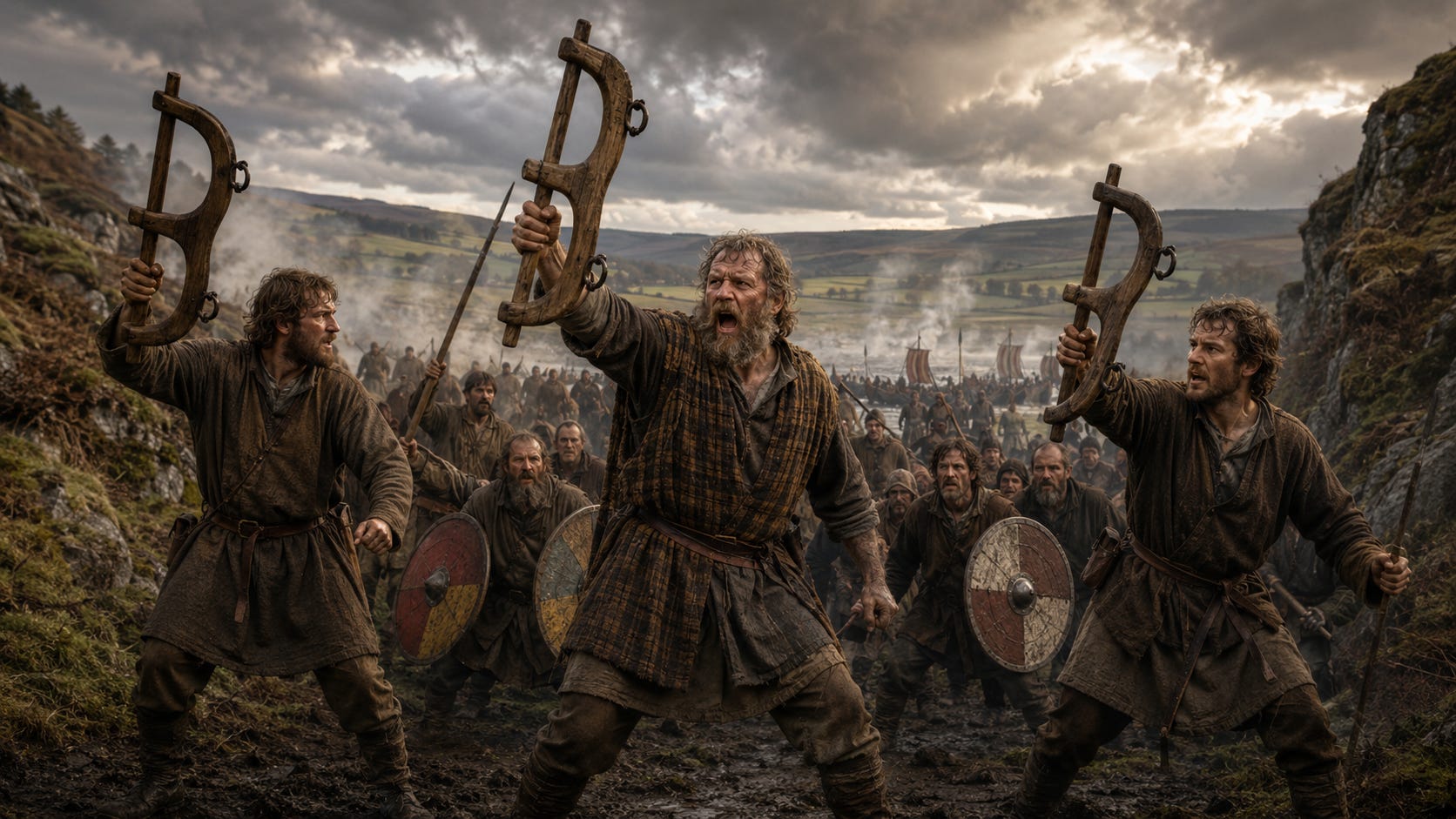
As the frightened soldiers rushed through a narrow passage, they encountered a farmer working nearby with his two grown sons. Later versions identify the father as Hay, although the earliest surviving accounts do not provide a securely documented personal history for him. Seeing his countrymen running, the farmer demanded to know whether they preferred to be slaughtered while fleeing or to die honourably while resisting their enemies. He and his sons then blocked the passage, forcing the retreating Scots to stop and face the danger behind them.
The three farmers were said to be carrying the heavy wooden yokes used with their ploughing oxen. Brandishing these makeshift weapons, they cried out that fresh assistance was arriving and urged the Scottish soldiers to rally around them. Their confidence restored the courage of the fugitives, who turned and charged back toward the battlefield. The Danes, surprised by the renewed attack and perhaps believing that Scottish reinforcements had arrived, broke formation and fled.
The farmer and his sons were brought before the king after the victory. The monarch thanked them for saving the army and, according to the legend, summoned an assembly at Scone to decide upon a suitable reward. The king offered the farmer as much land as a falcon could cross in a single flight after being released from a man’s hand. The bird reportedly flew several miles across the Carse of Gowrie before settling, marking the boundaries of an estate associated with Erroll.
The king was also said to have raised the three heroes into the nobility. Their arms were described as a silver shield bearing three smaller red shields, representing the father and his two sons as the three shields of Scotland. The imagery remains closely associated with the chiefly line of the Hays, whose arms display three red escutcheons upon a silver field. The clan motto, Serva Jugum, commonly translated as “Keep the Yoke,” likewise recalls the farming implement carried into the legendary battle.
The falcon in the story also became an enduring part of Hay identity. The chief’s crest features a falcon rising from a coronet, while the bird’s legendary flight connects the family to the lands of Erroll. The tale therefore provides an explanation for several important clan symbols at once: the yoke, the falcon, the three shields, and the ancestral territory. This unity helps explain why the legend remained so compelling for later generations.
For centuries, the account was repeated as the true beginning of one of Scotland’s most prominent families. It appeared in histories, peerage books, genealogies, and popular descriptions of the Scottish clans. Paintings and other commemorative works transformed the moment into a patriotic scene in which humble courage rescued an entire kingdom. For descendants of the Hay name, Luncarty offered an origin based upon personal merit rather than inherited privilege.
The difficulty is that the story was not written down anywhere near the time when the battle supposedly occurred. Its first secure appearance is associated with the history of Scotland published in Latin by Hector Boece in 1527, more than five centuries after the alleged event. Boece was a respected scholar and the first principal of King’s College in Aberdeen, but he wrote during an age when history, folklore, patriotism, and moral storytelling were often blended together. He included numerous ancient episodes that cannot be supported by surviving contemporary evidence.
No known tenth-century record describes three farmers turning a Danish victory into a Scottish triumph at Luncarty. Earlier Scottish chronicles also fail to provide firm confirmation of the battle as Boece related it. Even the identity of the king and the proposed date vary among later retellings, with different versions placing the event under different rulers near the end of the tenth century. These inconsistencies do not prove that no fighting occurred in the district, but they prevent historians from accepting the traditional account as established fact.
The documented origin of the Hay family points in a different direction. The surname appears to derive from the Norman-French forms de la Haye, de Haya, or de Haia, names associated with a hedge, enclosure, forest boundary, or hunting park. Families bearing related forms of the name were established in Normandy and England before the Hays became prominent in Scotland. This evidence places the family within the wider movement of Norman and Anglo-Norman knights, churchmen, and administrators who entered Scotland during the twelfth century.
The first firmly documented Scottish ancestor is William de Haya, who appears at the royal court from around 1160. William served as royal cup-bearer under Malcolm IV and William the Lion, placing him within the king’s trusted household. Charters and monastic records connect his family to lands in Perthshire, including the territory of Erroll. These surviving documents provide a more reliable foundation for Clan Hay history than a battle story written centuries after its supposed setting.
That does not make the Luncarty legend meaningless. Origin stories reveal how families understood themselves and how later generations connected names, lands, heraldry, and loyalty. The image of three farmers standing firm while trained soldiers fled communicated a powerful lesson about courage and duty. Whether or not the episode happened as described, the tale became part of the clan’s cultural inheritance and influenced how the Hays presented their identity.
The story also shows why legends must be handled carefully. If it is repeated without qualification, readers may mistake a Renaissance account for a contemporary record of tenth-century events. If it is dismissed completely, however, an important part of Clan Hay tradition disappears from view. The most rewarding approach is to preserve the story while clearly distinguishing it from the evidence supplied by medieval charters, seals, land grants, and witness lists.
Clan Hay’s documented history needs little embellishment. The family rose from royal service to become one of Scotland’s most powerful noble houses, supported Robert the Bruce during the Wars of Independence, and acquired the hereditary office of Lord High Constable of Scotland. Its chiefs became Earls of Erroll, while influential branches established themselves at Yester, Tweeddale, Kinnoull, Megginch, Delgatie, and other estates. Their real history includes war, diplomacy, religious conflict, political division, migration, and an extraordinary ability to survive changing times.
The Battle of Luncarty therefore stands at the meeting point of history and memory. The farmer, his sons, the wooden yoke, and the flying falcon form an unforgettable explanation of where the clan believed its honours began. The surviving records instead lead to William de Haya and Scotland’s twelfth-century royal court. Together, the legend and the documentary evidence tell us not only where Clan Hay came from, but also how one of Scotland’s great families remembered and reshaped its past.
Discover the complete story in The Complete History of Clan Hay by Bagtown Clans. The book follows the Hays from the Luncarty tradition and their probable Norman origins through Robert the Bruce, Bannockburn, the Earls of Erroll, the castles of Slains and Delgatie, the Jacobite era, and the worldwide Hay diaspora. It is available as a downloadable digital edition for readers interested in Clan Hay ancestry, Scottish history, and the remarkable people who carried the name across more than eight centuries.
References
Barrow, G. W. S., & Scott, W. W. (Eds.). (1971). The acts of William I, King of Scots, 1165–1214 (Regesta Regum Scotorum, Vol. 2). Edinburgh University Press.
Black, G. F. (1946). The surnames of Scotland: Their origin, meaning, and history. New York Public Library.
Boece, H. (1527). Scotorum historiae a prima gentis origine.
Boece, H. (1938–1941). The history and chronicles of Scotland (J. Bellenden, Trans.; R. W. Chambers, E. C. Batho, & H. W. Husbands, Eds.; Vols. 1–2). Scottish Text Society. (Original Scots translation published 1536)
Hay, R. A. (1835). Genealogie of the Hayes of Tweeddale, including memoirs of his own times. Thomas G. Stevenson.
Paul, J. B. (Ed.). (1906). The Scots peerage: Founded on Wood’s edition of Sir Robert Douglas’s peerage of Scotland (Vol. 3). David Douglas.