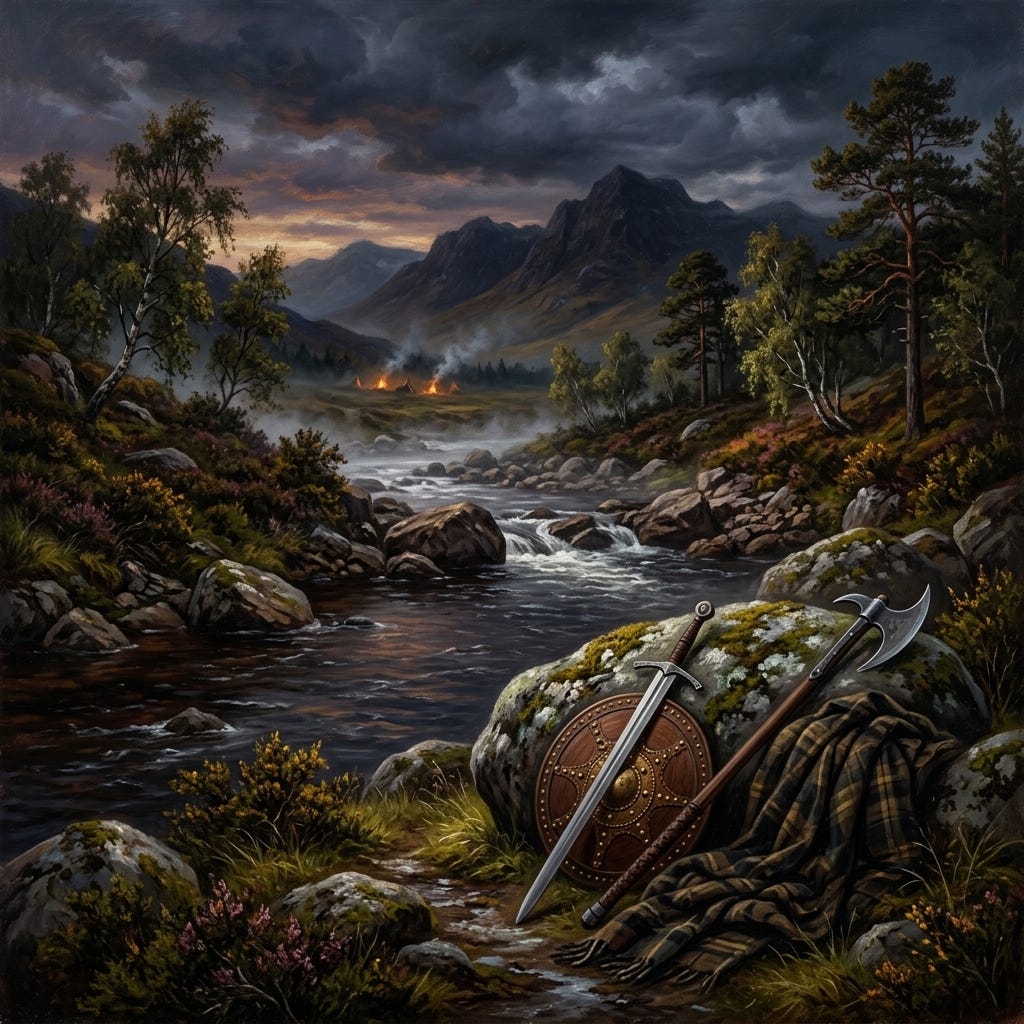
Where the dark, peat-stained waters of the River Truim rush down from the Drumochter pass to join the upper Spey, the valley of Badenoch narrows into a rugged amphitheatre of heather, birchwood, and stone. In the autumn of 1370, this quiet confluence at Invernahavon echoed with the lowing of hundreds of driven cattle and the steady tramp of four hundred Lochaber men. Armed with long bows, Lochaber axes, and broadswords, a raiding force of Clan Cameron was heading west toward their mountain fastnesses, heavy with the plunder of Badenoch. Behind them, moving swiftly across the hills to cut off their retreat, marched a larger host of the Clan Chattan confederacy led in person by Lachlan, the eighth chief of Mackintosh. By every calculation of medieval Highland warfare, the pursuers held the advantage. They knew the ground, they possessed superior numbers, and they were fighting to reclaim their own stolen herds.
Yet within sight of the enemy, before a single shaft was loosed, the Clan Chattan battle line fractured from within. As chronicled in Alexander Mackintosh Shaw’s Historical Memoirs of the House and Clan of Mackintosh and of the Clan Chattan, the confrontation at Invernahavon became one of the most consequential turning points in the history of the central Highlands. It was a day when ancient questions of blood, genealogy, and battlefield honour proved more dangerous to a Highland host than the axes of its sworn enemies, setting in motion a chain of vendettas that would culminate twenty-six years later in the royal arena at Perth.
The Roots of the Lochaber Feud
To understand why four hundred Camerons were driving Badenoch cattle past the mouth of the Truim, one must look back eighty years to a marriage that reshaped the map of the north. In 1291, Angus Mackintosh, sixth chief of his line, married Eva, the only child and heiress of Dougal Dall, the aged chief of the old Clan Chattan. Along with Eva’s hand, Angus received the leadership of the Clan Chattan confederacy and a claim to the forty merklands of Glenlui and Locharkaig in Lochaber. When the turbulent politics of the Wars of Independence forced Angus and Eva to withdraw from Lochaber to the pine forests of Rothimurcus in Badenoch, the Clan Cameron stepped into the vacuum. The Camerons occupied the vacated valleys around Loch Arkaig, insisting that lands abandoned by their owners belonged to those with the strength to hold them.
By the time Lachlan succeeded his father William as the eighth chief of Mackintosh in 1368, the dispute over Glenlui and Locharkaig had hardened into an implacable blood feud. Charters from the Lord of the Isles and confirmations from King David II meant little in the western glens where parchment carried no weight against steel. Season after season, raiding parties crossed the mountain passes between Lochaber and Badenoch, lifting cattle and burning steadings in a relentless war of attrition. When the Camerons swept into Badenoch in 1370 and turned homeward with a massive spreagh of cattle, Lachlan Mackintosh summoned the constituent septs of the Clan Chattan confederacy to intercept them at Invernahavon.
The Fatal Question of the Right Wing
A Highland clan confederacy was not a monolithic army under absolute martial law, but a delicate alliance of proud kindreds bound together by blood, tradition, and mutual protection. Marching alongside Lachlan Mackintosh’s immediate followers were the two great kindreds of the old Clan Chattan stock: the Clan Mhuirich, or Macphersons, led by their chieftain, and the Clan Dhaibhidh, or Davidsons, led by Davidson of Invernahavon, on whose very threshold the battle was about to be fought.
As the Clan Chattan warriors deployed into their fighting array facing the Camerons, a fierce dispute erupted between the chieftains of the Macphersons and the Davidsons. Both men demanded the command of the right wing, universally recognised in Highland warfare as the post of supreme honour. The Macpherson chieftain claimed the position by right of blood, asserting that his line represented the direct male heirs of the ancient chiefs of Clan Chattan through Muirich, parson of Kingussie, and his son Ewen Baan. In his eyes, even if the Mackintosh chief held the captaincy of the confederacy through Eva, the Macphersons remained the senior male stem of the original stock.
Davidson of Invernahavon countered with a strict appeal to the established customs of the clans. He contended that the post of honour on the right wing belonged by ancient usage not to the claimant of the senior line, but to the oldest cadet, the representative of the oldest surviving branch that had struck off from the main stem. Because the combat was taking place on the Davidsons’ own lands at Invernahavon, his followers were all the more determined not to yield a step of precedence to their kinsmen.
With the Cameron bowmen and axemen already forming up on the opposite brae, neither chieftain would back down. They laid the quarrel before Lachlan Mackintosh as umpire and supreme captain of the host. It was an impossible dilemma to resolve on the edge of a battlefield. To favour Davidson would alienate the Macphersons, whose fighting men outnumbered the Mackintoshes and Davidsons combined. To favour Macpherson would implicitly validate a rival genealogical claim to the headship of Clan Chattan itself. Pressed for an immediate answer, Lachlan Mackintosh ruled in favour of Davidson of Invernahavon, granting the Clan Dhaibhidh the right wing.
Slaughter by the Waters of Truim
The reaction of the Clan Mhuirich was instantaneous and catastrophic. Stung by what they regarded as a public insult to their lineage and their honour, the Macpherson chieftain ordered his men to sheathe their weapons and draw off from the line. In a scenario that would be tragically repeated centuries later on the moor of Culloden, the Macphersons marched up the hillside and stood idle as spectators, leaving Lachlan Mackintosh and Davidson of Invernahavon to face the Lochaber men alone.
What had moments before been a numerical superiority for Clan Chattan was suddenly reversed. Seeing the ranks of their pursuers split in half, the Camerons raised their war cry and charged down upon the Mackintoshes and Davidsons. The fighting along the banks of the Truim was desperate and merciless. Deprived of more than half their expected strength, the remaining Clan Chattan warriors were outflanked and borne backward by the weight of the Lochaber axes and the deadly volleys of the Cameron archers, among whom the celebrated bowman Charles MacGilony fought with terrible effect.
On the coveted right wing, the Davidsons paid the ultimate price for the honour they had won. Refusing to yield the ground of their own homesteads, the Clan Dhaibhidh stood until they were almost entirely annihilated, their chieftain and nearly all his kinsmen falling dead among the heather. The Mackintoshes, broken by the slaughter, were forced into a ragged retreat, leaving the Camerons masters of the field.
The Night Attack and the Long Shadow of Invernahavon
As darkness settled over the valley of the Spey and the victorious Camerons pitched their camp to rest among their spoils, the separated halves of Clan Chattan reckoned with the disaster. According to local Badenoch tradition recorded by Bishop Donald Mackintosh, Lachlan Mackintosh turned to stratagem to rouse his estranged kinsmen. He dispatched a clan bard into the Macpherson encampment under cover of night. Pretending to have come from the Cameron lines, the minstrel recited verses of biting satire, repeating boasts allegedly made by the Lochaber men that the Macphersons had hung back from the battle not out of wounded pride, but out of sheer cowardice.
Whether stung by the bard’s taunts or moved by a sudden revulsion at seeing their own blood kinsmen slaughtered while they looked on, the Macphersons’ anger shifted from Mackintosh to the Camerons. Dropping their grievance, the Clan Mhuirich snatched up their weapons and swept down upon the Cameron camp. Taken completely by surprise and exhausted from the day’s hard fighting, the Lochaber men were thrown into confusion. The Macphersons cut them down through the darkness, turning their triumph into a headlong rout. The surviving Camerons fled southward toward Drumochter, skirting the dark waters of Loch Ericht before turning westward toward the River Treig, where Charles MacGilony was finally overtaken and slain at a spot that long bore his name.
The last-minute rescue by the Macphersons salvaged the military honour of Clan Chattan, but the wounds opened at Invernahavon did not heal. The near-extermination of the Davidsons permanently altered the balance of power within the confederacy, while the ferocious counter-slaughter of the Camerons poured fresh oil on the Lochaber feud. For the next two decades, the memory of the dead at the confluence of the Truim drove both sides to such relentless bloodshed across Badenoch and Lochaber that King Robert III and his commissioners, the Earl of Moray and Sir David Lindsay, were finally forced to intervene—summoning thirty champions from each side to settle the “auld fede” to the death inside the timber barriers of the North Inch of Perth.
Adapted from: Mackintosh, A. (1880). Historical memoirs of the house and clan of Mackintosh and of the Clan Chattan. R. Clay, Sons, and Taylor.