Uncover the epic history of Clan Keith - https://fairbairncrests.com/products/the-complete-history-of-clan-keith-digital-edition
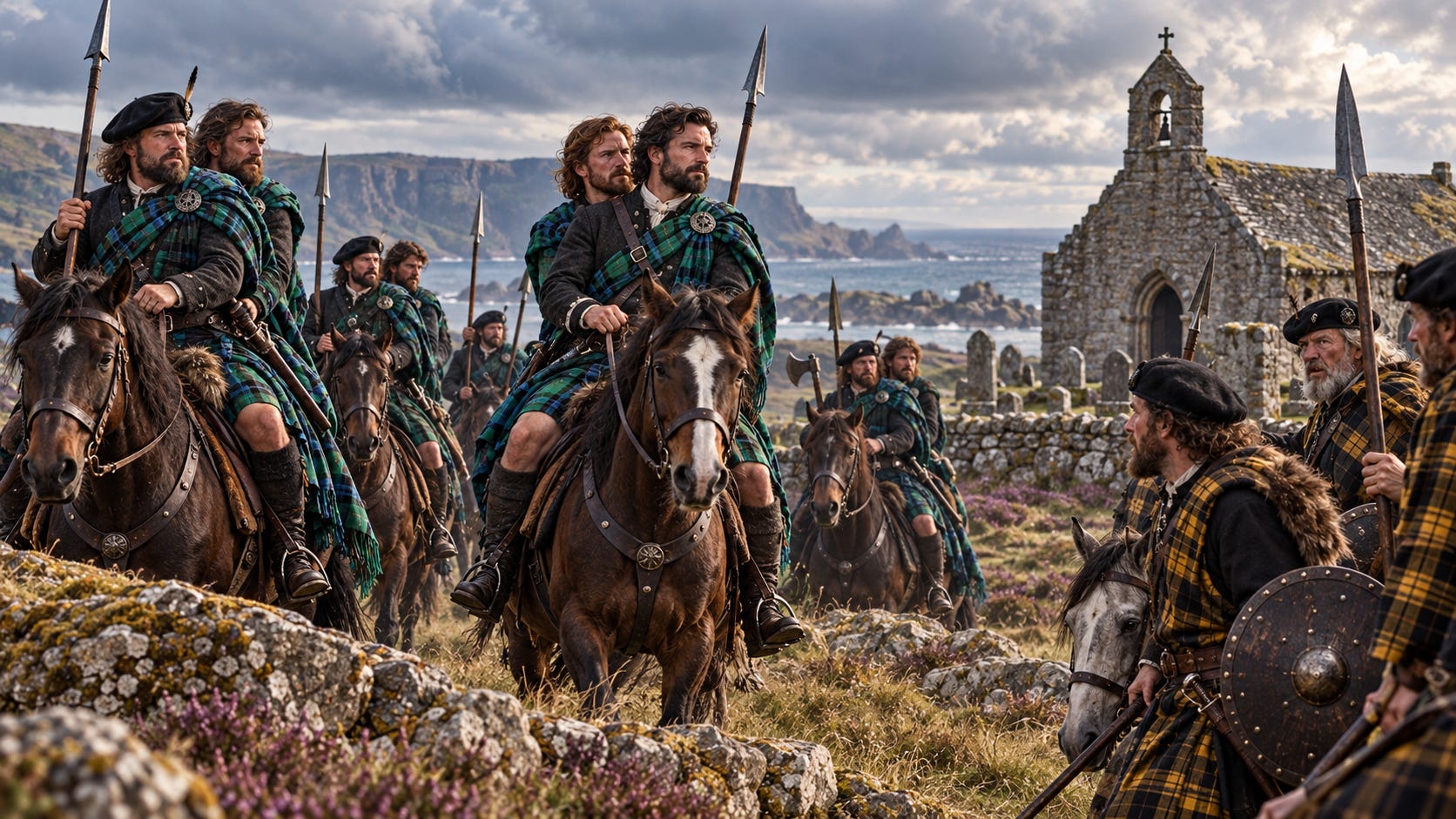
Few stories from Scotland’s clan past have the dramatic simplicity of the so-called Battle of Champions between the Keiths and the Gunns. According to one of the best-known versions of the tradition, the two rival families agreed that a dispute would be settled by a limited confrontation rather than by bringing entire armed followings into the field. Each side was supposedly permitted to arrive with the same number of horses, creating the expectation that the forces would be evenly matched. When the Keiths appeared, however, the Gunns discovered that their opponents had allegedly placed two warriors on every horse.
It is the kind of detail that makes a story almost impossible to forget. The supposed agreement concerned the number of horses rather than explicitly the number of men, allowing the Keiths, in the traditional telling, to claim that they had technically kept their word. For the Gunns, this was no clever interpretation of an agreement but a calculated act of deception. The resulting confrontation became remembered not merely as another violent encounter between northern families, but as a story about honour, trust and betrayal.
The setting usually associated with the episode adds even more drama. Later accounts place the confrontation in the far north of Scotland and connect it with a church or churchyard, giving the violence a setting that should have represented restraint, sanctuary and Christian order. Two groups supposedly arrived expecting an agreed contest, only for one side to discover that the terms had been interpreted very differently. The imagery is powerful: mounted men approaching a sacred place, an agreement already hanging in the balance, and the sudden realisation that the opposing force is larger than expected.
The feud tradition developed in a region where Keith and Gunn interests existed close enough to collide. Northern branches of the Keith family were part of a political landscape very different from the world of the Earls Marischal at Dunnottar, while the Gunns had their own extensive traditions, kinship networks and local interests. Competition over land, influence, personal injuries and the obligations of relatives could all create tensions capable of continuing across generations. Later storytellers naturally simplified those complicated relationships into memorable episodes involving identifiable heroes, villains and moments of revenge.
In the traditional account of the Battle of Champions, the Gunns agreed to meet the Keiths with a restricted number of combatants. The Keiths then supposedly exploited the wording of the agreement by bringing the agreed number of horses but placing two armed men on each animal. What followed was remembered as a disastrous encounter for the Gunns, who found themselves outnumbered in a confrontation that they believed was supposed to be conducted on equal terms. The detail about the doubled riders became the defining element of the story because it transformed an ordinary defeat into an accusation of deliberate treachery.
That accusation matters because medieval and early modern feuds were not simply contests over who possessed the largest force. Reputation mattered enormously, and an agreement could carry social weight far beyond the immediate people involved. A family believed to have broken agreed terms could be remembered as dishonourable, while the defeated side could preserve its grievance through stories repeated by descendants. The Battle of Champions therefore survived not only as a tale of fighting but as a moral story about what happens when one side believes the rules of a settlement have been deliberately manipulated.
But did the Keiths actually ride two men to every horse? That is where the story becomes much more difficult. The surviving accounts describing the confrontation were written considerably later than the period in which the battle is normally placed, and the versions do not agree on every important detail. Dates, numbers, locations and the sequence of events vary, meaning that historians cannot simply treat the most colourful version as if it were a contemporary battlefield report.
One of the important later sources for northern clan history is Sir Robert Gordon’s Genealogical History of the Earldom of Sutherland. Gordon preserved valuable information about the families and conflicts of northern Scotland, but he was writing long after many of the events he described. His work reflects traditions that had already been remembered, shaped and transmitted for generations. That does not make the stories worthless, but it does mean that they must be read differently from a charter, legal record or account written at the time of an event.
The famous two-men-to-a-horse detail is therefore best understood as part of the tradition unless stronger contemporary evidence emerges. It may preserve the memory of an actual confrontation in which one force unexpectedly possessed a numerical advantage. It may also represent a later explanation for why the Gunns suffered defeat, transforming an imbalance on the battlefield into a memorable story of broken faith. Over time, the distinction between what happened and the explanation descendants gave for what happened can become extremely difficult to recover.
This is one reason feud stories became such powerful elements of clan identity. A complicated struggle over land, jurisdiction or personal injury could be difficult to transmit across several centuries, but a story about men riding double required only a few sentences. Listeners could immediately understand why the Gunns would feel betrayed and why the episode might demand retaliation. The narrative reduced an entire web of northern relationships to a single visual image: one horse, two Keith warriors and an agreement that suddenly seemed worthless.
The rivalry should not, however, be imagined as permanent warfare between every Keith and every Gunn. Scottish families could feud in one generation, negotiate in another and become connected through marriage, local business or shared political interests. Even during periods of hostility, everyday life continued among people living in neighbouring districts. Later clan histories often give the impression of neatly separated groups locked in centuries of uninterrupted conflict, but the reality of kinship and regional politics was far more complicated.
The story also tells us something important about the way clan history was preserved. The events that survived most successfully were often those with a striking dramatic structure: an ambush, a betrayal, a heroic last stand or an act demanding revenge. Generations of retelling naturally favoured episodes that could hold an audience’s attention. The quieter work of negotiating settlements, arranging compensation, managing marriages and restoring working relationships rarely produced stories as memorable as warriors arriving two to a horse.
That does not mean the Battle of Champions should be discarded simply because every detail cannot be proven. Tradition is itself part of history because it reveals how communities understood their past and which grievances they believed were important enough to preserve. The Keith-Gunn story tells us that ideas of honour, fair dealing and betrayal mattered deeply to later generations who repeated it. Even where the surviving evidence prevents us from reconstructing the confrontation with certainty, the story’s long life tells us something significant about the culture that preserved it.
The later history of the two clans gives the old feud an unexpected ending. Modern descendants have been able to treat the remembered rivalry as heritage rather than an obligation to continue hostility. Reconciliation and friendship between people associated with the Keith and Gunn names demonstrate how the meaning of an inherited story can change. A tale once used to explain grievance can eventually become a shared piece of history discussed by descendants who meet as friends rather than enemies.
Perhaps that is the most interesting way to approach the Battle of Champions today. We do not have to choose between accepting every dramatic detail literally and dismissing the entire tradition as fiction. There may have been a genuine violent encounter behind the story, while generations of retelling shaped how its causes, numbers and acts of deception were remembered. The challenge is to enjoy the story while remaining clear about the difference between documented history and later tradition.
For Clan Keith, the Battle of Champions represents only one episode in a history stretching far beyond the northern feud traditions. The Keith story also includes the medieval office of Marischal, Robert Keith and Robert the Bruce, Bannockburn, Dunnottar Castle, the Reformation, the Honours of Scotland, Jacobite forfeiture, European military service, migration and the survival of the clan into the modern era. Those larger developments show a family whose history cannot be reduced to a single feud or legendary encounter. Readers interested in the Battle of Champions can explore that wider story in The Complete History of Clan Keith, where the famous traditions are placed alongside the documentary history that allows the Keith past to be followed across more than eight centuries.
References
Buchan, P. (1820). An historical and authentic account of the ancient and noble family of Keith, Earls Marischal of Scotland. Printed by P. Buchan for Clark & Sangster.
Gordon, R. (1813). A genealogical history of the earldom of Sutherland, from its origin to the year 1630, with a continuation to the year 1651. Archibald Constable and Company.
Paul, J. B. (Ed.). (1904–1914). The Scots peerage (Vols. 1–9). David Douglas.
Rigby Publishing. (2026). The complete history of Clan Keith. Rigby Publishing.