

The misty eastern shores of Loch Lomond in Stirlingshire have long been the ancestral heartland of Clan Buchanan, a family whose history is woven deeply into the fabric of Scotland. For centuries, the clan’s origins were romantically attributed to an eleventh-century myth involving Anselan O Kyan, a noble Irish prince of the clan Ó Catháin who supposedly received lands from King Malcolm II as a reward for fighting the Danes. However, modern Y-DNA testing has rewritten this legendary narrative, proving that the Buchanans are actually descended from indigenous P-Celtic or Brittonic tribes who inhabited the ancient Kingdom of Alba long before the year 1000. The clan’s name itself speaks to these early roots and deep ecclesiastical ties; derived from the Gaelic “Mac a Chanonaich,” meaning “Son of the Canon,” or “Buth Chanain,” meaning “house of the canon,” their identity evolved from early church stewards to formidable feudal lords.
This transition from clerical stewards to landed nobility was officially documented in 1225 when Maldonus, the Earl of Lennox, granted the island of Clairinch to his seneschal, a man named Anselan, in exchange for a yearly tribute of one pound of beeswax. This tiny island became the spiritual anchor of the clan and inspired their fierce war cry, “Clar Innis!” Soon after, Anselan’s successor, Gilbert, formally adopted the surname Buchanan. The clan’s ancestral territories rapidly expanded across the region, encompassing significant seats of power such as the medieval Peel of Buchanan, the sprawling Buchanan Auld House, and later strongholds like Leny House and Cambusmore. Over the centuries, these lands witnessed dramatic territorial shifts. Most notably, in 1682, crippling financial debts and the death of the clan’s chief without a male heir forced the sale of the Buchanan Auld House and its surrounding estates to the Marquess of Montrose, a prominent figure of Clan Graham.
Before the tragic loss of their ancestral seat, daily economic life for the Buchanans was intrinsically tied to the rugged Highland landscape. Clan members practiced seasonal farming and transhumance, guiding their cattle herds to upland pastures during the grazing season. They sheltered in small, stone-built huts known as shielings, spending their days repairing equipment and making butter, cheese, and salted curds to survive the harsh Scottish winters. This agrarian lifestyle was enriched by a vibrant cultural tradition kept alive by dedicated clan artisans. Chiefly pipers provided the soundtrack to both daily life and martial campaigns, while revered bards and seanchaidhs—traditional storytellers and historians—meticulously preserved the clan’s oral history and genealogies. The clan also experienced profound religious shifts over the centuries. Originally tied to the Catholic Church, as their canonical name suggests, the Buchanans later became staunch supporters of the Protestant Reformation and the Covenanter cause. This intellectual and religious evolution was heavily influenced by brilliant clan minds, including the renowned sixteenth-century humanist scholar George Buchanan, who tutored King James VI, and the eighteenth-century poet Dugald Buchanan, who helped translate the New Testament into Scottish Gaelic.
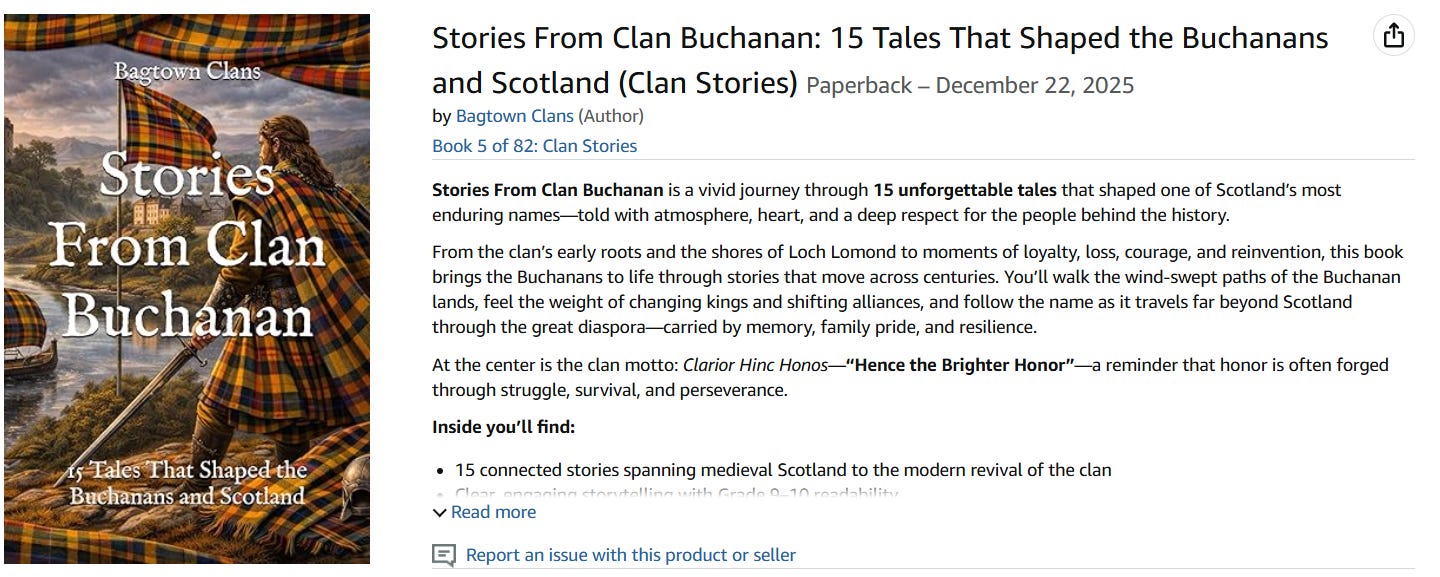
The strength of the clan was maintained through a complex genealogical web branching out from the chiefly line. Powerful cadet branches emerged, including the Buchanans of Leny, Arnprior, Spittal, and Auchmar, who helped govern the clan’s expanding influence. Surrounding these core families were over fifty recognized septs—affiliated families such as the Gibsons, Harpers, Dewars, Watsons, and MacAuslans—who lived upon the lands and fought under the Buchanan banner. This diverse extended family was united by potent symbols of identity. They wore indigenous plant badges of bilberry and oak pinned to their bonnets and draped themselves in a visually striking asymmetrical tartan, a textile anomaly woven in vivid asymmetrical grids of red, blue, green, yellow, and black. Their chiefly heraldry proudly displayed a black lion rampant on a gold shield enclosed by a double tressure flory counter-flory, a design mirroring the Royal Arms of Scotland to signify the clan’s marital ties to the royal Stewart line. Their most famous symbol, however, is their crest badge: a dexter hand holding aloft a ducal cap, encircled by laurel branches and bearing the motto “Clarior Hinc Honos,” meaning “Brighter hence the honour.” This crest commemorates the legendary martial prowess of Sir Alexander Buchanan, who famously slew the English Duke of Clarence at the Battle of Baugé in 1421.
Such fierce combat was a recurring theme in the clan’s history, which is marked by both local feuds and national warfare. In the fifteenth century, they engaged in a bitter and bloody feud with Clan MacLaren, a conflict famously ignited at a local fair when a Buchanan insulted a MacLaren by playfully slapping him in the face with a salmon. On the national stage, the Buchanans were fierce political players. They boldly supported Robert the Bruce during the Wars of Scottish Independence, aided his escape in 1306, and fought alongside him at the Battle of Bannockburn. During the volatile Wars of the Three Kingdoms, Sir George Buchanan led his clansmen to fight for the Covenanters at the tragic Battle of Dunbar. However, by the time of the Jacobite Risings in the eighteenth century, the clan was leaderless and deeply fractured. While some prominent Buchanans served the Hanoverian government, others fiercely supported the Jacobite cause, most notably Francis Buchanan of Arnprior, who acted as the rebellion’s armorer and treasurer before being captured and executed for high treason.
The devastating aftermath of the Battle of Culloden ushered in a dark era of decline for Highland culture, and the Buchanans suffered immensely. Targeted by the government for their Jacobite ties, they endured the brutal repressions of the Act of Proscription, which outlawed highland dress and customs. The subsequent Highland Clearances, combined with economic destitution and the earlier loss of their chief and lands, dismantled their traditional way of life. This sparked a massive wave of global emigration, scattering Buchanan descendants across North America, Australia, New Zealand, and beyond.
Despite this tragic dispersal, the spirit of Clan Buchanan proved indestructible. As early as 1725, successful diaspora merchants in Glasgow established the Buchanan Society to provide charitable and educational relief to impoverished clansfolk, creating the oldest recorded clan society in the world. Centuries later, in 1970, the Clan Buchanan Society International was founded, further uniting the millions of descendants now spread across the globe. The dawn of the modern era brought the ultimate triumph for this scattered family: the end of a 337-year interregnum. In 2018, following decades of exhaustive genealogical research, John Michael Baillie-Hamilton Buchanan was legally recognized by the Lord Lyon King of Arms as the Chief of the Name and Arms of Buchanan. In a magnificent 2022 inauguration ceremony held at the Cambusmore estate—complete with newly forged clan jewels, global gatherings, and the first Clan Parliament in over three centuries—the clan officially embraced its modern renaissance, seamlessly blending ancient Highland traditions with the vibrant energy of its worldwide community.
References
Buchanan Society. (2025). Buchanan Society 300th Anniversary 1725 - 2025. Buchanan Society.
Celtic Studio. (2026). Buchanan Coat of Arms: Family Clan Crest, Motto. Celtic Studio.
Clan Buchanan Society International. (2023). The Buchanan Banner: The Chief’s Inauguration. Clan Buchanan Society International.
Clan Buchanan Society International. (2026). The Clan Buchanan. Clan Buchanan Society International.
Clans and Scottish Societies of Canada. (2023). Clan Buchanan Society International. Clans and Scottish Societies of Canada.
House of Argyll. (2025). Explaining Buchanan Tartan: Patterns, History, and Modern Uses. House of Argyll.
Kiddle Encyclopedia. (2025). Clan Buchanan Facts for Kids. Kiddle Encyclopedia.
Killearn Heritage Trail. (n.d.). Buchanan Monument. Killearn Heritage Trail.
Lincoln, A. (2025). Buchanan Tartan Colors Explained in Highland Symbolism. Blog SKC.
Loch Lomond Waterfront. (2026). The Ruins of Buchanan Castle. Loch Lomond Waterfront.
The Buchanan. (n.d.). Official site for The Buchanan Clan Chief & Events. The Buchanan.
Travels with a Kilt. (n.d.). Buchanan Castle and the Rudolf Hess Connection. Travels with a Kilt.
Tuovinen, K. (2022). A Touring Guide to Buchanan Places in Scotland. Clan Buchanan Society International.
Unknown Author. (n.d.). The Sovereignty of the Shore: A Comprehensive Analysis of Clan Buchanan’s Historical Evolution, Heraldic Continuity, and Global Resurgence.
USA Kilts. (n.d.). The Clan Buchanan Story: From Legend to Legacy. USA Kilts.