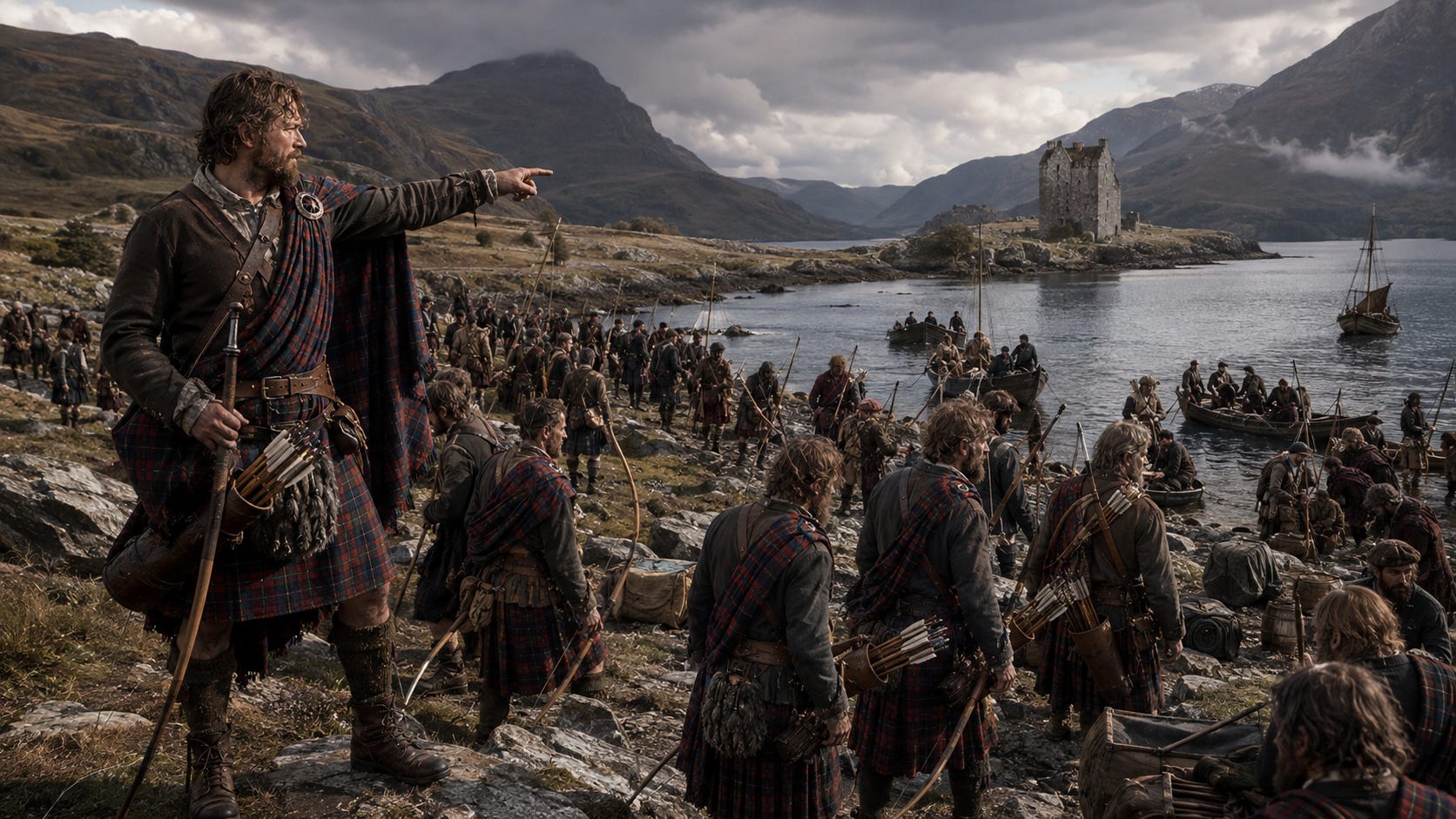
This remarkable expedition is just one of the little-known episodes explored in The Complete History of Clan MacNaughton.
When people imagine Highland warfare, they often picture swords, targes, and the later Jacobite battlefields. Yet one of the most intriguing episodes in Clan MacNaughton history belongs to 1627, when a MacNachtan leader was commissioned to raise roughly 200 Highland bowmen for a royal expedition to France. It was a striking meeting of old Highland military traditions and the increasingly modern warfare of seventeenth-century Europe.
The expedition grew out of the foreign policy of King Charles I and his powerful favourite, George Villiers, Duke of Buckingham. Buckingham was preparing an intervention intended to support French Huguenots at the Île de Ré. The Stuart government needed troops for a difficult continental campaign and looked toward western Scotland for specialised soldiers. Among them were Highland archers—men still trained in the use of the bow at a time when firearms were rapidly becoming standard infantry weapons.
According to the records discussed in The Complete History of Clan MacNaughton, an Alexander MacNachtan received a commission to raise a substantial company of Highland archers. Clan compilations and state records place the force at roughly 200 bowmen.
Raising 200 men was not simply a matter of summoning relatives who shared the MacNachtan name. The book explains that the recruits came from the broader tenantry of the Dunderave estates and allied families within the Campbell sphere of influence. Their recruitment demonstrates the ability of MacNachtan leadership to mobilise significant manpower when called upon.
Perhaps the most surprising part of the story is the weapon itself. By 1627 firearms had transformed European warfare, yet the bow had not completely disappeared from the Highlands. The manuscript describes Highland archers as valued for speed, mobility, and the ability to deliver concentrated volleys without the logistical requirements of gunpowder and matchcord. The Crown’s request suggests that these older skills were still considered useful in certain situations. The book describes the expedition as one of the final significant instances in which Highland bowmen were formally incorporated into a British military expedition.
The challenge did not end once the men were recruited. Alexander MacNachtan also had to assemble, provision, equip, and move a large company out of western Scotland. Transporting roughly 200 armed Highlanders from the MacNachtan heartland around Loch Awe, Loch Fyne, Glen Shira, and Dunderave toward ports connected with a continental campaign required considerable organisation.
The book suggests that their journey likely involved coastal vessels carrying the company from the sheltered waters of Loch Fyne toward more established southern maritime centres. The commander also had to maintain discipline, provide basic necessities, and move the men toward an unfamiliar theatre of war. Their successful assembly and dispatch therefore says much about the administrative ability of MacNachtan leadership.
It is tempting to imagine the expedition as an independent MacNaughton war party marching beneath a clan banner. The historical situation was more complicated. Alexander MacNachtan was acting under royal authority. His commission operated within the Stuart patronage system, and Campbell cooperation in Argyll was important. The Campbells were the dominant regional power, and the MacNachtans had long navigated a relationship involving service, dependency, office-holding, and local influence.
This shows how Highland military power was changing. Men associated with local obligations could now be recruited for central-government objectives far beyond the glens where those traditions had developed.
For the MacNachtan leadership, royal service could also create opportunity. Participation in such expeditions offered the possibility of favour, financial reward, and increased social standing. The same political system that placed the clan within Campbell-dominated Argyll could also provide access to the wider ambitions of the Stuart monarchy.
By the seventeenth century, MacNachtan leaders remained connected to Highland military culture while also becoming increasingly involved in leases, rents, estate administration, and regional offices. Military mobilisation and estate management belonged to the same political world.
After the bowmen expedition, the documentary focus shifts back toward administrative service. By the 1630s and 1640s, the Campbells were consolidating authority in Kintyre, and Malcolm MacNachtan emerged as an important administrator there. His role as chamberlain included overseeing tenancies, managing local disputes, and enforcing the authority of a superior landlord.
The decades ahead would become far more dangerous as religious and constitutional conflict divided Scotland. Seen from that perspective, 1627 represents a moment when the clan could still turn traditional Highland military resources into useful royal service.
The story of the 200 Highland bowmen deserves greater attention because it challenges easy assumptions about Highland history. It reminds us that the bow survived as a recognised military weapon later than many people expect. It shows that Highland communities were connected to international politics rather than existing in isolation. And it reveals that clan leadership involved logistics, administration, patronage, and negotiation as much as fighting.
Most importantly, it gives us a glimpse of real men caught in a period of military change. Roughly 200 bowmen were recruited through networks connected with MacNachtan authority and prepared to leave Scotland for a royal expedition overseas. Their individual stories are not all preserved in the surviving account, but the scale of the mobilisation shows that the event mattered.
The 1627 expedition connects Dunderave, the Campbell political network, the Stuart monarchy, Highland archery, and continental warfare in one remarkable episode. It is exactly the sort of lesser-known story that can disappear beneath Scotland’s more famous battles, even though it tells us a great deal about how Highland society actually worked.
The Complete History of Clan MacNaughton explores this expedition as part of the larger story of a clan that survived through adaptation. From the earliest MacNachtans around Loch Awe and Loch Fyne to Dunderave Castle, royal service, the loss of ancestral estates, migration to Ireland and North America, and the survival of the clan into the modern era, the book follows the people behind the name through centuries of Scottish history.
For readers with MacNaughton, MacNachtan, Macnaghten, McNaughton, McNitt, or McNutt ancestry—or anyone fascinated by the lesser-known stories of Scotland’s clans—the tale of the 200 Highland bowmen is only one chapter in a much larger history waiting to be rediscovered.