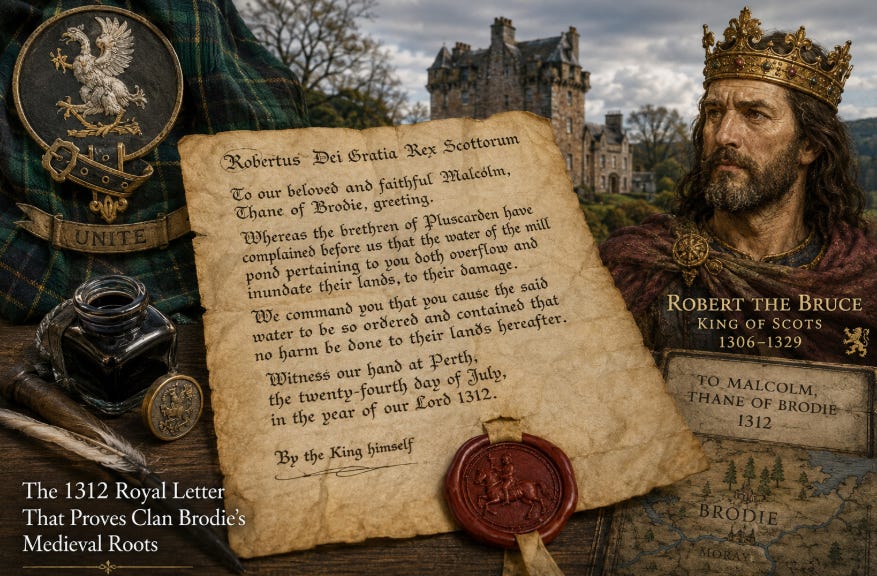
For anyone trying to trace the origins of a Scottish clan, there is often a frustrating point where documented history disappears into legend. Ancient genealogies may claim descent from kings, warriors, or forgotten rulers, but surviving medieval records are usually much harder to find. Clan Brodie is fortunate to possess something far more valuable than a later family tradition: an actual royal document dating from the reign of Robert the Bruce. Written in 1312 and addressed to Malcolm, Thane of Brodie, the surviving letter provides one of the strongest pieces of evidence for the medieval roots of the Brodie family.
Discover the full story of Clan Brodie and explore your Scottish heritage—get your digital copy of The Complete History of Clan Brodie here: https://fairbairncrests.com/products/the-complete-history-of-clan-brodie-digital-edition
The letter is remarkable partly because of how ordinary its subject appears at first. Robert the Bruce was not writing to Malcolm about a great battle, a rebellion, or a secret royal mission. Instead, the king became involved in a local disagreement concerning a mill pond and the monks of nearby Pluscarden. Yet it is precisely this everyday dispute that makes the document so valuable, because it places a real individual named Malcolm firmly on the lands of Brodie in the early fourteenth century.
By 1312 Robert the Bruce had been King of Scots for six turbulent years. Scotland was still in the midst of the long struggle that followed the Wars of Scottish Independence, and royal authority could not be taken for granted throughout every part of the kingdom. The king depended upon a network of officials and landholders who could administer territory, maintain order, collect revenues, and protect royal interests. Malcolm, identified in the surviving document as Thane of Brodie, was evidently part of that administrative world.
The title “thane” is important because it tells us something about Malcolm’s standing. A thane was not simply an ordinary farmer living on the land, but a royal official and landholder associated with the administration of a defined territory. Thanes could be responsible for collecting royal dues, overseeing local affairs, maintaining resources, and performing obligations owed to the Crown. Malcolm’s appearance in direct royal correspondence therefore places the Brodie lands within the governmental structure of medieval Scotland.
The problem that attracted royal attention involved water, one of the most important resources in a medieval agricultural economy. Mills were essential because communities depended upon them to process grain, and a mill pond provided the controlled water necessary to operate the machinery. Altering a pond, dam, channel, or watercourse could have serious consequences for neighbouring properties. In Malcolm’s case, the monks of Pluscarden complained that water associated with his mill pond was damaging or inundating their cultivated lands.
The monks did not simply accept the situation. Pluscarden possessed important property interests in Moray, and like many medieval religious communities, its members were prepared to defend the economic value of their lands. They brought their complaint to the king, and Robert I responded by directing his attention to Malcolm. The fact that the dispute reached the Crown provides a fascinating glimpse into how local land management, monastic property rights, and royal authority could intersect in medieval Scotland.
There is also something wonderfully human about the document. More than seven centuries later, people often imagine Scottish clan history primarily in terms of castles, swords, battles, tartans, and rival chiefs. The first secure documentary glimpse of the Brodies is much less romantic but arguably far more revealing. Malcolm appears as a practical landholder dealing with water rights, agricultural infrastructure, neighbouring monks, and the authority of his king.
That very ordinariness is what makes the 1312 letter such powerful historical evidence. Legends can grow over generations, genealogies can be reconstructed centuries after the people involved have died, and stories can be repeated until they are mistaken for established fact. A contemporary royal document is different. It was created because Malcolm existed, held a recognised position at Brodie, and was involved in a real dispute important enough to generate correspondence from the Scottish Crown.
This distinction is particularly important because the earliest history of Clan Brodie contains several much older traditions. One long-repeated story claims that King Malcolm IV granted the lands of Brodie to an ancestor of the family around 1160. Other traditions have attempted to connect the Brodies with the Pictish rulers who once dominated northern and eastern Scotland. Moray certainly contains extraordinary evidence of its Pictish past, including Rodney’s Stone, but the surviving evidence does not provide an unbroken genealogical line connecting the medieval Brodies directly to Pictish royalty.
The traditional twelfth-century land grant presents a similar problem. It fits comfortably into the known history of Moray, when Scottish kings were attempting to strengthen royal control of the region and establish loyal landholders there. However, no surviving contemporary charter has been identified that proves Malcolm IV granted Brodie to a named ancestor of the later family. The 1312 letter is therefore so important because it moves the story away from retrospective tradition and onto firm documentary ground.
There is a frequently repeated reference to an earlier document from 1311 involving a Michael de Brothie, sometimes described in later genealogies as the son and heir of Malcolm. That claim is interesting, but the precise details require greater caution because the documentary foundation is not as secure. The surviving 1312 letter to Malcolm provides something much more definite. By that year, there was unquestionably a recognised Thane of Brodie dealing directly with the government of Robert the Bruce.
The spelling of the name would continue to change during the medieval period. Later records contain forms such as Brothie and Brothy before the modern spelling of Brodie became standardised. Such variations were perfectly normal in an age when scribes recorded names according to contemporary usage rather than a fixed modern spelling. What remained constant was the family’s association with the lands from which its identity developed.
Later fourteenth-century documents add further pieces to the story. Thomas de Brothy appears as a juror at an inquest in Inverness in 1376 and 1377, while John de Brothy appears as a witness in an important regional dispute in 1380. These records do not allow historians to construct a perfectly continuous father-to-son genealogy from Malcolm onward. They do, however, demonstrate the continuing presence of people carrying the territorial Brodie name within the legal and administrative society of medieval Moray.
The story of the 1312 letter becomes even more extraordinary when we consider what happened to Brodie Castle centuries later. During the turmoil of the Scottish civil wars, Brodie Castle was attacked and burned in 1645 by forces associated with Lord Lewis Gordon. The destruction caused considerable damage and resulted in the loss of family papers accumulated over generations. Buildings could be rebuilt, livestock could eventually be replaced, and fields could be restored, but documents destroyed by fire were gone forever.
Against remarkable odds, the medieval royal letter survived. While other records disappeared during the destruction of the castle, the document connecting Malcolm of Brodie with Robert the Bruce endured. Its survival preserved a direct material link between the later Brodie family and the administration of one of Scotland’s most famous kings. Today, more than seven centuries after it was written, the fragile document remains one of the most important pieces of evidence in the entire history of Clan Brodie.
For descendants of the Brodie family, that survival gives the document an importance that goes well beyond the details of a medieval disagreement over water. The letter allows modern Brodies to move beyond vague statements that their family is “ancient” and identify a specific man living within a specific historical world. Malcolm was Thane of Brodie during the reign of Robert the Bruce, administered valuable agricultural land in Moray, dealt with a powerful neighbouring religious community, and was significant enough to receive a royal mandate. Few objects could provide a more tangible connection between a modern Scottish surname and the realities of medieval Scotland.
The 1312 letter also teaches an important lesson about Scottish clan history more generally. The most compelling history is not always the most dramatic story, and genuine antiquity does not require invented ancestors or exaggerated legends. A dispute concerning a mill pond may sound modest compared with tales of Pictish kings and heroic warriors, but that small piece of vellum provides something those legends cannot: contemporary evidence. It proves that the Brodie name and territory had entered the documented history of Scotland by the early fourteenth century.
From Malcolm, Thane of Brodie, the story would continue through centuries of political upheaval, religious conflict, estate expansion, financial difficulty, migration, and cultural change. Brodie Castle would be burned and rebuilt, members of the family would enter national politics and public office, cadet branches would spread beyond the original estate, and descendants would eventually carry the Brodie name far beyond Moray. Through all of those transformations, the ancient lands around Brodie remained the geographical heart of the family’s identity. The little royal document of 1312 stands near the beginning of that extraordinary documented journey.
The story of the letter is explored in greater depth in The Complete History of Clan Brodie, which follows the family from the uncertain traditions surrounding its earliest origins through more than seven centuries of documented Scottish history. The book examines the Brodies of medieval Moray, Brodie Castle, the chiefs and cadet branches, the Covenanting period, the burning of the castle, Jacobite-era politics, tartan and heraldry, genealogy, migration, and the modern worldwide clan. For anyone with Brodie ancestry—or anyone fascinated by the evidence behind Scotland’s clan histories—the 1312 letter provides the perfect doorway into the much larger story of this enduring Moray family.
References
Brodie, W. (1862). Genealogy of the Brodie family.
National Records of Scotland. (n.d.). Brodie family of Brodie (NRAS770). National Records of Scotland.
National Trust for Scotland. (n.d.). Collections and research on Brodie Castle. National Trust for Scotland.
Registrum Episcopatus Moraviensis. (n.d.).
Robert I. (1312). Letter to Malcolm [Manuscript]. National Trust for Scotland.
Rampini, C. (n.d.). A history of Moray and Nairn.