Discover the full story of Clan Wood—get your digital copy of The Complete History of Clan Wood here: https://fairbairncrests.com/products/the-complete-history-of-clan-wood-digital-edition
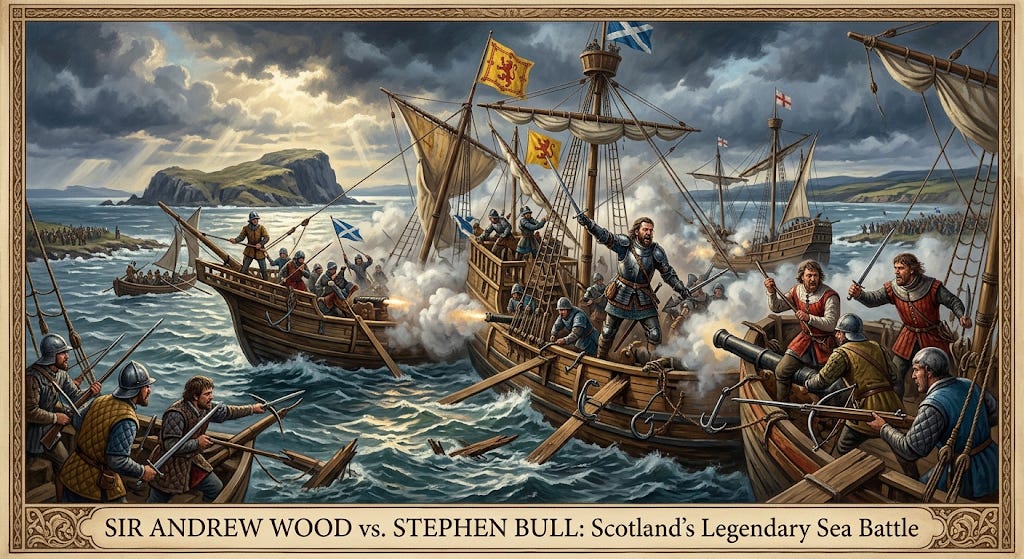
Near the mouth of the Firth of Forth, Scotland’s maritime future was once said to have hung upon two ships. Their commander was Andrew Wood of Largo, a merchant captain who had become one of the Crown’s most trusted seamen. Waiting near the Isle of May, according to the famous story, was an English force led by Stephen Bull with orders to capture or destroy him. What followed became one of Scotland’s greatest naval legends, although the evidence requires the story to be told with both excitement and care.
Wood rose during the troubled reign of James III, when Scotland had no permanent navy and relied upon experienced shipmasters. He combined commerce with warfare, carrying goods and defending Scottish waters when hostile vessels threatened trade. James III rewarded his service with the lands of Largo in Fife, first held by Crown lease and then granted more permanently. When the king was killed after Sauchieburn in 1488, Wood had to prove that his usefulness outweighed his loyalty to a fallen monarch.
By 1489 the records associate Wood with two vessels whose names became inseparable from his reputation: the Flower and the Yellow Carvel. They were likely armed merchant ships rather than vessels built solely for battle, reflecting the flexible nature of medieval sea power. Cannon could punish an enemy at a distance, but victory was often decided when ships closed and armed men fought across the decks. Wood’s advantage lay in disciplined crews and an intimate knowledge of the Scottish coast.
The confrontation with Stephen Bull reportedly began with an English raid near Dunbar. Later accounts describe five English vessels attacking Scottish commerce until Wood challenged them with his two ships and captured the force despite being outnumbered. The prizes were supposedly brought to Leith as proof that Scotland could strike back at sea. Records confirm Wood’s maritime service and growing importance, but the detailed action and exact numbers come from later tradition rather than a surviving battle report.
Scottish chronicler Robert Lindsay of Pitscottie supplied the version later generations remembered. Writing decades after the event, he described the English defeat as an insult demanding revenge and named Stephen Bull as the commander chosen to humble Wood. Bull allegedly sailed north, positioned his ships near the Isle of May and waited for Wood to return from a trading voyage. The island stood beside the main route into the Forth, making it an ideal place to surprise approaching ships.
Pitscottie added one of the tale’s most memorable details by claiming that Bull seized fishermen and forced them to identify Wood’s sails. At last the Flower and the Yellow Carvel appeared, returning from Flanders and apparently unaware of the ambush. Once the fishermen confirmed their identity, the English vessels moved to trap them before they reached the inner firth. It is a wonderfully tense scene, but no independent tactical record confirms the fishermen, their words or Bull’s precise formation.
The battle reportedly opened with artillery, smoke and splintering timber before becoming a savage close-range struggle. Pitscottie gives Wood a stirring speech, calling upon his men to defend their king, honour and lives. Grappling irons pulled ships together while archers, gunners and boarding parties fought for the decks. These details plausibly reflect combat of the period, yet the speech and staged progression are literary devices rather than eyewitness testimony.
According to the chronicle, neither side could break the other before darkness ended the first day’s fighting. The crews paused through the night, tending wounds, repairing damage and preparing to resume at dawn. When battle began again, wind and tide carried the vessels northward along the Fife coast toward the River Tay. Later tradition imagined crowds gathering onshore to watch the ships drift past in cannon smoke.
On the second day, Wood’s experience in home waters supposedly began to decide the contest. His sailors understood the tides, shoals and changing winds, while the English fought far from familiar harbours. Bull’s resistance finally collapsed, and he surrendered with his surviving ships. The prizes were taken into Dundee before the captured men were brought to James IV.
The conclusion is told in the language of chivalric history. James IV reportedly praised the English sailors and sent them home without ransom, accompanied by a warning that Scotland’s seas would be defended. This generosity made the king appear honourable while turning Wood into the ideal royal servant. Whether every gesture occurred as described cannot be established, but the scene explains why the story survived: it united danger, victory and mercy.
Separating history from legend does not mean dismissing Wood’s achievement. Contemporary records establish his royal maritime service, his association with the Flower and the Yellow Carvel, and his growing position under James IV. They do not provide a ship-by-ship account of the Stephen Bull encounter or confirm every flourish preserved by Pitscottie. The safest conclusion is that the tradition reflects genuine Scottish naval success while its dialogue and heroic set pieces were shaped by later storytellers.
The clash also opens a window onto naval warfare before Scotland possessed a large standing fleet. Royal security depended upon merchant captains who could arm commercial vessels, assemble crews quickly and turn local knowledge into a weapon. The Firth of Forth was not merely a dramatic setting but an economic highway carrying trade and revenue toward Leith, Edinburgh and the royal court. Wood’s career shows how seamanship, commerce and politics worked together to defend a kingdom whose strength at sea rested upon skilled individuals rather than a permanent naval institution.
His rewards were lasting even if their connection to one battle cannot be proved. Wood received a royal licence in 1491 to fortify Largo, rose to knighthood and remained involved in the maritime ambitions of James IV. In 1513 his lands became the free Barony of Largo, with an obligation to transport the king and royal party to the Isle of May. The island associated with Bull’s legendary ambush was therefore written into the Wood family’s baronial identity.
The battle remains compelling because it stands where evidence meets national memory. Wood was more than a fictional hero: he was a merchant, royal servant, landholder and commander who helped protect Scotland during a vulnerable age. Pitscottie transformed that career into an unforgettable contest with Stephen Bull and gave Scotland the naval champion later generations celebrated. His rise, the Woods of Largo and their maritime legacy are explored in The Complete History of Clan Wood, a richly researched book for readers of Scottish clan, naval and Stewart history.
References
Burnett, G. (Ed.). (1887). The Exchequer rolls of Scotland (Vol. 10, A.D. 1488–1496). H.M. General Register House.
Hepburn, W. (2023). The household and court of James IV of Scotland, 1488–1513. Boydell Press.
Lindsay, R. (1899–1911). The historie and cronicles of Scotland (A. J. G. Mackay, Ed.; Vols. 1–3). Scottish Text Society.
Macdougall, N. (1989). James IV. John Donald.
Montagu, F. M. (1863). Memorials of the family of Wood of Largo. Privately printed.
Rodger, N. A. M. (1997). The safeguard of the sea: A naval history of Britain, 660–1649. HarperCollins.
Stevenson, K. (2006). Chivalry and knighthood in Scotland, 1424–1513. Boydell Press.