Discover more fascinating stories about Clan Cunningham - https://fairbairncrests.com/products/15-tales-that-shaped-the-cunninghams-and-scotland-digital-edtion
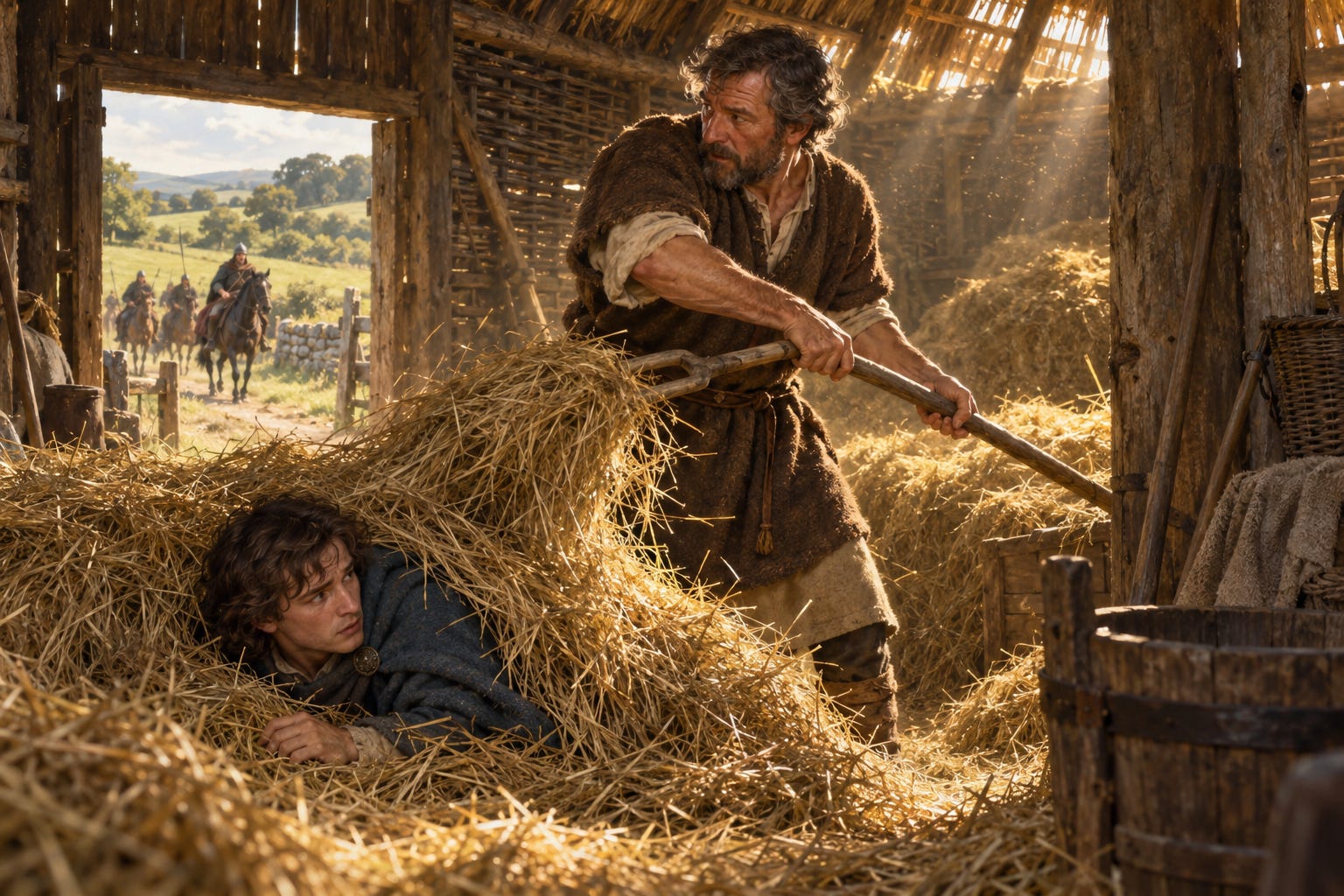
A prince is running for his life, and a farmer has only moments to decide whether to help him. There is no army waiting in the yard, no fortress to offer protection, and no time for an elaborate plan. There is only a hiding place, a heap of hay, and a tool made for everyday work. From this simple scene comes one of the most memorable traditions associated with Clan Cunningham: the royal rescue behind the words “Over Fork Over.”
In a familiar telling, the fugitive is Malcolm Canmore, the future Malcolm III of Scotland, fleeing the forces of Macbeth. His rescuer is another Malcolm, identified as the son of Friskin, although versions differ over the rescuer’s name. The farmer conceals the prince beneath hay, using his fork to cover him before the pursuers can discover him. Some accounts place the hiding place inside a barn, while others describe a haystack.
The motto supplies the story’s urgent voice. “Over Fork Over” becomes an instruction to keep throwing hay across the hiding place until the prince disappears beneath it. When Malcolm later gains the throne, tradition says he rewards his protector with the territory of Cunningham. In one compact narrative, the family receives an explanation for its lands, its emblem, and its enduring words of identity.
It is an effective story because the balance of power briefly turns upside down. A future king depends upon someone whose concerns are crops, animals, and the next day’s labour. The farmer cannot command soldiers, but he can understand his surroundings and act before fear stops him. Read this way, the tale celebrates practical intelligence as much as personal bravery.
The royal setting has a historical foundation, but that does not establish the rescue itself. Malcolm was the son of Duncan I, who died in battle against Macbeth in 1040, and Malcolm became king in 1058. Macbeth’s reign and Malcolm’s eventual rise belong to Scotland’s recorded history. The flight into a Cunningham barn belongs to a different category of evidence: family tradition attached to those historical figures.
That distinction matters because familiar names can make an unverified episode feel documented. Knowing that Malcolm and Macbeth existed does not tell us where a fugitive stopped, who sheltered him, or what anyone shouted while moving hay. The sources consulted for this account do not establish a contemporary record of the rescue or a royal grant made in payment for it. The responsible description is therefore a legend about the family’s origins, rather than a proven account of how the family began.
There is also a difference between recording a tradition and witnessing an event. A genealogist writing centuries after Malcolm’s reign may show that a story was circulating in that later period. Unless the writer identifies reliable earlier evidence, the account cannot by itself carry us back to the supposed moment in the barn. Repetition in modern clan histories can demonstrate the legend’s popularity without independently confirming its events.
The family’s more securely grounded beginnings lead towards twelfth-century Ayrshire and the lordship of the de Morvilles. Accounts of the Cunningham line identify Warnebald, a follower of Hugh de Morville, as an early ancestor associated with Kilmaurs. His son Robert appears in the history of religious land grants, placing the family within the ordinary records of medieval property and patronage. This is a different route into the past from the story of a grateful eleventh-century prince.
The shakefork brings the two kinds of history together. In Cunningham heraldry it is a pointed, Y-shaped figure, conventionally understood as a representation of an agricultural fork. It belongs on the shield and should be distinguished from the unicorn’s head used as the crest. Once the rescue story is known, the shape becomes easy to read as the implement that hid Malcolm beneath the hay.
Yet a heraldic emblem is not a contemporary illustration of everything later said about it. The fully formed package of surname, hereditary arms, and motto should not simply be projected into Malcolm’s lifetime. Other explanations have connected the fork with service in royal stables or with the wheat sheaves of the Comyn arms. These competing interpretations remain theories, and none should be presented as a settled replacement for the barn story.
One possibility is that an existing emblem encouraged people to develop an explanation for it. Another is that a remembered story influenced how later generations understood or displayed the emblem. The evidence considered here does not settle the direction of that relationship. What we can see is how neatly the words, the fork, and the rescue reinforce one another once they are brought together.
That neatness helps explain the legend’s appeal. A complicated history of property transfers can be difficult to remember, whereas a frightened prince beneath a heap of hay creates an immediate picture. The short motto gives the picture movement and sound. A person encountering the symbol for the first time can learn its traditional explanation in a few sentences and carry it away.
The reward at the end gives the story another purpose. In the legend, the family’s position begins with a useful and courageous act, and the king recognises an obligation to the person who helped him. This offers a moral explanation for inherited standing: the ancestor deserves remembrance because he protected someone in danger. That is an interpretation of the story’s meaning, not evidence that the promised reward actually occurred.
The choice of a farming tool also makes the tale unusually approachable. Its hero works with something ordinary, using knowledge that comes from daily labour. Readers do not have to imagine themselves as nobles or warriors to understand his decision. They can ask whether they would recognise the danger, offer shelter, and keep working while strangers searched nearby.
For people exploring Cunningham heritage today, the legend can provide a shared point of recognition without serving as proof of individual descent. A surname, a motto, and an inherited story offer ways to begin asking questions about family and place. They do not replace parish registers, wills, charters, or the patient work of genealogy. Enjoying the tale and investigating the records can be parts of the same interest.
This meeting of storytelling and historical inquiry runs through Stories From Clan Cunningham: 15 Tales That Shaped the Cunninghams and Scotland. The collection explores a family remembered through royal legends, feuds, faith, craftsmanship, and literary friendship. Available in EPUB, KPF, and PDF formats, it invites readers to continue beyond the shakefork into the clan’s wider world. The farmer’s rescue remains a compelling doorway into that world, especially when we understand both its appeal and the limits of what can be proved.
References
Bagtown Clans. (2025). Stories from Clan Cunningham: 15 tales that shaped the Cunninghams and Scotland. Rigby Publishing.
Clan Cunningham International. (n.d.). Tartans.
Kerr-Peterson, M. (2023, July 10). Crest meaning: Cunningham. St Kilda Kilts.
Scots Connection. (n.d.). Cunningham clan.
The Royal Household. (n.d.). Macbeth (r. 1040–1057).
The Royal Household. (n.d.). Malcolm III (r. 1058–1093)