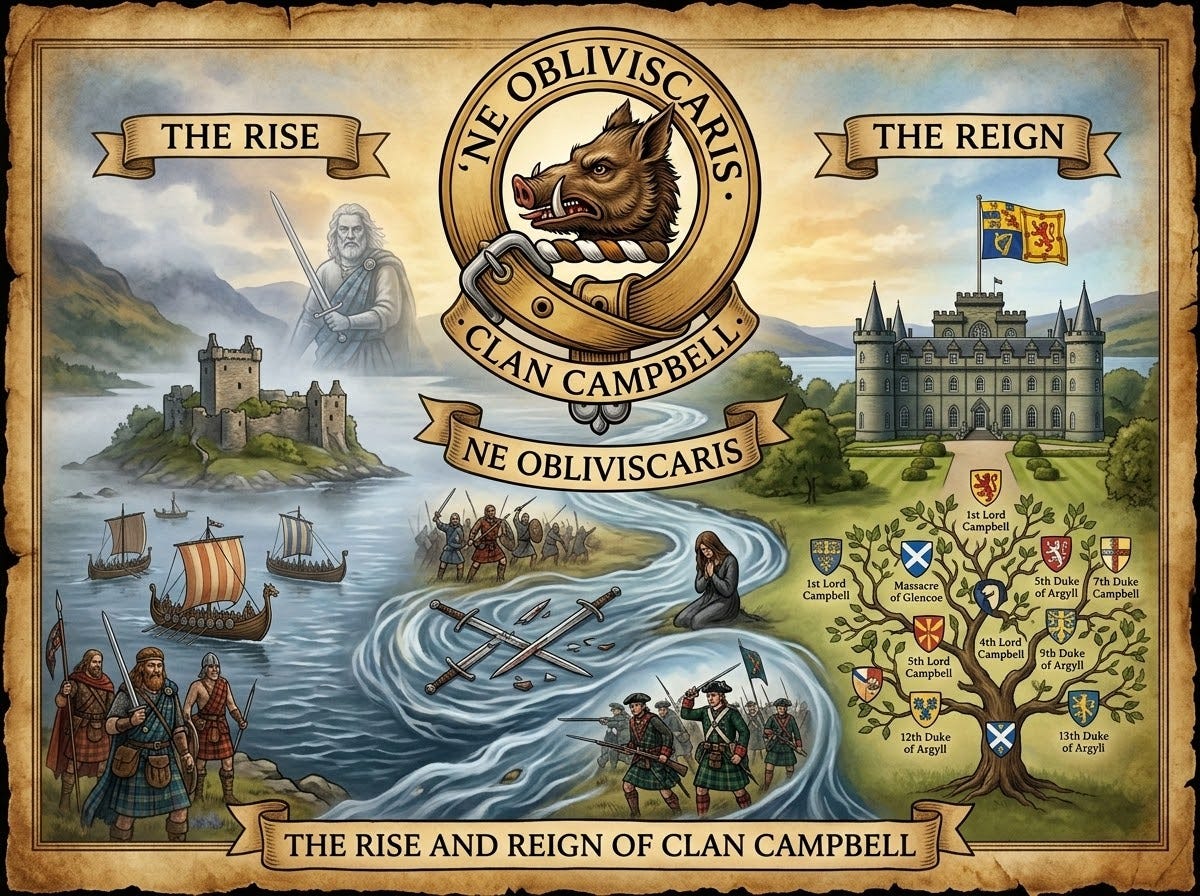
The sweeping history of Clan Campbell begins in the mists of Celtic mythology, tracing its primordial roots to the Ossianic hero Diarmid O’Duibhne, who famously slew a monstrous, poisonous boar at Ben an Tuire in Kintyre. While this heroic legend firmly established the clan’s early Gaelic designation as Clann Diarmaid, documented history grounds their origins in the thirteenth century when Eva, the heiress of the O’Duibhne tribe on the shores of Loch Awe, married a landowner named Archibald or Gillespie. The name “Campbell” itself evolved during this period, deriving not from the romanticized Norman invention “De Campo Bello,” but rather from the Gaelic “cam beul,” meaning “crooked mouth” or “wry-mouth,” which was likely an affectionate nickname given to a highly respected early ancestor. This rich heritage is vividly encapsulated in the symbols that have united the kindred for centuries.

Honoring their mythic founder, the clan’s crest badge features a boar’s head erased fessways, encircled by a strap and buckle bearing the chief’s Latin motto, “Ne Obliviscaris,” which translates to “Forget Not.” When marching into battle, clansmen rallied to the fierce cry of “Cruachan!”, named after a prominent farm on the western bank of Loch Awe, while proudly wearing sprigs of bog myrtle tucked into their bonnets as a plant badge. Their visual identity is further defined by their tartans, most notably the ancient green, blue, and black sett that became famous as the Black Watch or Government tartan, alongside specific authorized setts for cadet branches like Breadalbane, Cawdor, and Loudoun. In chiefly heraldry, the coat of arms is distinguished by a gyronny of eight in gold and black, a pattern that definitively marks Campbell lineage.
From their ancestral heartland in Argyll, the Campbells orchestrated a masterful territorial expansion that reshaped the map of Scotland. Their original headquarters was the island fortress of Innis Chonnell on Loch Awe, but their lands rapidly expanded to include vast stretches of Perthshire, Clackmannanshire, Nairnshire, and Ayrshire. Over time, their power was cemented through a network of formidable strongholds, including Kilchurn Castle, Castle Campbell, Cawdor Castle, and eventually the magnificent Gothic Revival Inveraray Castle on Loch Fyne, which remains the family seat today. The genealogical structure that managed these vast territories was headed by the chiefly line of the Dukes of Argyll, known by the Gaelic title MacCailein Mòr, meaning “Son of Colin the Great.” Below the chief, the clan’s strength was bolstered by powerful cadet branches—such as the Earls of Breadalbane, Cawdor, and Loudoun—and swelled by numerous septs, or associated families like the MacArthurs, MacTavishes, and Bannatynes, who sought the protection of the Campbell banner.
The meteoric rise of the Campbells was frequently forged in the crucible of conflict and astute political maneuvering. They aligned themselves firmly with Robert the Bruce during the Wars of Scottish Independence, a loyalty rewarded with royal marriages and the forfeited lands of rival clans like the MacDougalls and MacDonalds. This ignited centuries of bitter feuds, as the Campbells uniquely weaponized royal law, debt, and legal charters to expand their territories and crush their enemies. Their history is marred by dark episodes of violence, such as the Dunoon Massacre of the Lamonts in 1646 and the infamous Massacre of Glencoe in 1692, where Campbell-led government troops violated the sacred Highland code of hospitality to slaughter the MacDonalds in their sleep. During the ideological struggles of the seventeenth century, the clan led the Presbyterian Covenanter movement against Royalist forces, and throughout the Jacobite Risings of the eighteenth century, they steadfastly supported the British Hanoverian Crown. Campbell militias and the Black Watch regiment played decisive roles in halting the Jacobites at Sheriffmuir in 1715 and finally defeating them at Culloden in 1746.
Beneath the military and political dominance, the daily culture of the Campbells was a complex blend of Highland tradition and progressive adaptation. Economically, they transitioned from traditional cattle rearing and raiding to sophisticated estate management and agricultural improvements. They were early and zealous champions of the Protestant Reformation in Scotland, utilizing their influence to install reformed ministers and shape the national Kirk. Concurrently, they acted as great patrons of the Gaelic arts, supporting learned orders, bards, and pipers who composed enduring clan music such as “The Campbells Are Coming” (Baile Inneraora). However, following the defeat of the Jacobites, the traditional Highland way of life began to decline. Although the Campbells avoided the brutal post-Culloden repression suffered by rebel clans, they were not immune to the sweeping socioeconomic changes of the era. The subsequent Highland Clearances and the modernization of agricultural estates uprooted many families, sparking a wave of global emigration that carried Campbells to the farthest reaches of North America and the British Empire.
Today, the legacy of Clan Campbell transcends the borders of Scotland, thriving as a vibrant, global community. The clan is currently led by Torquhil Ian Campbell, the 13th Duke of Argyll, who actively preserves the family’s heritage from Inveraray Castle while navigating the demands of the modern era. Modern clan societies, most notably the Clan Campbell Society (North America), serve as vital hubs for genealogical research, historical education, and the fostering of kinship among millions of descendants worldwide. This enduring spirit is celebrated at global gatherings, world festivals, and traditional events such as the Inveraray Highland Games hosted on the castle grounds, ensuring that the history, culture, and power of MacCailein Mòr will truly never be forgotten.
References
Argyll Estates. (n.d.). The Campbell family. Inveraray Castle.
Argyll Estates. (n.d.). Clan Campbell timeline. Inveraray Castle.
Clan Campbell Society (North America). (n.d.). Cadet branches of Clan Campbell.
Clan Campbell Society (North America). (n.d.). Clan Campbell customs to know.
Clan Campbell Society (North America). (n.d.). Clan Campbell history.
Clan Campbell Society (North America). (n.d.). Symbols of Clan Campbell kids page.
Electric Scotland. (n.d.). Clan Campbell history.
Historic Environment Scotland. (n.d.). Kilchurn Castle: History.
Lyons, M. (2026). Massacre at Glencoe. History Today, 76(2).
National Army Museum. (n.d.). Jacobite risings.
ScotClans. (n.d.). History of the Campbells of Breadalbane.
Scottish Tours. (n.d.). What happened at the Glencoe massacre.
Tartan Vibes Clothing. (2025). Why is the Campbell clan hated? Key reasons revealed.
Wikipedia contributors. (2025). Clan Campbell. Wikipedia, The Free Encyclopedia.
Wikipedia contributors. (2025). Torquhil Campbell, 13th Duke of Argyll. Wikipedia, The Free Encyclopedia.