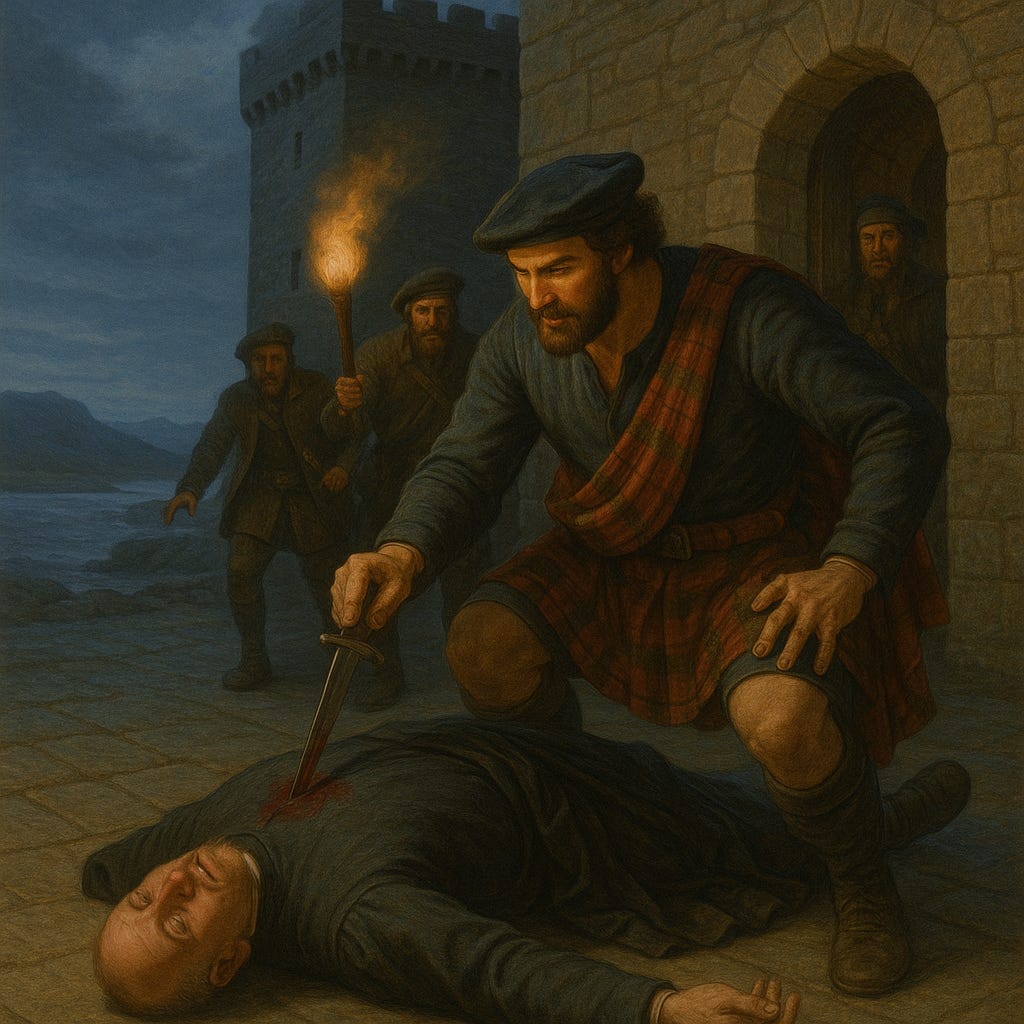
Clan histories are filled with battles, raids, and larger-than-life figures. Yet sometimes the most gripping stories emerge not from open warfare, but from the murky shadows of an island feud. One of the most mysterious and dramatic episodes in the history of Clan MacNeil of Barra centers on the death of a man remembered only by his title—the “Peursan Mór”, or “Big Parson”—who was slain in 1609. His murder drew the gaze of kings, churchmen, and island chiefs, and it stands as a window into the raw politics of the Hebrides at the very moment when Scottish royal power was pressing hardest upon the clans.

The Victim: Who Was the “Big Parson”?
The “Big Parson” was a churchman with considerable influence on Barra. Contemporary sources suggest he was tied to the parochial administration of the island, at a time when the church was being harnessed by the Crown as a tool of control. By 1609, James VI had declared that the Hebrides would no longer be ruled by local custom alone—clans would bend to royal law, or face suppression. Ministers and parsons, many of whom were drawn from local kindreds, became essential go-betweens: preaching loyalty, levying tithes, and reporting on troublesome lairds.
On Barra, this made the “Big Parson” both powerful and vulnerable. He was no neutral figure—he represented authority in an island where the MacNeils had long defied outsiders, and where the castle of Kisimul symbolized independence against both Crown and Kirk.
The Crime: A Murder That Shocked the Isles
In the autumn of 1609, the “Big Parson” was murdered in circumstances never fully explained. Records hint at violence so sudden and shocking that it reverberated across the Hebrides. The killing was not the kind of sea-raid or cattle theft so common in island life. Instead, it was the assassination of a man of the cloth, someone who, at least in theory, was protected by both sacred law and secular authority.
The murder immediately raised the question: who would dare strike down a parson? On Barra, nothing happened without clan knowledge. And so suspicion inevitably fell upon the ruling MacNeil chief, Ruairidh an Tartair (“Rory the Turbulent”), or upon his circle.
The Suspects: Family, Clan, or Outsiders?
Historians differ on who was responsible, and the sources are tantalizingly incomplete. Three main theories survive:
The Chief Himself
Rory the Turbulent was notorious for his defiance of royal power and had already been branded a pirate and rebel. To some observers, the idea that he ordered the killing of a parson aligned with his reputation. But Rory was also a cunning political survivor—he knew murdering a churchman would draw the Crown’s wrath. Was he reckless enough to commit it?Rival Kindreds
Barra was not isolated. Other island kindreds, including branches of the MacDonalds and MacLeans, were enmeshed in disputes with the MacNeils. The parson, as an enforcer of royal statutes, might have been caught in the crossfire of a wider feud. A rival clan killing him and leaving suspicion on the MacNeils would have been a clever tactic.Internal Betrayal
Perhaps most fascinating is the theory that members of the MacNeil household itself engineered the killing. Rory’s sons would later rebel against him (famously seizing him in Kisimul Castle in 1612). If the parson had supported one line of succession over another, his removal might have been part of a deeper family struggle.
The Aftermath: Royal Justice and the Statutes of Iona
The timing of the murder is crucial. In 1609, James VI summoned the chiefs of the Isles to Iona and forced them to accept the Statutes of Iona, a harsh set of rules designed to pacify the Gaelic west. Chiefs were ordered to educate their heirs in the Lowlands, to support Protestant ministers, and to end piracy and lawlessness. The death of a parson on Barra was the worst possible event for the MacNeils at such a moment: it looked like a direct rejection of royal law.
Records show that Rory MacNeil was summoned and interrogated. Though never conclusively proven guilty, his reputation was blackened. The killing of the “Big Parson” became another charge in the long litany of complaints against him, justifying the Crown’s increasing intervention in Barra’s affairs. Rory survived the immediate storm but carried the stain of suspicion for the rest of his turbulent career.
Why This Story Matters
The murder of the “Big Parson” is more than a local mystery. It represents the collision of three great forces in Highland and Island history:
Faith and Power: The church was not just spiritual but political; killing its representative was an act of rebellion.
Clan Politics: Within the MacNeils themselves, shifting loyalties and rivalries made trust a rare commodity.
Royal Pressure: James VI’s government used the episode as proof that Hebridean chiefs were unruly and dangerous, legitimizing their gradual disarmament and control.
For the MacNeils of Barra, the murder is a reminder of how their independence came under fire not only from fleets and armies, but from accusations and intrigue.
Echoes in Folklore and Memory
In Barra folklore, the story of the parson’s murder sometimes blurs with tales of Rory’s temper and the ruthlessness of his household. Oral tradition, though fragmentary, has preserved the sense of scandal: a man of God cut down in the shadow of Kisimul’s walls. Even today, islanders will shake their heads at the story—less a solved crime than a lingering warning about the costs of power.
Conclusion: A Mystery That Endures
We will probably never know who wielded the blade, or whose order sealed the “Big Parson’s” fate. What is clear is that his murder in 1609 stands as a turning point in Barra’s history. It symbolized the end of an age when the MacNeils could rule unchecked and the beginning of a new era of royal oversight.
For descendants of Clan MacNeil today, the tale of the “Big Parson” is a reminder that their ancestors lived in a world of danger and drama, where even the church was caught in the struggle for survival. It is one of those rare clan stories that combines mystery, politics, faith, and betrayal—a story that still grips the imagination four centuries later.
Suggested sources for reference in a blog footnote or further reading section:
Bannerman, J. (1977). Studies in the History of Dalriada.
MacCoinnich, A. (2015). Plantation and Civility in the North Atlantic World: The Case of the Northern Hebrides, 1570–1639.
National Records of Scotland, Privy Council Papers (1609).
Historic Environment Scotland, “Kisimul Castle” official site history.