

Uncover the epic history and origin of Clan MacMillan - https://fairbairncrests.com/products/the-complete-history-of-clan-macmillan-ditigal-edition
Some family histories begin with a name on a page. At Kilmory Knap, in the coastal landscape of Argyll, the MacMillan story rises from a carved stone cross. Its surfaces bring together a named man, a hunting scene and the central image of Christian sacrifice. More than five centuries after its creation, the monument still invites us to ask how a family wanted to be remembered.
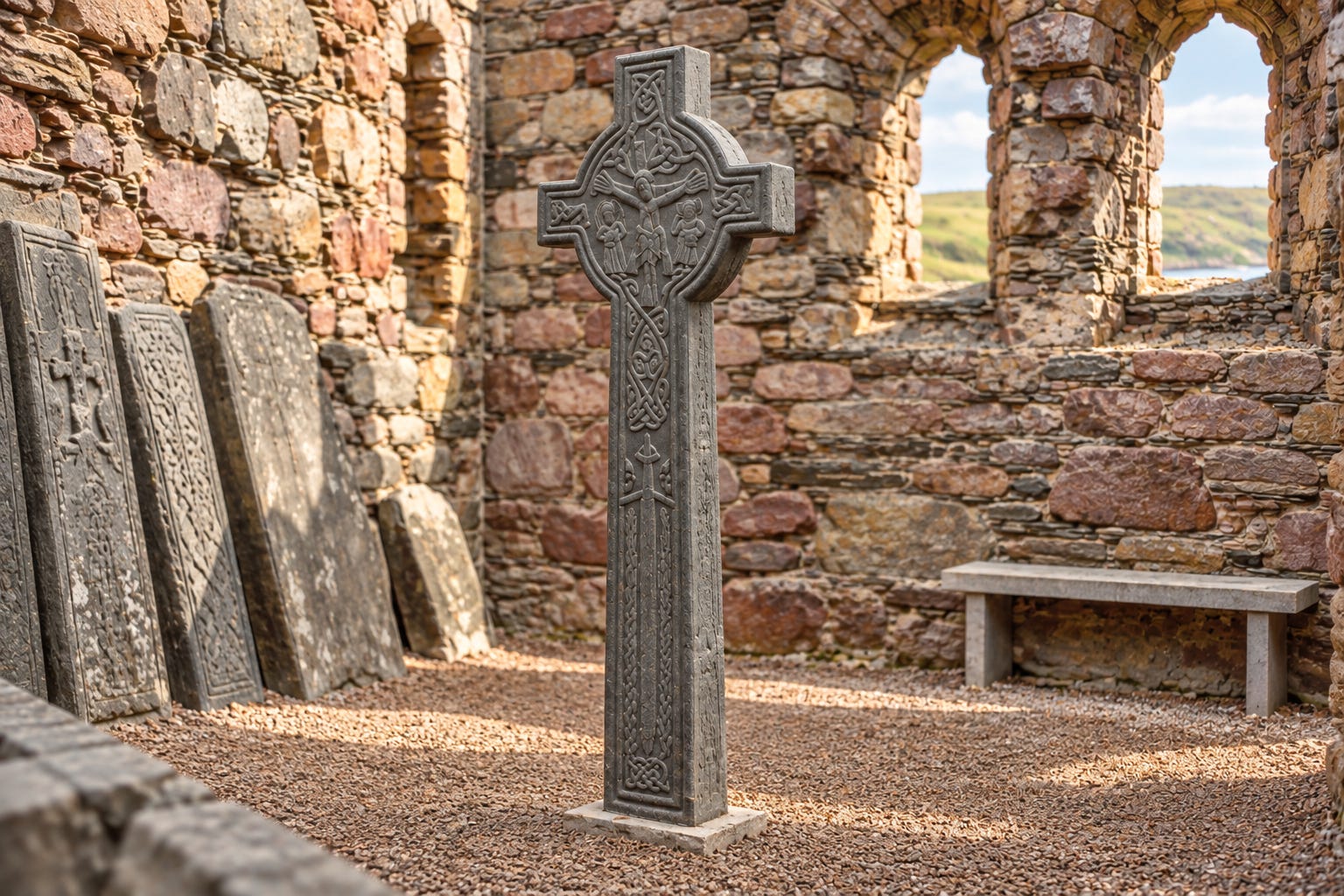
Known as MacMillan’s Cross, the monument is generally dated to the later fifteenth century and is associated with Alexander MacMillan. Nearly three metres high, it has a distinctive rounded cross-head and richly worked surfaces. It now stands within Kilmory Knap Chapel, among a collection of carved stones that preserve other fragments of the region’s past. Its scale attracts attention, but the smaller details explain why it matters.
The strongest connection to Alexander appears in the inscription, whose Latin words translate as “This is the cross of Alexander MacMillan.” That short statement gives the monument something many medieval stones have lost: a clear personal identity. We can connect the object with a named MacMillan without depending entirely on stories written centuries later. The inscription does not supply his whole life, but it gives that life a firm point of contact with the surviving landscape.
It is worth pausing over what those words leave unsaid. They do not provide a complete pedigree, a list of victories or an explanation of every right Alexander possessed. Nor does naming him establish precisely where he was buried or whether the cross was raised during his lifetime. A careful reading allows the inscription to remain powerful without making it answer questions beyond its scope.
Alexander is associated with the keeping of nearby Castle Sween, placing him within the political world of medieval Knapdale. A castle keeper occupied a position connected with authority, responsibility and relationships with greater lords. The cross offers another view of that standing, expressed through commemoration rather than fortification. Read together, castle and cross suggest how a prominent family could make its presence felt in both political and religious settings.
On one face, a huntsman and dogs appear in a scene involving deer. The movement of animals and human figure brings the stone to life, drawing the eye along the carved surface. For a modern viewer, it is tempting to imagine Alexander enjoying a particular day outdoors. The safer interpretation is that hunting supplied a recognisable image of rank and a way of life associated with access to land and resources.
That distinction makes the scene more interesting. A monument presents a selected identity, showing what its makers and patrons considered worth displaying. Here, the hunt can be understood as a statement about standing rather than a literal record of an expedition. The figure may be associated with Alexander, but the carving cannot give us a reliable portrait of his face, temperament or private habits.
The opposite face places the Crucifixion above a long sword. This combination brings Christian devotion and armed status into the same design. The sword suggests a social identity in which force and leadership mattered, while the sacred scene directs attention towards suffering and salvation. Neither image should overwhelm the other when we try to understand the monument as a whole.
For the family remembering Alexander, faith and reputation could belong within one act of remembrance. The Christian setting suggests concerns extending beyond the survival of a surname or the display of authority. A cross could encourage reflection on the soul as well as recognition of the person named upon it. We cannot recover Alexander’s private beliefs from the stone, but we can recognise the religious language chosen for his commemoration.
The interlaced patterns deserve attention too. Their ordered strands required planning, control and a skilled hand capable of working within the shape of the monument. Such decoration connects the cross with the wider artistic traditions of the western Highlands, where patrons shared forms and craftspeople worked within established styles. Alexander’s name is individual, while much of the design belongs to a broader cultural world.
This is also a story about the people whose names the inscription does not preserve. Someone shaped the stone, organised its surfaces and turned an intended design into lasting lines. Others must have helped with the practical work of moving and erecting such a substantial object. The monument therefore suggests both a patron’s resources and the labour required to make remembrance visible.
Its location gives those efforts a social setting. Kilmory was a place of worship and burial, where one household’s memorial stood within a community’s shared sacred ground. The surrounding stones remind us that Alexander belonged among other people with their own families, loyalties and hopes. Looking beyond the famous cross prevents the wider community from disappearing behind a single distinguished name.
The coastal setting also helps explain why this corner of Argyll belongs within a larger history. In the book’s account of Knapdale, water connects households and lordships as much as it separates pieces of land. Castle, chapel and memorial can therefore be considered as parts of a lived landscape rather than isolated attractions. They invite readers to think about journeys, neighbours and obligations alongside ancestry.
The huntsman’s clothing has sometimes encouraged claims about the early history of the kilt. Such interpretations show how later generations searched medieval objects for familiar signs of Scottish identity. Yet carved clothing cannot reveal the colours of a lost textile or establish a standard tartan worn by an entire clan. The figure offers material for studying dress, while the stronger story remains the combination of status, activity and remembrance.
For anyone exploring MacMillan ancestry, the cross offers a connection that is meaningful without being a complete family tree. Sharing the surname does not, by itself, prove direct descent from the Alexander named here. Nevertheless, a person can value the monument as part of the history surrounding that name. Heritage can involve learning about a community and its places while keeping personal genealogy open to further investigation.
This balance between connection and careful questioning runs through The Complete History of Clan MacMillan. The illustrated book places Kilmory Knap beside the clan’s other homelands, following the story through changing lordships, religious divisions and migration overseas. Available in EPUB, KPF and PDF formats, it offers a wider setting for the people and places introduced here. MacMillan’s Cross is a memorable place to begin: a surviving name surrounded by images that still reward a closer look.
References
Bagtown Clans. (2026). The complete history of Clan MacMillan [Illustrated manuscript edition]. Rigby Publishing.
Clan MacMillan International. (n.d.). Clan MacMillan’s history: A brief overview.
High Life Highland. (n.d.). MacMillan cross at Kilmory of Knap. Am Baile.
Historic Environment Scotland. (n.d.). Kilmory Chapel, Macmillan’s Cross. Trove.
Historic Environment Scotland. (n.d.). Kilmory Knap Chapel: History and stories.
"We cannot recover Alexander’s private beliefs from the stone, but we can recognise the religious language chosen for his commemoration."
Pull the other one.