Uncover the epic history of Clan Donald - https://fairbairncrests.com/products/the-complete-history-of-clan-donald-digital-edition
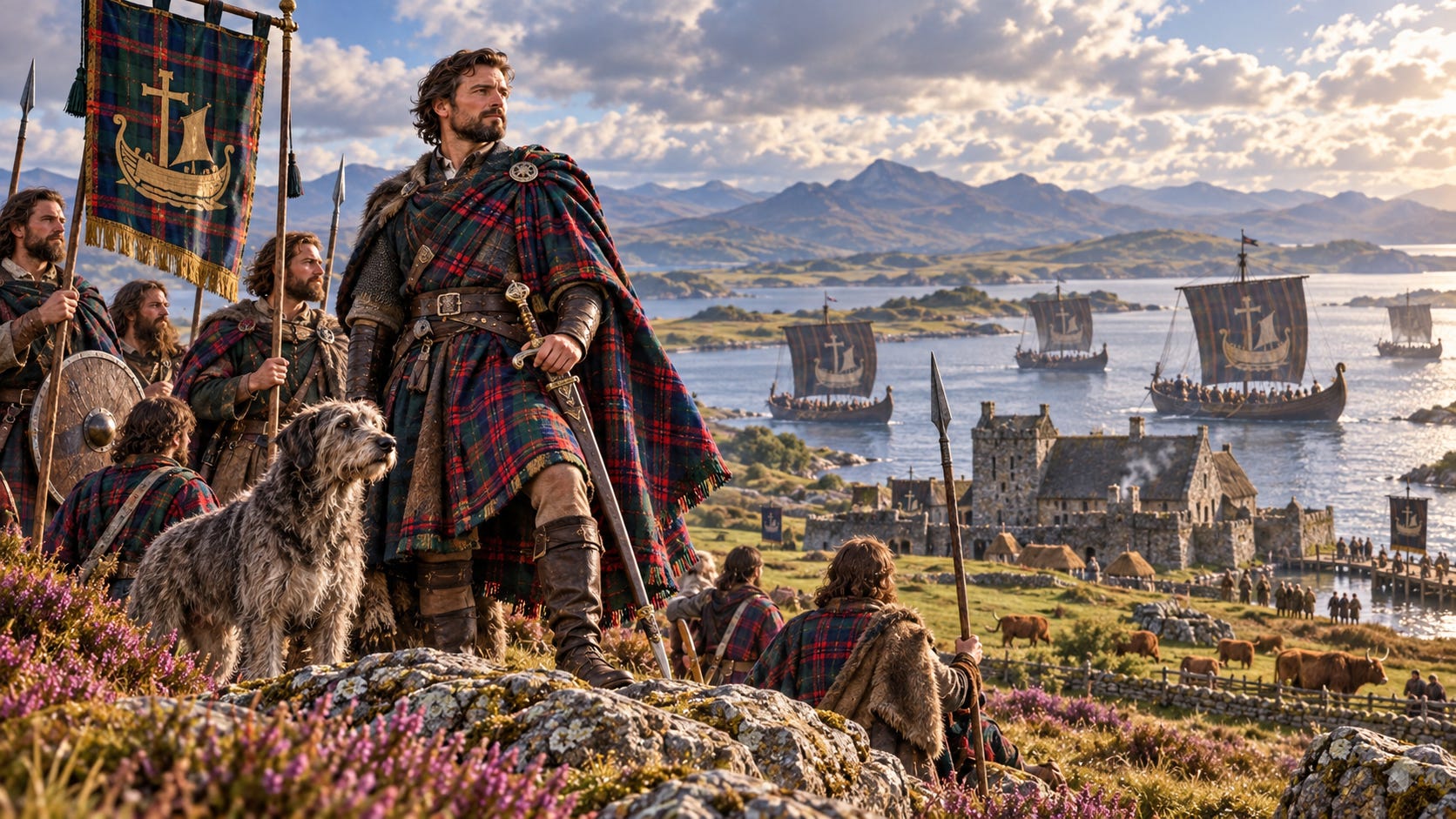
To understand how Clan Donald became Lords of the Isles, it helps to begin with the sea rather than the land. The western coast of Scotland was part of a maritime world linking Argyll, the Hebrides, Man and Ireland, and political power depended on the ability to move people, goods and fighting men across those routes. Clan Donald grew inside this seaborne world, and its rise cannot be separated from the geography that made the western Highlands and islands a connected political region.
The dynasty’s deeper origins lay with Somerled, a powerful twelfth-century ruler whose influence stretched across Argyll and the islands. Somerled was not yet a Clan Donald chief in the later sense, because the clan took its name from a descendant named Dòmhnall, or Donald. Even so, Somerled established the dynastic foundation from which several important western families emerged, including the line that became Clan Donald. His descendants inherited territorial claims and alliances that had to be defended and rebuilt.
The name Clann Dòmhnaill means the descendants or children of Donald, and it was through the descendants of Raghnall, a son of Somerled, that this branch of the wider dynasty took shape. Dòmhnall himself is less well documented than some later lords, but his descendants transformed his name into a durable political identity. Over time they became distinguishable from related houses such as the MacDougalls and strengthened their position around places such as Islay and Kintyre. Clan Donald was not founded in a single ceremony; it emerged gradually as descent, landholding and political opportunity reinforced one another.
Islay became especially important because it combined productive land with access to sea routes leading toward Kintyre, the Hebrides and Ireland. Yet sea power did not mean that the MacDonalds ruled by fleets alone, because every galley depended on communities ashore for timber, food, labour and trained men. The emerging lordship rested on both maritime mobility and control of productive land.
The thirteenth century brought a major change when Norwegian and Scottish claims over the Hebrides came into conflict. Aonghas Mór, an important early MacDonald lord, lived in a world where western rulers had to negotiate between competing royal powers. After the Norwegian expedition of 1263 and the Treaty of Perth in 1266, the Scottish Crown gained sovereignty over the Hebrides, but local lords did not disappear. The MacDonalds instead had to secure recognition of their lands within a new royal framework, and their ability to adapt helped prepare the way for later success.
The relationship with the Scottish monarchy became still more important during the Wars of Independence. Aonghas Óg supported Robert Bruce when Bruce’s position was insecure, and the western maritime world offered refuge, movement and assistance that could be strategically valuable. Bruce’s victory helped place the MacDonald house more securely within the new royal settlement and opened opportunities for further growth.
The decisive transformation came under John of Islay in the fourteenth century. John expanded the family’s position through negotiation, territorial opportunity and marriage. His marriage to Amie MacRuairi connected the MacDonald household to substantial western lands, while his later marriage to Margaret Stewart, daughter of the future Robert II, tied the family directly to the Stewart dynasty. These unions brought claims, heirs and political connections that helped turn a strong regional family into a much larger lordship.
Marriage also helped create the powerful branches that later defined Clan Donald. John’s descendants through Amie MacRuairi became associated with lines such as Clanranald and Glengarry, while children of the Stewart marriage helped establish other important family interests. These branches could strengthen the wider kindred by placing close relatives in strategic territories, but they also developed ambitions and followers of their own. The success of the dynasty created a broad network that increased MacDonald power while making its politics more complicated.
By the 1330s, the title Lord of the Isles had become an important expression of MacDonald authority. It signalled a lordship broader than possession of one island and presented its ruler as the head of a major regional power. The Lords of the Isles combined Gaelic traditions of kinship and leadership with charters, marriage settlements and royal recognition.
Finlaggan on Islay became one of the great centres of this political world. Set on small islands in a freshwater loch, it was important because political, ceremonial and household activity gathered there. Finlaggan represented the practical reality of MacDonald power: a centre from which relationships were maintained across a much larger maritime lordship.
The Lordship reached an even greater level of power through the MacDonald claim to the Earldom of Ross. Donald, Lord of the Isles, pursued the claim through his wife Mariota, whose inheritance connected the western dynasty to one of northern Scotland’s greatest earldoms. The dispute led to the Battle of Harlaw in 1411, but the conflict was not simply a Highland invasion of the Lowlands; it was also a struggle over inheritance, aristocratic power and control of Ross. Donald’s son Alexander eventually gained recognition as Earl of Ross, bringing the MacDonald house to one of the highest points of its territorial influence.
By the fifteenth century, Clan Donald had become powerful because it combined several different sources of authority. They could lead armed followers, but they could also issue grants, patronise churches and operate within the legal structures of the kingdom. Their strength came from functioning in both the Gaelic world of the western seaboard and the wider political world of medieval Scotland.
The rise of the Lords of the Isles was therefore not the work of one warrior or one dramatic conquest. From the descendants of Somerled came a dynasty that used Islay as a territorial base, Finlaggan as a political centre, the sea as a highway and marriage as a means of expansion. By the time the Lordship reached its height, MacDonald influence stretched across islands and mainland districts and touched some of the most important political struggles in Scotland. Their later decline would reveal the difficulty of holding such a wide network together, but their rise remains one of the most remarkable stories in Scottish clan history.
For readers who want to follow this story beyond the rise of the Lordship, The Complete History of Clan Donald carries the history forward through Harlaw, the fall of the Lordship, the great MacDonald branches, Glencoe, Jacobitism, the Clearances and the global diaspora. It also explores the culture, language, migration and modern institutions that kept the Clan Donald identity alive long after the medieval political structure disappeared. The book provides a broad starting point for anyone researching MacDonald history, ancestry or the wider story of Scotland’s western clans.
References
Caldwell, D. H. (2008). Islay: The land of the lordship. Birlinn.
Caldwell, D. H. (2025). The archaeology of Finlaggan, Islay: Excavations at the centre of the Lordship of the Isles, 1989–1998. Society of Antiquaries of Scotland.
Macdonald, A., & Macdonald, A. (1896–1904). The Clan Donald (3 vols.). Northern Counties Publishing Company.
McDonald, R. A. (1997). The Kingdom of the Isles: Scotland’s western seaboard, c. 1100–c. 1336. Tuckwell Press.
Munro, J., & Munro, R. W. (Eds.). (1986). Acts of the Lords of the Isles, 1336–1493. Scottish History Society.
Oram, R. (Ed.). (2014). The Lordship of the Isles. Brill.
Penman, M. (2014). The MacDonald lordship and the Bruce dynasty, 1306–1371. In R. Oram (Ed.), The Lordship of the Isles (pp. 62–87). Brill.
Sellar, W. D. H. (1966). The origins and ancestry of Somerled. The Scottish Historical Review, 45(140), 123–142.