Uncover the epic complete history of Clan Stewart - https://fairbairncrests.com/products/the-complete-history-of-clan-stewart
The Battle of Bannockburn was won in June 1314. The first Stewart king would not take the throne until 1371. Between those dates lay a marriage, the birth of a child, a parliamentary decision, and decades in which Scotland’s succession remained uncertain.
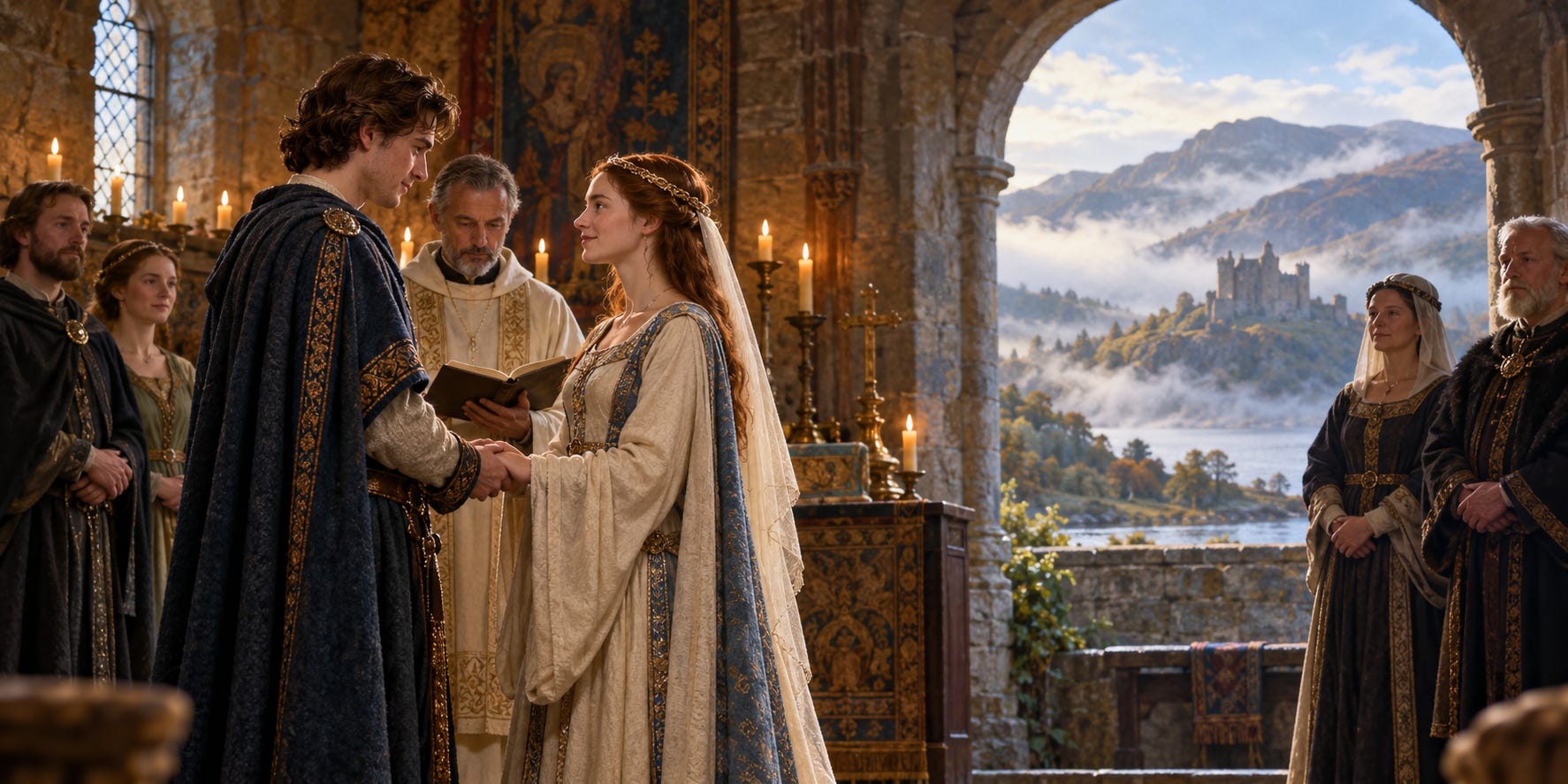
The couple at the centre of the story were Walter Stewart, the hereditary High Steward of Scotland, and Marjorie Bruce, daughter of King Robert the Bruce. Their marriage in 1315 brought two powerful lines together. It did not make Walter a king, and it did not guarantee that their child would become one. It gave the Stewarts a claim whose importance would grow as the years passed.
A victory with an uncertain future
Bannockburn transformed Robert the Bruce’s position. His victory strengthened his rule and Scotland’s resistance to English claims, but winning a battle did not settle who would inherit his crown. A kingdom emerging from years of war needed a succession that its leading figures could recognise and defend.
Walter already held a place in Scottish public life. His family had served as hereditary stewards for generations and possessed substantial lands in western Scotland. Marjorie brought something different to their marriage: she was the king’s daughter. Any child of theirs would belong to both the Stewart family and Robert’s royal line.
It is tempting to tell the marriage as a simple reward for Walter’s service after Bannockburn. That version makes a neat story, but the marriage’s lasting importance lies in the succession it made possible, not in an assumed bargain struck after the battle. Walter’s standing mattered; so did the position he and Marjorie occupied in a country still working to secure its future.
Marjorie’s place in the story
Marjorie can disappear from accounts that move quickly from Robert the Bruce to his grandson. Yet the grandson’s claim ran through her. The parliamentary record that later addressed the succession identified young Robert as Marjorie’s son and named her marriage to Walter as the basis of his legitimate birth.
Walter and Marjorie had one son, Robert. Marjorie died while he was still very young, leaving him with a royal connection he could not yet use for himself. Stories about the precise circumstances of her death have circulated for centuries, but their dramatic details are less secure than the parentage recorded in the succession settlement. Her role does not depend on any of those later stories: without Marjorie, there was no Bruce descent for the Stewart child to claim.
In December 1318, Robert the Bruce held a parliament at Scone. Its members agreed that, if the king died without a surviving legitimate son, Robert Stewart—Marjorie and Walter’s child—should succeed him. This was a conditional decision, made while the future was still unknown. It gave the boy’s possible inheritance a public footing beyond family expectation.
The long wait for a crown
The condition did not come into effect when Robert the Bruce died in 1329. By then he had a son, David, who inherited as David II. Robert Stewart remained connected to the royal succession, but his uncle occupied the throne. David was young, and the kingdom continued to face war and political strain.
Robert’s position became more demanding as he grew older. He served in government during periods when David was absent, including after the king’s capture by the English in 1346. Acting for a captive monarch gave Robert experience and influence, but it could also create tension between the reigning king and the man expected to succeed him. The marriage that had joined their families did not remove the competing interests of two living political figures.
David’s release in 1357 did not end the question of who would follow him. He might still have had a child, and he explored other possibilities for the succession. Robert therefore spent much of his adult life as a prospective heir rather than a king in waiting with a fixed date for his accession. The outcome depended on events that Walter and Marjorie could never have foreseen.
When David II died without a child in 1371, Robert Stewart succeeded him as Robert II. At his coronation, the right by which he had inherited was publicly declared, and an earlier succession instrument from Robert the Bruce’s reign was brought forward. What began as a conditional provision for Marjorie’s young son had become part of the explanation for a new royal dynasty.
What the marriage changed
Walter and Marjorie’s marriage connected the hereditary stewards to the Bruce royal family. Their son’s claim then had to survive more than fifty years of births, deaths, war and political disagreement before it resulted in a crown. The story is compelling because no one at the wedding could know how those events would unfold.
It also reminds us to keep Marjorie in the picture. Robert II became the first Stewart king because he was Walter’s son and Robert the Bruce’s grandson through her. Bannockburn helped secure Bruce’s reign; the marriage carried his family line into a possible future; and the succession decisions made by the kingdom helped turn that possibility into a recognised claim.
This is one chapter in a much wider history. The Complete History of Clan Stewart follows the family from its origins as royal stewards through the Stewart kings, later branches, Jacobite history, migration and the Stewart name today. If this marriage has sparked your interest, the book continues the story beyond Robert II’s accession.
References
Records of the Parliaments of Scotland to 1707. (1318). Ordinance and statute entailing the crown on the heirs of Robert I, whom failing on Robert Stewart.
Records of the Parliaments of Scotland to 1707. (1371). Declaration that John Stewart, Earl of Carrick, is heir to the throne of Scotland.
The Royal Family. (n.d.). David II (r. 1329–1371).
The Royal Family. (n.d.). Robert II (r. 1371–1390).