Uncover the epic history and origin of Clan Graham - https://fairbairncrests.com/products/the-complete-history-of-clan-graham-digtial-edition
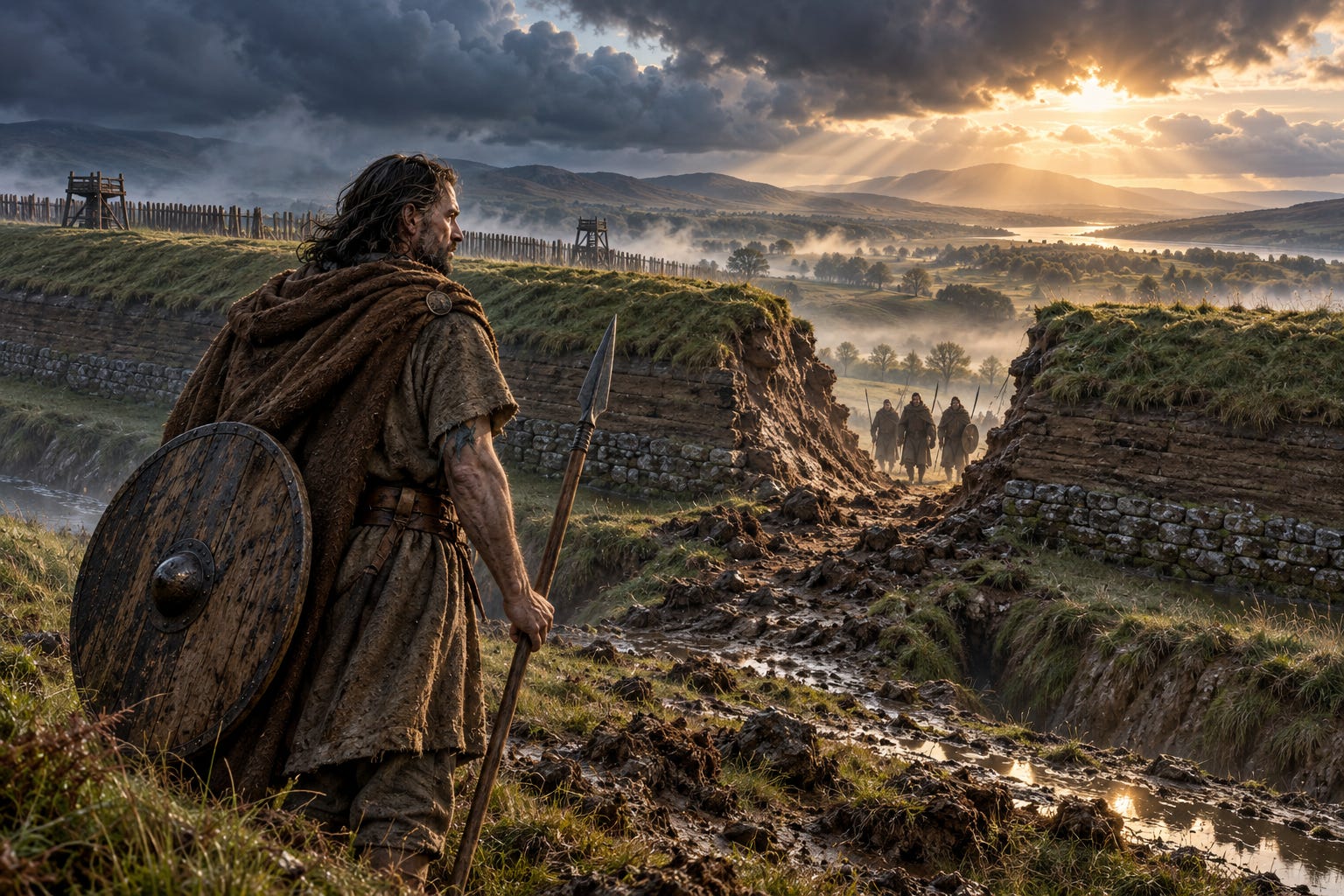
According to an old Graham tradition, a warrior named Grim faced a challenge worthy of an ancestor: breaking through a Roman wall. The barrier stretched across the country, marking the reach of an empire whose soldiers had conquered distant lands. Grim overcame it, and later generations attached his victory to the beginnings of the Graham family. It is a stirring opening to a clan history, but the distance between a memorable legend and a documented ancestor is considerable.
The story centres on the Antonine Wall, the Roman frontier built between the Forth and Clyde. In its familiar form, Grim, also called Grame or Greme, leads the attack that defeats the barrier. His achievement explains why the remains became known as Graham’s Dyke and gives the family a founder associated with resistance to Rome. Different retellings add royal connections and wider adventures, turning a successful warrior into an ancestor fit for a distinguished Scottish house.
That appeal is easy to understand. An ancient wall could still be seen in the landscape, while the Grahams were a family whose name carried influence centuries later. A tale linking the two offered an explanation that people could remember and repeat. It also suggested that Graham courage began long before medieval titles, royal appointments or the famous campaigns of Montrose.
Before following Grim into battle, however, it helps to picture the right wall. The Antonine Wall was built largely from turf on a stone foundation, with a substantial ditch and a network of forts and roads. Construction began around AD 142 under Emperor Antoninus Pius, well north of Hadrian’s Wall. This was a formidable military frontier, although it looked different from the towering stone barrier a modern reader might imagine.
Roman occupation of the Antonine frontier lasted only about two decades, ending in the AD 160s. Some later versions place Grim’s exploit in the early fifth century, long after that frontier had ceased to operate as it originally had. That gap is a serious problem for any account presenting him as the man who ended its Roman occupation. The monument’s history and the legend’s chronology cannot simply be fitted together.
The wall continued to exist after its garrisons departed, and its surviving earthworks invited explanations. People living beside an old ditch or rampart could see that someone had undertaken an enormous task, even when its original purpose was poorly understood. Names and stories helped make those remains familiar. The survival of the name Graham’s Dyke therefore tells us something about how the wall was remembered, without identifying the person who supposedly breached it.
The connection was already part of an older historical discussion by the time The Scots Peerage examined Graham origins in the early twentieth century. It noted John of Fordun’s association of the wall with the name Grymisdyke and considered the tradition of descent from Grim. Later writers developed accounts that connected the warrior with Fergus, Denmark and an ancient royal family. Such additions gave the Grahams a place within a much larger story about Scotland’s beginnings.
Those accounts need to be read with their dates and purposes in mind. Medieval and early modern chroniclers were writing centuries after Roman rule, and later authors could borrow from earlier ones. Several books repeating an attractive story do not necessarily provide several independent witnesses to the event. Their agreement may show that the tradition travelled successfully through literature rather than that anyone had recovered contemporary evidence for Grim.
The earliest documented Grahams take us into a different setting: the Scotland of King David I. William de Graham appears among witnesses to royal and religious transactions in the first half of the twelfth century. His name is associated with records from around 1127 and with Holyrood’s foundation charter, conventionally dated to 1128. Here the evidence identifies someone participating in public business, rather than a warrior whose existence depends upon a much later origin story.
A charter witness might seem a quiet replacement for a man who shattered an imperial frontier. In practice, appearing among the witnesses to an important grant places William within a network of people trusted to recognise and confirm rights. These records show him in relation to rulers, churches and property. They give historians a starting point from which real associations can be examined, even though they reveal little about his private life.
The form de Graham has encouraged a geographical explanation of the surname, often involving a proposed connection with Grantham in England. An Anglo-Norman setting also fits the movement of families and royal servants between England and Scotland in this period. Neither explanation supplies a complete account of William’s birthplace, parents or journey. His documented activity is firmer ground than a detailed migration story assembled to fill the spaces around his name.
Even after William appears, the family history requires careful reconstruction. Later Grahams held substantial interests at Dalkeith, and the surviving records bring wives, brothers, children and religious gifts into view. Some relationships can be established through those transactions, while other links in older pedigrees remain uncertain. The family’s growth becomes visible through the acquisition of land, marriage and service across generations.
Grim still deserves a place in the story because the legend reveals what later generations valued in an ancestor. Courage against overwhelming power, an association with Scotland’s landscape and a claim to great antiquity all helped make him memorable. Readers can appreciate those themes while recognising that the tale does not establish his place in a pedigree. Its importance lies partly in the questions it raises about how families remember their beginnings.
Did a Graham really break through a Roman wall? No surviving evidence securely identifies the legendary Grim as a historical Graham ancestor or proves the famous exploit. The documented story begins much later, with William de Graham and the medieval world in which the family gained standing. From that starting point, there is a rich history of households, estates and difficult political choices to explore.
In The Complete History of Clan Graham: Land, Kinship and a Changing Scotland, that journey continues from origin traditions into the lives revealed by the records. Discover the rise of Graham branches, the importance of Mugdock and Menteith, the fortunes of Montrose and Claverhouse, and the movement of Graham lives beyond Scotland. For readers drawn to the name, the book offers a way to explore both its celebrated stories and the people behind them. Add it to your Scottish history collection and discover how the Graham past took shape.
References
Bagtown Clans. (2026). The complete history of Clan Graham: Land, kinship and a changing Scotland. Rigby Publishing.
Paul, J. B. (Ed.). (1909). The Scots peerage: Founded on Wood’s edition of Sir Robert Douglas’s Peerage of Scotland (Vol. 6). David Douglas. Digitized edition.
The Antonine Wall. (n.d.-a). Building the Antonine Wall. https://www.antoninewall.org/about-the-antonine-wall/building-the-wall.
The Antonine Wall. (n.d.-b). The Romans in Scotland. https://www.antoninewall.org/about-the-antonine-wall/the-romans-in-scotland.