

Bring a piece of this remarkable history into your own home. Download your own copy of The Gordon Crest Badge. It’s a high-quality instant download—perfect for framing, crafting, or your family archives!
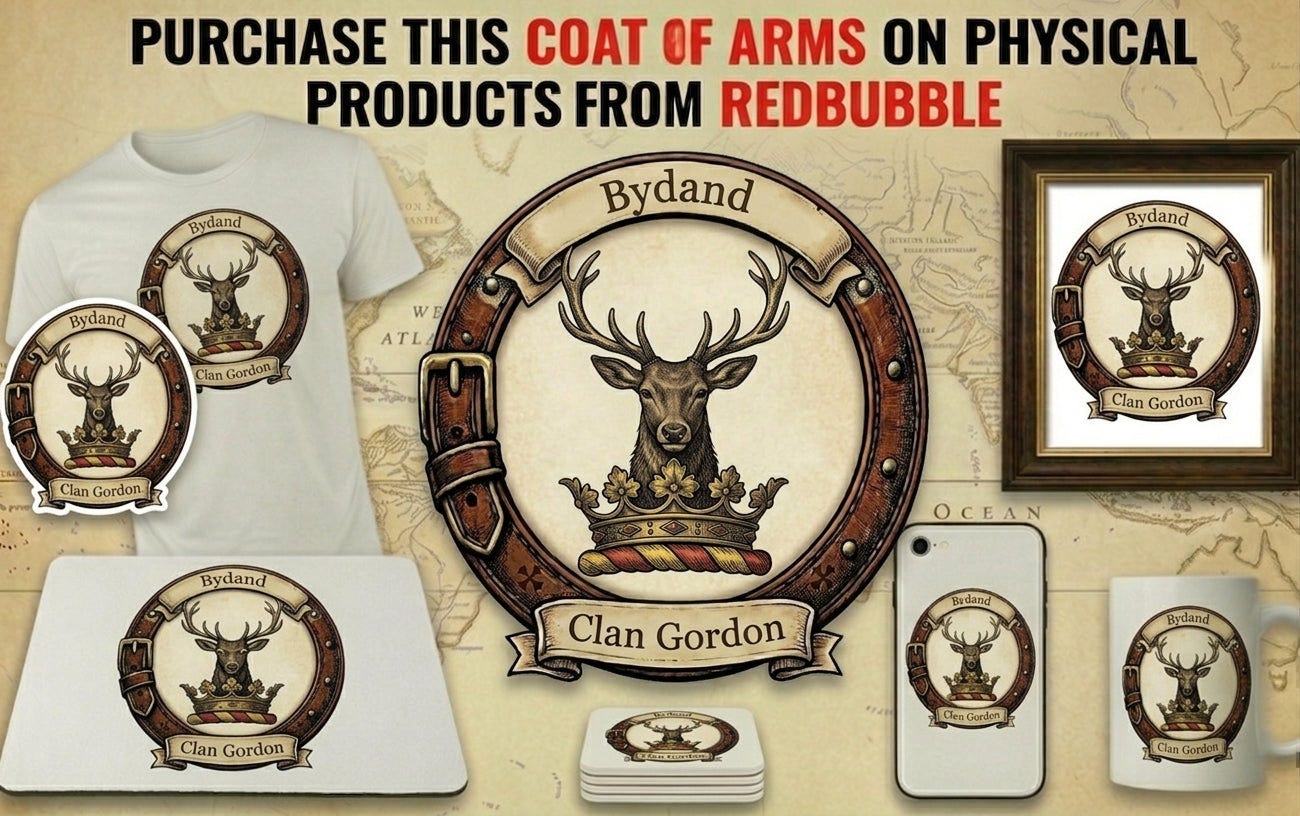
When you envision the mist-shrouded landscapes of the Scottish Highlands, it is impossible not to imagine the fierce, fiercely loyal, and formidable families that once ruled them. Among the greatest of these is the House of Gordon, historically known as the “Cock of the North.” For centuries, this powerful clan wielded almost regal authority over the northeast of Scotland. Today, millions of people across the globe who claim Gordon ancestry proudly display the clan’s iconic crest badge—a magnificent stag’s head issuing from a coronet, encircled by a strap and buckle bearing the motto “Bydand.”
But this striking emblem is far more than a simple family logo. It is a highly codified, legally protected piece of history that perfectly distills a millennium of political maneuvering, territorial expansion, and military glory. To understand the Gordon crest badge is to understand the evolution of the clan itself, from their arrival as Anglo-Norman settlers to their status as the undisputed magnates of the Scottish Highlands.
From Normandy to the Borders: The Legend of the Boar To trace the origins of the Gordon crest, we must first look to the origins of the family name. While romantic 18th-century genealogists attempted to link the family to the ancient city of Gordonia in Macedonia or the “Gorduni” tribe mentioned by Julius Caesar, the historical truth points to a Norman origin. The family’s ancestors likely came from the manor of Gourdon in Normandy, arriving in Britain during the Norman Conquest of 1066. By the reign of King David I in the twelfth century, the family had moved north into Scotland, settling in Berwickshire. The name “Gordon” itself is thought to be habitational, derived from the Welsh words “gor din,” meaning “on the hill.”
For their first three centuries in Scotland, the Gordons were a Lowland Border family. During this early period, their primary armorial symbol was not a stag, but a wild boar. According to local legend, during the reign of King Malcolm Canmore, the Scottish Borders were terrorized by a ferocious wild boar. A brave Gordon knight tracked the beast down and slew it, saving the local populace and impressing the King. As a reward, the monarch granted him vast lands and the right to bear three boar’s heads on his banner.
While this tale is likely a romantic myth invented to explain the family’s early coat of arms, it perfectly encapsulates the clan’s core values. The boar’s head symbolized a preference for honorable, direct, and courageous action, which was later immortalized in the family’s secondary Latin motto, Animo non astutia (”By courage, not by craft”). For generations, the boar’s head remained the primary crest of the Gordon lords, and it can still be seen today in the first quarter of the Chief’s coat of arms.
The Shift to the North and the Rise of the Stag The evolution from the boar to the stag mirrors the family’s dramatic shift in territory and power. During the Wars of Scottish Independence, Sir Adam de Gordon proved himself to be a brilliant diplomat and a staunch supporter of Robert the Bruce. Sir Adam was even chosen as one of the ambassadors to carry the famous Declaration of Arbroath to the Pope in 1320. In recognition of his unwavering loyalty, King Robert granted Sir Adam the lordship of Strathbogie in Aberdeenshire.
This grant provided the Gordons with a northern stronghold. As they transitioned from Border reivers to Highland magnates, their heraldry evolved to reflect their new environment. The wild boar of the southern forests was gradually replaced by the stag—a creature synonymous with the vast Highland hunting grounds and an ancient symbol of nobility, majesty, and vigilance.
Heraldic seals reveal that the boar’s head was still being used as a crest in the 1430s, but by the 1450s—coinciding with Alexander Gordon’s elevation to the Earldom of Huntly—the buck’s head began to appear. This shift served a practical purpose as well, visually differentiating the powerful northern, chiefly line of Huntly from the southern cadet branches of the family, such as the Gordons of Lochinvar, who retained the boar’s head.
Deconstructing the Modern Crest The modern crest of the Chief of Clan Gordon is a masterpiece of heraldic design. In the formal language of heraldry, it is blazoned as: In a ducal coronet Or, a stag’s head and neck affrontée proper, attired with ten tines Gold. Every element of this design carries profound historical weight.
First is the “crest coronet,” often referred to as a ducal coronet. In Scottish heraldry, this does not necessarily indicate the title of Duke (though the Gordons were later elevated to a Dukedom in 1684). Instead, it denotes the high status of the Chief as a peer and as the monarch’s Lieutenant of the North. It is a visual reminder of the family’s long-standing service to the Scottish Crown.
Next is the stag’s head, which is described as affrontée, meaning it faces directly forward. Early 16th-century depictions sometimes showed the stag in profile, but by the 17th century, the front-facing head became the standard. This striking, forward-facing gaze represents the eternal vigilance of the “Cock of the North.”
Finally, the antlers of the stag are traditionally depicted with ten tines, or points. In the language of hunting and heraldry, a stag with ten points is known as a “Royal stag” or a “Hart of Ten.” This specific detail, finalized in the Gordon armory by the 1680s, represents both the natural richness of the Gordon estates and the wild, noble courage associated with the animal.
The Meaning of “Bydand” Surrounding the crest on the badge is the famous motto: “Bydand.” Because the Gordons are a Scottish clan, many people mistakenly assume this word is Gaelic. In reality, “Bydand” is a linguistic relic of Middle Scots, the dialect spoken in the Scottish Lowlands and Borders where the family originated.
“Bydand” is the present participle of the verb bide (meaning to wait or stay), utilizing the standard Middle Scots “-and” suffix. Therefore, the literal translation is “Remaining,” “Abiding,” or “Staying.” However, the philosophical implication goes much deeper. It is a declaration of absolute steadfastness and resilience. It is historically linked to the Scots phrase “Bide and Fecht” (Stay and Fight), suggesting a warrior’s refusal to retreat from danger. It perfectly encapsulates the clan’s ability to survive centuries of political upheaval, religious turmoil, and brutal clan feuds.
The Law of the Strap and Buckle When a person of Gordon descent wears this emblem today, they are actually wearing a “Crest Badge,” not a “Clan Crest.” Under strict Scottish heraldic law, there is no such thing as a collective clan crest. The stag’s head, the coronet, and the motto are the sole, personal property of the Clan Chief—currently the Marquess of Huntly.
However, clansmen and women—those who bear the Gordon name, belong to a recognized sept, or offer allegiance to the Chief—are permitted to wear the Chief’s crest to show their familial loyalty. To demonstrate that the wearer is a follower and not the owner of the arms, the crest must be surrounded by a strap and buckle. The Chief alone is entitled to wear the crest within a plain circlet, typically adorned with three eagle feathers to denote his rank.
The Plant Badge and the Gordon Highlanders Before metal crest badges became popular during the Victorian era, clansmen identified each other on the battlefield using plant badges pinned to their bonnets. The plant badge of Clan Gordon is rock ivy (eidhean na craige). Ivy is renowned for its tenacity and its ability to completely overwhelm its surroundings—a fitting metaphor for the “Gey Gordons” (the gallant, overwhelming Gordons) who rapidly expanded their power across the north of Scotland. Following the Jacobite Rising of 1745, when the wearing of tartan was strictly outlawed by the British government, Gordon clansmen wore sprigs of rock ivy as a silent, defiant symbol of their identity.
The global recognition of the Gordon crest badge today is largely owed to the famed Gordon Highlanders military regiment. Raised in 1794 by the 4th Duke of Gordon to fight in the French Revolutionary Wars, the regiment famously adopted the Duke’s personal crest as their cap badge. Surrounded by a wreath of ivy and bearing the “Bydand” motto, the emblem was carried by soldiers across the globe, from the Battle of Waterloo to the trenches of the First World War.
Today, whether it is cast in silver and worn on a kilt jacket, or carved into the ancient stone fireplaces of Huntly Castle, the Gordon crest badge remains a striking testament to a family that helped shape the very fabric of Scottish history. Through the image of the Royal stag and the enduring promise of “Bydand,” the legacy of the House of Gordon remains steadfast, unyielding, and forever abiding.
--------------------------------------------------------------------------------
Sources
Court of the Lord Lyon. (n.d.). Crests.
Coventry, M. (2008). Castles of the clans: The strongholds and seats of 750 Scottish families and clans. Goblinshead.
Innes of Learney, T., & Adam, F. (1970). The clans, septs & regiments of the Scottish Highlands (8th ed.). Johnston and Bacon.
Moncreiffe of that Ilk, I. (1967). The Highland clans. Barrie & Rockliff.
Way of Plean, G., & Squire, R. (1994). Collins Scottish clan & family encyclopedia. HarperCollins.
Woodcock, T., & Robinson, J. M. (1988). The Oxford guide to heraldry. Oxford University Press.