

Uncover the epic history of Clan Campbell - https://fairbairncrests.com/products/the-complete-history-of-clan-campbell-digital-edition
Few events in Scottish history carry the emotional weight of the Massacre of Glencoe. On the morning of 13 February 1692, government soldiers who had been quartered among the MacDonalds of Glencoe turned their weapons against the people who had been sheltering them. Approximately thirty-eight people were killed in the attack, and the violation of hospitality ensured that Glencoe would be remembered long after many larger battles had faded from popular memory. For generations, one explanation has dominated the story: the Campbells murdered the MacDonalds because of an ancient clan feud. The truth is more complicated, and in many ways more disturbing.
Campbells unquestionably participated in the massacre. The officer commanding the detachment stationed in Glencoe was Captain Robert Campbell of Glenlyon, and the troops belonged to the Earl of Argyll’s Regiment of Foot. Those facts gave later generations all the ingredients needed to transform Glencoe into a story of Campbell treachery against Clan Donald. Yet the men at Glencoe were not an independent Campbell war band carrying out a private feud. They were serving soldiers in a regular government regiment operating within a military chain of command.
To understand what happened, Glencoe has to be placed in the political crisis that followed the Revolution of 1688 and 1689. King James VII of Scotland and II of England had been displaced, and William of Orange emerged as the new monarch. Scotland remained deeply divided, however, and supporters of the exiled James continued to pose a serious problem in the Highlands. The new Williamite government wanted submission from Highland chiefs whose loyalty remained uncertain. This was not simply a struggle between individual clans but part of a much larger contest over monarchy, political authority and control of the Highlands.
Clan Campbell had emerged from the revolution closely associated with the new regime. Only a few years earlier Campbell fortunes had appeared disastrous, following the failed Argyll Rising of 1685 and the execution of the ninth Earl of Argyll. The revolution reversed those losses, restored Archibald Campbell to his inheritance and placed the Campbells once again among the most influential political forces in western Scotland. Campbell manpower was increasingly incorporated into government military operations. The distinction between Campbell interests and government policy consequently became difficult to separate, but that does not mean they were identical.
The government demanded that Highland chiefs swear allegiance to King William by the end of 1691. Failure to do so could bring severe punishment, and the deadline created an atmosphere in which obedience was expected rather than negotiated. The MacIans of Glencoe, a branch of the MacDonalds, were late in completing the required oath. Administrative difficulties and brutal winter conditions contributed to the delay, but in an environment where the government was looking for unmistakable submission, lateness could become politically dangerous. What might otherwise have been an administrative problem now gave powerful men an opportunity.
One of those men was John Dalrymple, Master of Stair and Secretary of State for Scotland. Dalrymple regarded the continuing instability of the Highlands as a serious political problem and saw the Glencoe MacDonalds as a suitable example through which government authority could be demonstrated. Orders moved through the machinery of the state and the military command structure, transforming a missed deadline into something far more sinister. The objective was no longer merely to collect an oath or impose a financial penalty. The community was marked for violent punishment.
This point matters enormously when discussing Clan Campbell’s responsibility. The plan did not originate when Robert Campbell of Glenlyon gathered his clansmen and decided to attack neighbouring MacDonalds. Orders originated at the highest levels of government and were transmitted through senior military officers before reaching the soldiers in Glencoe. King William’s authority stood behind the government’s Highland policy, while the Master of Stair played a central role in shaping the action. Campbell soldiers became the instruments through which that policy was implemented.
The choice of the Earl of Argyll’s Regiment nevertheless gave the operation a particularly poisonous character. Relations between Campbell and MacDonald interests had a long and often violent history, involving land, political allegiance and Campbell expansion across the western Highlands. Campbell leaders had repeatedly served the Crown as agents of Highland administration, while MacDonald groups had often found themselves resisting the expansion of both Campbell influence and central government authority. Old regional hostility therefore existed, but Glencoe cannot be explained adequately as the latest episode in an endless Campbell-MacDonald blood feud. By 1692 these rivalries had become intertwined with the expanding military power of the Scottish state.
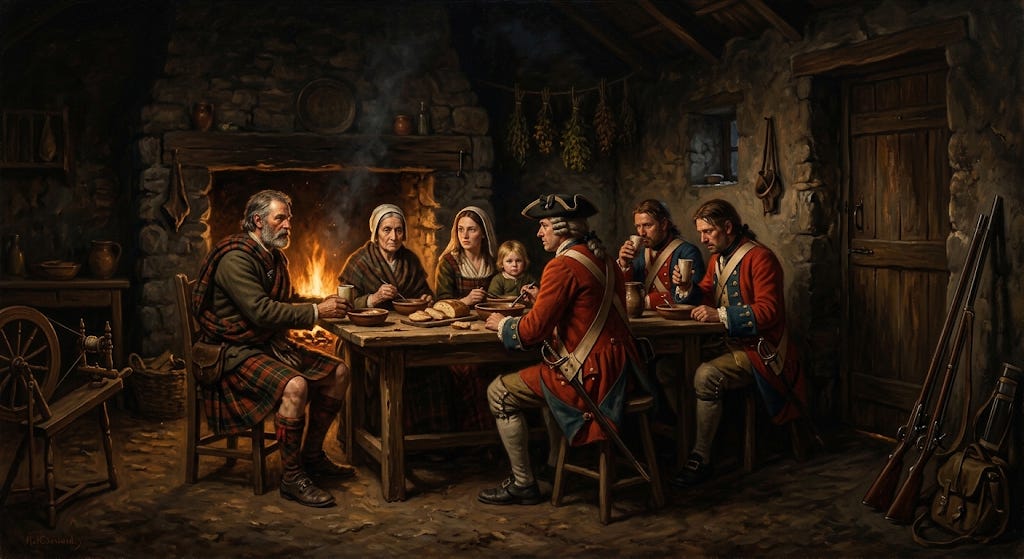
For nearly two weeks Glenlyon’s soldiers lived among the inhabitants of Glencoe. They received shelter and hospitality from the very people they would later be ordered to kill. This is one reason the massacre became so infamous. Highland society placed enormous importance on hospitality, and violence against hosts after accepting their food and shelter represented something more shocking than an ordinary battlefield killing. The soldiers were not attacking an enemy formation drawn up across a field; they were turning upon a population among whom they had been living.
The troops themselves appear not to have known the ultimate purpose of their presence until the final instructions reached them. Those instructions called for the killing of men under seventy. In the early hours of 13 February, the operation began, and approximately thirty-eight people were killed. Captain Robert Campbell of Glenlyon’s role cannot be erased from the story simply because he was acting under orders. He commanded soldiers who participated in the killings, and his Campbell identity became permanently attached to the tragedy.
But responsibility and collective guilt are not the same thing. Saying that Glenlyon was acting under government orders does not make the massacre less terrible, nor does it remove the responsibility of those who carried out unlawful or murderous instructions. What it does change is the claim that “Clan Campbell massacred Clan MacDonald.” Clan Campbell was a vast collection of branches, families, tenants and followers, not a single person capable of making one decision. Most people bearing the Campbell name had nothing whatsoever to do with the orders issued for Glencoe.
Even the Earl of Argyll’s position requires careful distinction. He commanded the regiment on paper and was politically aligned with the government’s harsh approach toward Highland resistance. The Campbell leadership had also benefited greatly from the new Williamite settlement and was closely connected to the effort to pacify the Highlands. Yet the Earl was not identified as the author of the specific orders directing the killings at Glencoe. His political world helped create the environment in which the operation became possible, but that is different from saying that the Campbell chief personally devised the massacre.
The reaction afterward shows that contemporaries themselves understood Glencoe as something more serious than normal Highland warfare. Political controversy eventually produced an official inquiry, and the killings were condemned as murder. Attention centred upon government ministers, the military command structure and those who carried out the orders. Glenlyon and the regiment were soon sent to the European continent to participate in the Nine Years’ War, removing many of the soldiers involved from the immediate Scottish controversy. The political system could investigate Glencoe, but responsibility remained tangled among royal authority, ministers, military officers and the men on the ground.
Over time, that complicated chain of responsibility was reduced to a much simpler story. Campbell soldiers had killed MacDonalds, the commanding officer was a Campbell, and the regiment bore the name of the Earl of Argyll. Against the background of generations of Campbell-MacDonald rivalry, it was easy for popular memory to convert a government massacre into a clan massacre. The simplified version was dramatic, memorable and easily passed from one generation to another. Unfortunately, it concealed much of what makes Glencoe historically important.
The deeper lesson of Glencoe is not that clan rivalry was irrelevant. Campbell interests, MacDonald grievances, land disputes and earlier conflicts all formed part of the political landscape in which the massacre occurred. The crucial point is that by the late seventeenth century those older Highland relationships were operating inside an increasingly powerful state system capable of issuing proclamations, maintaining permanent regiments and ordering military punishment. A Campbell officer could simultaneously be a member of a Highland kindred and a commissioned servant of the government. At Glencoe, those identities collided with horrifying consequences.
None of this should be used to excuse Robert Campbell of Glenlyon or the soldiers who participated in the killings. Nor should correcting the popular version diminish the suffering of the MacDonalds of Glencoe. Historical accuracy requires something harder than choosing one clan as villain and another as victim and ending the investigation there. The massacre involved government policy, royal authority, ministerial decisions, military obedience, regional hostility and individuals who chose to carry out the orders placed before them. That complexity makes the event more understandable without making it any less appalling.
More than three centuries later, Glencoe remains powerful precisely because it sits at the meeting point between history and memory. The Campbell name will probably always be associated with the massacre because Robert Campbell of Glenlyon and soldiers of Argyll’s Regiment were physically present and directly involved. But the documentary story points beyond the tartan-clad image of one clan attacking another and toward the machinery of government that planned, authorised and transmitted the operation. To understand Clan Campbell’s real history, Glencoe must be confronted rather than avoided—but it must also be told accurately.
The Complete History of Clan Campbell explores this episode within the much larger story of how the Campbells became one of Scotland’s most powerful families, how they became increasingly intertwined with royal government, and how events such as Glencoe created legends that still shape perceptions of the clan today. The Campbell story is filled with victories, disasters, political calculations, royal alliances and controversial episodes that cannot be reduced to simple tales of heroes and villains. Looking beyond those legends reveals something more interesting: the complicated reality of power in Scotland’s Highlands.
References
Campbell of Airds, A. (2004). A history of Clan Campbell: Volume 3, From the Restoration to the present day. Edinburgh University Press.
MacPhail, J. R. N. (Ed.). (1914–1934). Highland papers (Vols. 1–4). Scottish History Society.
Stevenson, D. (1980). Alasdair MacColla and the Highland problem in the seventeenth century. John Donald.
Is there a list name of died during the actual massacre, and a list name whom have died during the escape/aftermath?
I had been to Glencoe abput 10 yers ago. They had a new fancy interactive display, in a large building mde just for this. Myself a "thought to be Campbell at the time, " I kept very quitet. It's a big deal. A massacure of 38 member's of Clan McDonalds. Just think If they had really killed them all there would probably be no MaDonald's Arches today!