Uncover the epic history and origins of Clan Buchanan - https://fairbairncrests.com/products/the-complete-history-of-clan-buchanan-digital-edition
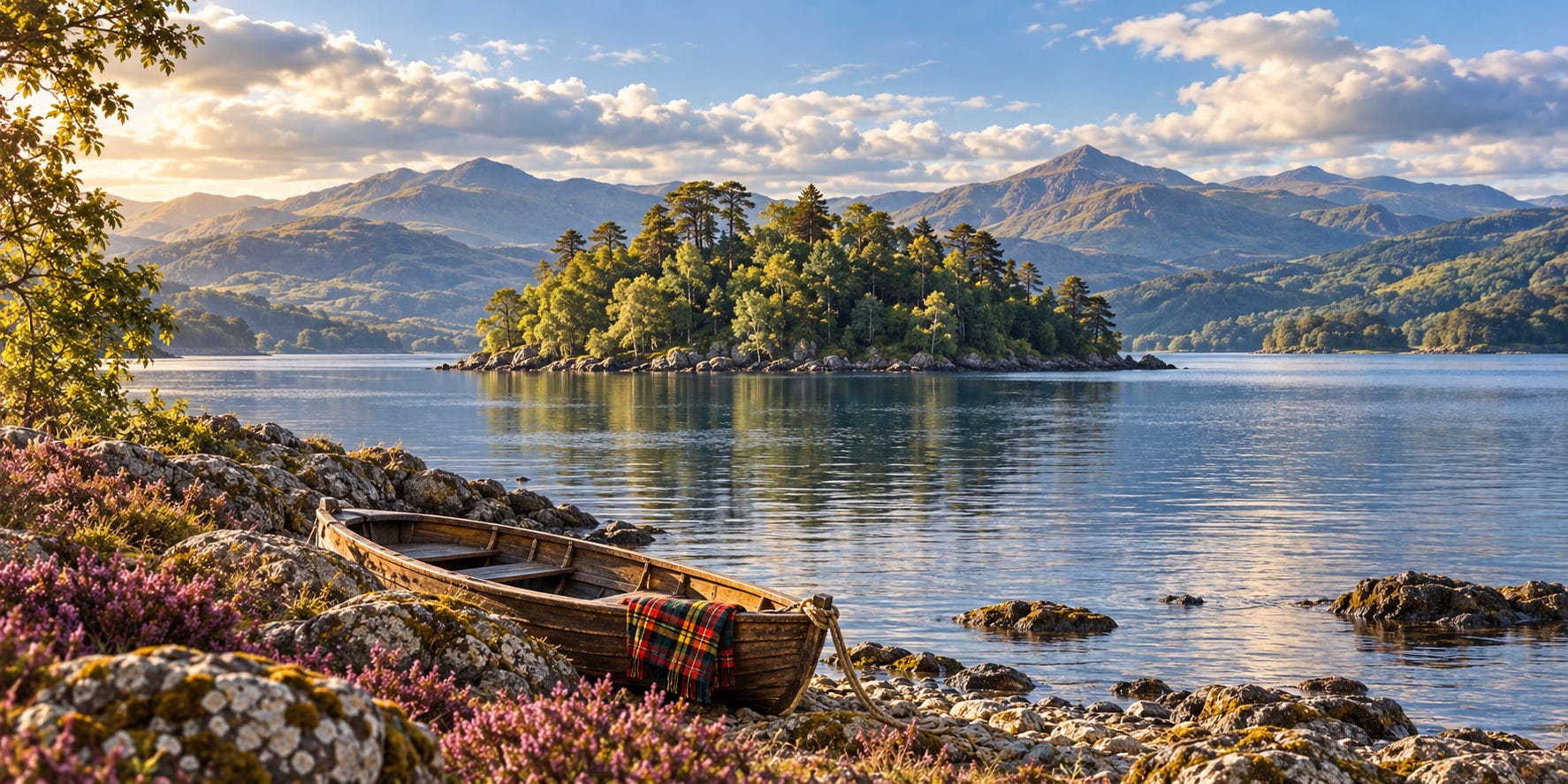
Scattered across the southern waters of Loch Lomond are islands whose quiet appearance hides centuries of history. Among them is Clairinch, a small wooded island with a significance far greater than its physical size might suggest. For members of Clan Buchanan, it is more than a point on a map: it is one of the oldest documented links between the clan and its ancestral homeland. Its story reaches from medieval charters and feudal obligations to migration, shared memory and modern conservation.
To understand Clairinch, it is necessary to imagine Loch Lomond as a working landscape rather than simply a beautiful view. During the Middle Ages, its waters connected settlements, estates, churches, grazing lands and fishing grounds. Boats carried people and goods between places that might appear isolated to a modern visitor. An island could therefore be a useful possession within a network of local rights and relationships.
The earliest secure Buchanan connection with Clairinch appears during the thirteenth century. A man named Absalon, identified in the surviving record as the son of Macbethad, was active within the lordship of Lennox. Around 1225, Maldoven, Earl of Lennox, granted Clairinch to Absalon and his heirs. Unlike the much later legends surrounding the clan’s distant origins, this charter connects an identifiable person with a specific place and a recognized lord.
The terms of the grant offer a fascinating glimpse into medieval landholding. According to the surviving translation, Absalon was required to provide the Earl of Lennox with one pound of wax each year at Christmas. This was not a purchase price in the modern sense but a recurring obligation that acknowledged the relationship between the holder of the island and his superior lord. The wax was a practical commodity, and its annual delivery helped confirm that the rights granted to Absalon continued to be recognized.
The charter reportedly took place on Clairinch itself, making the island both the subject and the setting of the transaction. Witnesses included members of the earl’s circle, as well as clerical figures who helped authenticate important agreements. The surviving document does not tell us whether buildings stood on the island or describe the ceremony that may have accompanied the grant. Even so, it places Clairinch firmly within the political and social world of the medieval earldom of Lennox.
The Buchanan connection received further recognition in 1231, when King Alexander II confirmed the arrangement. The royal act, issued at Linlithgow, also included permission for fishing in Loch Lomond. This detail reminds us that the value of the territory was not limited to the ground itself. Access to the surrounding water and its resources formed an important part of life beside the loch.
These documents do not prove every claim later made about the beginnings of Clan Buchanan. They do not establish an uninterrupted genealogy reaching back to the legendary Anselan O Kyan, nor do they describe a fully developed clan gathering beneath a recognizable Buchanan tartan. What they provide is something more reliable: evidence that a family associated with the later Buchanans possessed rights on Clairinch in the early thirteenth century. That modest but secure foundation gives the island an important place in the clan’s recorded history.
Over the centuries, the Buchanan relationship with the wider territory changed dramatically. Different branches established themselves on estates such as Leny, Arnprior, Spittal, Drumikill and Carbeth, each developing its own interests and family connections. The principal Buchanan estate eventually became burdened by debts, legal claims and inheritance difficulties. By the end of the seventeenth century, the old chiefly lands had passed into the hands of the Graham family, Marquesses of Montrose.
The loss of the estate did not mean that Clan Buchanan disappeared. Branches survived, families continued to carry the name and Buchanans built new lives in Glasgow, Ireland, North America and other parts of the world. As the clan became more widely dispersed, remembered places gained greater importance. Clairinch could represent a shared point of origin even for people who had never stood on its shore or seen Loch Lomond.
The island also became associated with the traditional Buchanan gathering cry. Whether every detail attached to that tradition can be documented is less important than understanding why Clairinch became such a powerful symbol. Unlike a later tartan design or romantic illustration, it was a real place with a medieval connection supported by surviving records. Speaking or reading its name allowed distant descendants to imagine a landscape that had once stood at the centre of Buchanan life.
A remarkable new chapter began in 1934 when William George Buchanan purchased Clairinch from the Montrose estate. William had spent many years associated with Chile before retiring in Britain, making him part of the wider story of Buchanans whose lives extended far beyond Scotland. His purchase did not revive a medieval legal right or restore the old clan estate. It was a modern transaction undertaken by a man who understood what the island had come to represent.
When William George Buchanan died in 1939, he left Clairinch to the Buchanan Society. Founded in Glasgow in 1725, the Society had already spent more than two centuries supporting people connected with the Buchanan name through charitable and educational work. Receiving the island added a physical piece of the ancestral landscape to its responsibilities. Clairinch was no longer held by one laird and his heirs but entrusted to an organization capable of caring for it on behalf of future generations.
The bequest was reportedly accompanied by the wish that Clairinch serve as a sanctuary for birds and animals, with no shooting permitted. This purpose gives the island’s modern history a meaning that extends beyond genealogy. Its value now rests partly in the woodland, wildlife and natural environment that occupy it. Stewardship requires more than celebrating an old charter; it requires protecting the living place that the charter described.
The Society’s care of Clairinch represents a distinctly modern form of clan inheritance. Medieval possession involved service, superior lordship and hereditary rights, while modern stewardship depends on charitable responsibility and preservation. The island belongs to a world in which most Buchanans live far from Loch Lomond and participate in clan life voluntarily. Yet the desire to protect it shows that distance has not erased the family’s attachment to its homeland.
Clairinch also offers a valuable lesson about how clan history should be understood. Its importance does not depend on decorating it with invented battles, buildings or ceremonies. The documented story is already compelling: a medieval grant, a yearly payment of wax, royal confirmation, centuries of changing ownership and an eventual return to Buchanan care. Respecting the limits of the evidence allows the genuine continuity of the island to stand out more clearly.
Today, Clairinch links several different periods of Buchanan history. It recalls the world of the earls of Lennox, the growth and loss of the ancestral estate, the dispersal of Buchanan families and the rise of modern clan organizations. It is simultaneously an ancient possession, a remembered homeland and a protected natural space. Few places express so clearly how an inheritance can be lost, remembered and responsibly renewed.
For people researching Buchanan ancestry, the island provides a connection that does not require every family tree to lead directly to a medieval chief. A person may belong to a cadet branch, descend from emigrants or simply carry a family memory whose earliest details have been lost. Clairinch remains part of the wider history into which those individual stories fit. It offers a shared landmark without demanding that every Buchanan claim exactly the same line of descent.
The story of Clairinch is explored within the broader journey of the clan in The Complete History of Clan Buchanan. The book follows the Buchanans from their earliest recorded appearance through warfare, scholarship, religious conflict, migration, changing traditions and the restoration of the chiefship. It also separates documented history from later legend while preserving both as important parts of the clan’s inheritance. Available in EPUB, KPF and PDF formats, it offers readers a fuller understanding of the people and events that gave places such as Clairinch their lasting meaning.
Clairinch may be a tiny island, but its history reaches across eight centuries and around the world. It reminds us that a homeland is not preserved by memory alone, nor is inheritance simply something received from the past. Both must be cared for, examined and passed forward. In that sense, Clairinch remains not only at the heart of Loch Lomond, but at the heart of Clan Buchanan.
Buchanan, W., of Auchmar. (1849). An historical and genealogical essay upon the family and surname of Buchanan. J. A. & U. P. James. (Original work published 1723)
Buchanan Society. (1927). The Buchanan Society: Instituted 1725. Jackson, Wylie and Co.
Clan Buchanan Society International. (2023, January). Clan jewels. Buchanan Banner, 56–58.
Fraser, W. (1874). The Lennox (Vol. 1, Memoirs). Privately printed.
MacDonald, P. E. (2020). Buchanan (Revised ed.) [Research paper]. The author. (Original work published 2014)
Smith, J. G. (1896). Strathendrick and its inhabitants from early times: An account of the parishes of Fintry, Balfron, Killearn, Drymen, Buchanan, and Kilmaronock. James MacLehose and Sons.