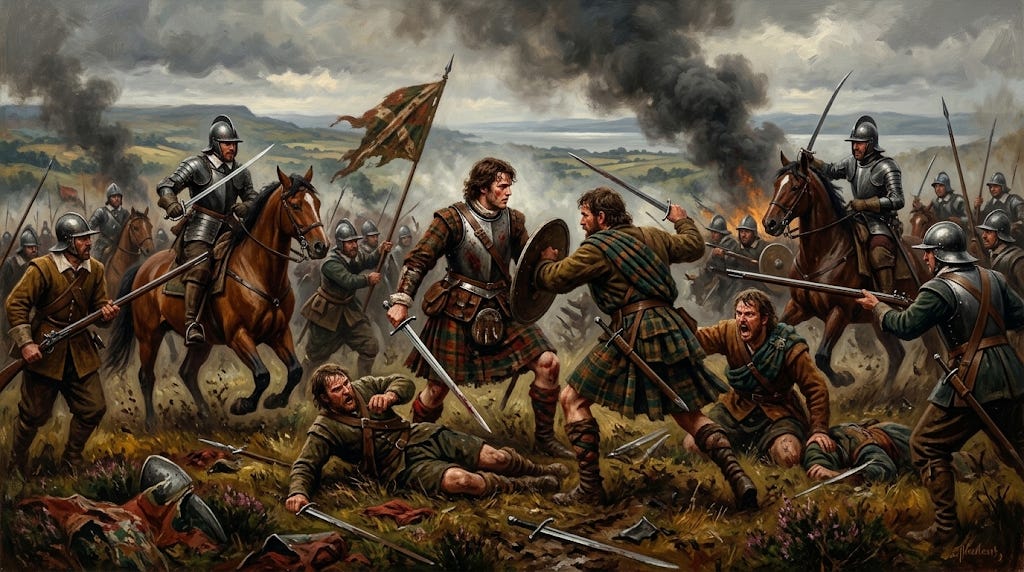
On Sunday, July 20, 1651, the summer air above the Firth of Forth was thick with the acrid stench of black powder and the thunder of English cannon. On the bruised slopes near Inverkeithing, a tightening ring of Oliver Cromwell’s seasoned Ironsides and infantry closed around a stubborn, bloodied knot of Highlanders. At the center of that shrinking circle stood a twenty-five-year-old warrior, Sir Hector Roy Maclean of Duart, seventeenth chief of his clan, his tartan dark with blood from half a dozen wounds. Around him, the Lowland cavalry that was supposed to guard his flanks had already vanished from the field in disgraceful flight, leaving eight hundred men from the Isles to face four thousand battle-hardened Parliamentarians alone.
What unfolded over four desperate hours on that Fife hillside remains one of the most devastating acts of clan devotion in Scottish history. As the Rev. Alexander Maclean Sinclair records in The Clan Gillean, the Battle of Inverkeithing was not merely a military defeat for the Royalist cause, nor simply a tactical blunder by a fiery young commander who refused to yield ground. It was the day an entire generation of Mull, Morvern, Coll, and Tiree manhood chose annihilation over abandoning their chief, coining a Gaelic rallying cry that would echo down the centuries as the ultimate expression of Highland loyalty.
The Fiery Heir of Duart
When Sir Hector Roy succeeded his father, Sir Lachlan, as Lord of Duart in 1648, he inherited both a proud martial lineage and a clan estate strangled by political debt. In body and spirit, he was the image of his famous great-grandfather, Sir Lachlan Mor. Energetic, fearless, and commanding, young Hector Roy wasted little time showing the Western Highlands that the sword of Duart had not rusted. When Campbell raiders from Ardnamurchan and Lorn harried the Maclean tenants of Morvern and Mull, and the Marquis of Argyll ignored his protests, Hector Roy marched straight into Ardnamurchan, seized two of the ringleaders, and hanged them on the spot. He forced the remaining cattle-lifters to make full restitution, swept through Lorn to mete out the same rough justice, and bluntly informed the powerful Marquis of Argyll that if he could not control his own thieves, Maclean of Duart would control them for him.
Yet no amount of personal valor could shield Duart from the financial web spun by the House of Argyll. Throughout the civil wars of the 1640s, while the Macleans poured their blood and treasure into the campaigns of the Marquis of Montrose at Inverlochy, Auldearn, Alford, and Kilsyth, the Duart estates had been unable to pay public dues. Worse still, General David Leslie and Argyll had invaded Mull in 1647 with five thousand men, stripping the island bare and forcing Hector Roy himself to be handed over for a time as a hostage. Taking ruthless advantage of the clan’s distress, Argyll bought up every public and private claim against the Macleans, compounding them with interest upon the thirty thousand pounds he had already extorted from Sir Lachlan in Carrick Castle. By 1650, Argyll presented young Sir Hector Roy with a staggering bill for seventy thousand pounds, extracting ten thousand in cash and a bond for the remaining sixty thousand.
Despite the ruinous cost of their loyalty to the House of Stuart, the Macleans never wavered. When Charles I was executed at Whitehall in January 1649 and his son, Charles II, landed in Scotland in June 1650 to be crowned at Scone, Sir Hector Roy once again summoned his kinsmen to the royal standard.
Betrayal on the Slopes of Fife
By the summer of 1651, Oliver Cromwell had marched north to crush the new Scottish King once and for all. After shattering David Leslie’s Covenanting army at Dunbar the previous September, Cromwell advanced in June against the Royalist forces entrenched in a strong defensive position before Stirling. Unable to storm the Scottish lines directly, Cromwell resolved in mid-July to outflank them. He dispatched a formidable division of four thousand men—roughly half of them heavy cavalry—under the command of Major-General John Lambert across the Firth of Forth at Queensferry to sever the Scottish army’s supply lines from Fife.
To intercept Lambert, the Scottish command sent Major-General James Holburn of Menstrie with a force of approximately three thousand five hundred men. On the morning of Sunday, July 20, the two armies collided on the rising ground at Inverkeithing. Holburn’s battle line was divided into distinct wings: on the left stood two hundred horse and eight hundred Lowland infantry under the gallant Sir John Brown of Fordel; in the center and right stood eight hundred Highlanders under Colonel Sir Hector Roy Maclean of Duart, alongside seven hundred clansmen under Sir George Buchanan; and holding the wings and support were a thousand cavalrymen under Holburn’s personal command.
Before the infantry could even lock blades, treachery gutted the Scottish line. Holburn of Menstrie—whom Highland memory and Sinclair’s history alike condemn as both a traitor and a coward—wheeled his one thousand horsemen around and fled the battlefield when the action had scarcely begun. On the left wing, Sir John Brown’s Lowland foot and small troop of cavalry fought with desperate courage against Lambert’s overwhelming numbers, but they were soon crushed and driven back, leaving Sir John mortally wounded and a prisoner in English hands.
That left the Macleans and the Buchanans standing completely unsupported on the hillside. Raked by a murderous fire from Lambert’s field artillery, Sir Hector Roy saw only one course of action worthy of his name. Rather than stand still to be torn apart by cannon shot, or scatter in retreat across the open hills where Lambert’s two thousand horsemen could ride them down at leisure, the young chief ordered the charge.
Fear Eile Airson Eachainn
Moving rapidly up the slope into the teeth of the English guns, the seven hundred Macleans and roughly one hundred Macquarries and allied Islesmen of Hector Roy’s regiment hurled themselves against Lambert’s veteran brigades. Without cavalry to protect their flanks, however, their advance carried them straight into a trap. Lambert’s horse and foot swung around both sides of the Highland column, sealing the ring of steel behind them.
What followed was a four-hour cauldron of hand-to-hand slaughter. Outnumbered more than two to one, battered by musket volleys and cannon fire, and pressed from every side by English pikes and sabers, the Macleans fought shoulder to shoulder around their chief. Tall and conspicuous in his panoply at the heart of the fray, Sir Hector Roy became the primary target of the English troopers.
As the fighting reached its fiercest pitch, an English soldier lunged through the smoke to deliver a fatal blow to the young Lord of Duart. Seeing his chief in mortal peril, a Maclean clansman sprang directly between Hector Roy and the leveled weapon, taking the death-stroke in his own body. Before the fallen man had touched the trampled heather, another kinsman stepped over his corpse into the breach, shouting at the top of his lungs, “Fear eile airson Eachainn!”—”Another for Hector!”
Moments later, he too was cut down. Immediately, a third clansman leaped into the same post of certain death with the same defiant cry upon his lips. One after another, without hesitation or command, eight Maclean warriors successively threw their own bodies in front of English blades and musket balls to shield their chief, each dying with “Fear eile airson Eachainn!” ringing across the din of battle.
The Price of Unyielding Valor
Even such superhuman devotion could not turn back four thousand men forever. Toward the close of the fourth hour, covered in blood from multiple wounds, Sir Hector Roy was struck squarely in the breast by a musket ball and fell dead among the bodies of his protectors.
Around his fallen form, the remnant of his regiment was virtually wiped from the earth. Of the eight hundred men who had marched onto the field of Inverkeithing under the banner of Duart that Sunday morning, only about thirty-five ever returned to their island homes. Two thousand Scotsmen lay dead upon the field. For the cadet houses of Clan Gillean, the roll of the slain read like a funeral dirge for the entire clan. Alongside their twenty-five-year-old chief perished Ewen and Lachlan Cattanach, sons of Lachlan Og of Torloisk; Donald and John Og, sons of Allan Maclean of Ardgour; Archibald, son of Maclean of Boreray; the veteran Captain Ewen Maclean of Treshnish; Ewen, son of John Garbh of Coll; Ewen, son of the first Maclean of Muck; Charles, son of Maclean of Inverscadale; Allan, son of Macquarrie of Ulva; and five sons of the great warrior Lachlan Odhar of Airdchraoishnish—Murdoch, Allan, Lachlan, Ewen, and John—all cut down in a single afternoon. Among the handful who survived, covered in wounds, were Lieutenant-Colonel Donald Maclean of Brolas, John Maclean of Kinlochaline, John Maclean of Totaranald, Neil Maclean of Drimnacross, and John Diurach Maclean of Morvern, who had led the forlorn hope.
Historians have long debated the wisdom of Hector Roy’s refusal to retreat when Holburn’s cavalry deserted him. Even the Rev. Sinclair, while admiring the young chief’s lion-hearted courage, laments the fiery recklessness that threw away hundreds of irreplaceable lives in an impossible stand, leaving a ten-year-old boy, Sir Allan, to inherit a crippled clan at the mercy of Cromwell and Argyll. As John Maclean of Inverscadale wrote nearly a century and a half later in 1797, “In point of numbers we have scarcely got the better of this yet”. Yet on the hillside of Inverkeithing, where eight men stepped forward one by one to die for their chief, the Clan Gillean carved a monument of fidelity that neither Cromwell’s ironsides nor Argyll’s parchment could ever erase.
Adapted From: Sinclair, A. M. (1899). The Clan Gillean. Haszard and Moore.