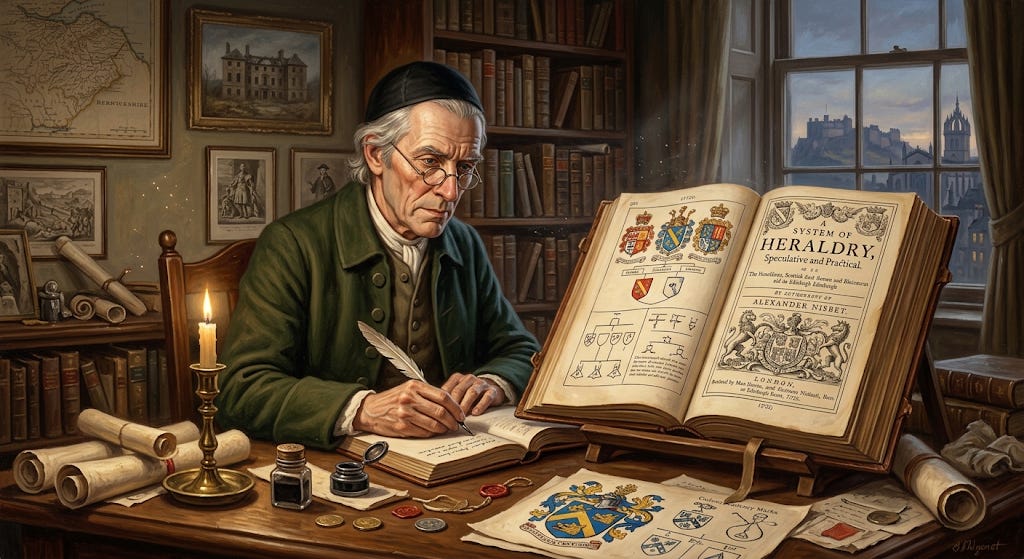
Alexander Nisbet inherited a famous name but almost none of the power that had once supported it. By the time he reached adulthood, the family estate was gone, the chiefly household had been shattered by civil war, and the old territorial world of his ancestors survived largely in documents and memory. From that loss emerged the man who would produce one of the greatest monuments to Scottish heraldry.
The disaster began with Sir Alexander Nisbet of that Ilk, who committed his family and fortune to the cause of Charles I during the Wars of the Three Kingdoms. His eldest son, Sir Philip Nisbet, served the king and the Marquess of Montrose before being captured after the Royalist defeat at Philiphaugh and executed in Glasgow in 1646. Two other sons also died in royal service, while debt and litigation overwhelmed the family’s resources. In 1652, Nisbet House and the surrounding ancestral lands passed to John Ker, ending the senior family’s possession of the place from which its surname had come.
The youngest surviving son, Adam Nisbet, followed a different path from his soldier brothers and worked as a writer in Edinburgh. He married Janet Aikenhead, the daughter of a Writer to the Signet, and their son Alexander was baptised in April 1657. The third of ten children, Alexander grew up in Edinburgh’s legal world but without command of his family’s estate, tower house or Border influence.
That contrast helps explain the unusual force of Alexander’s interest in coats of arms, genealogy and inherited identity. Heraldry was not merely decorative art in seventeenth-century Scotland; it communicated family relationships, rank, property, marriage alliances and claims to social standing. Stone walls could be transferred to a creditor, but a carefully established name and coat of arms could survive on parchment.
Alexander entered the University of Edinburgh in 1675 and completed his studies in 1682. He had been prepared for legal work and practised for a time as a writer, a profession that demanded familiarity with documents, formal language and the construction of evidence. Yet heraldry and antiquarian research increasingly commanded his attention, and contemporaries described him as a professor or teacher of the subject. What might have remained a private fascination gradually became a life’s work.
His approach united the eye of an artist, the habits of a lawyer and the curiosity of a historian. He examined heraldic authorities and Scottish genealogical materials to explain who had used particular arms and how one family branch differed from another. In doing so, he preserved information about families whose papers, monuments and local memories might otherwise have disappeared.
Nisbet established his reputation with An Essay on Additional Figures and Marks of Cadency, published in 1702. Cadency distinguishes members and branches of the same family, an important matter when similar coats pass through generations and acquire numerous variations. His 1718 Essay on the Ancient and Modern Use of Armories widened the discussion and prepared the ground for the comprehensive system he had struggled for years to complete.
Producing an illustrated scholarly work of that scale was expensive, and intellectual ambition did not guarantee financial security. Nisbet proposed publishing his great system by subscription in 1699, but the response failed to provide enough support. He then appealed to the Scottish Parliament, which in 1703 voted him £248 6s. 8d. Scots to assist his undertaking. The promised money was never paid, leaving him to continue a nationally significant project without the public assistance that legislators had approved.
His persistence finally produced A System of Heraldry, Speculative and Practical in 1722. The large volume explained the art of blazon, classified armorial figures and supplied examples drawn heavily from the arms and histories of Scottish surnames. It was more than a manual for identifying shields: it joined technical instruction with genealogical and historical memorials, turning heraldry into a doorway through which readers could enter Scotland’s past. For later researchers, its value lay not only in Nisbet’s interpretations but also in the vast quantity of material he gathered and attempted to organise.
The work’s authority does not mean that every genealogy within it should be accepted without question. Like other antiquaries of his age, Nisbet worked before modern archival standards and sometimes repeated traditions that later historians would treat cautiously. Even so, his effort to identify sources and compare armorial evidence made his work far more useful than a collection of romantic family legends.
Nisbet did not live to shape the complete work as later readers came to know it. He died in December 1725 and was buried in Greyfriars churchyard in Edinburgh, leaving manuscripts and heraldic material behind. A second volume issued by the printer Robert Fleming in 1742 drew upon those papers but contained altered and incomplete extracts, so it cannot be treated as a fully authorised continuation prepared by Nisbet himself. Later two-volume editions appeared in 1804 and 1816, while heraldic plates intended for his system were reproduced with scholarly notes by Andrew Ross and Francis J. Grant in 1892.
The Nisbets had once expressed their status through land, military service, marriage and the fortified house standing near the Blackadder Water. Alexander possessed none of that territorial authority, yet he created a paper monument that outlasted the political causes and financial troubles that ruined his grandfather. The scholar who could not recover Nisbet House helped preserve the identities of hundreds of Scottish houses.
His influence reaches well beyond professional heralds. Genealogists still consult his volumes because they preserve names, relationships and armorial details drawn from records that may be difficult to locate or no longer survive in their original setting. Artists and historians likewise use his descriptions to reconstruct how Scottish families represented themselves in the early modern period.
Today, Alexander Nisbet remains indispensable because he understood that heraldry was a language of memory. His books preserved the descent, alliances and identities encoded in Scottish arms at a moment of enormous constitutional and social change. Through patience, scholarship and endurance, the landless descendant of a broken chiefly house became one of the most celebrated authorities on Scottish heraldry.
The Complete History of Clan Nesbitt follows the family from its Berwickshire origins through Border warfare, religious conflict, the loss of Nisbet House, worldwide migration and the recovery of the chiefly line. It examines the clan’s arms, crest, motto and tartan while separating documented evidence from later tradition. Readers who want to understand the world that formed Alexander Nisbet—and the legacy he preserved—will find the larger story in this richly researched volume.
References
Nesbitt, R. C. (1941). Nisbet of that ilk. John Murray.
Nisbet, A. (1702). An essay on additional figures and marks of cadency: Shewing the ancient and modern practice of differencing descendants in this and other nations. John Reid Junior.
Nisbet, A. (1718). An essay on the ancient and modern use of armories. William Adams.
Nisbet, A. (1722). A system of heraldry, speculative and practical: With the true art of blazon, according to the most approved heralds in Europe. J. Mack Euen.
Ross, A., & Grant, F. J. (Eds.). (1892). Alexander Nisbet’s heraldic plates, originally intended for his “System of heraldry”. George Waterston & Sons.
Stephen, L., & Lee, S. (Eds.). (1885–1900). Dictionary of national biography (Vol. 41). Smith, Elder & Co.
Thomson, T., & Innes, C. (Eds.). (1814–1875). The acts of the Parliaments of Scotland (Vol. 11). H.M. General Register House.